Streptanthus campestris
Southern jewelflower
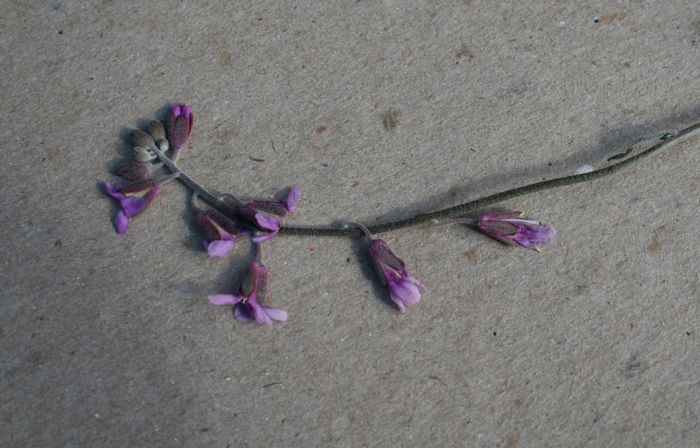
Photo by Chez Brungraber
Family: Brassicaceae · Type: Herb · Native
Conservation status: CNPS 1B.3
Streptanthus campestris (Southern jewelflower) is a native California herb in the Brassicaceae family, recognized by flower shape and color distinguish from S. bernardinus.
Southern jewelflower is a rare (CNPS 1B.3) California native perennial found in the Transverse Ranges and Peninsular Ranges in open, rocky conifer forest, chaparral, and woodland at elevations of 900 to 2,300 meters. Flowering from May to June, this plant produces light purple flowers with pale yellow bases, approximately 9 to 12 millimeters long. Growing 6 to 15 meters tall with simple or few-branched glaucous stems, it has a distinctive glabrous appearance. Its basal leaves form a rosette of oblanceolate to obovate shapes, while mid-stem leaves are sessile, lanceolate to narrowly ovate, 3.5 to 11 centimeters long with entire to wavy margins. The dark purple calyx sepals are 7 to 10 millimeters long, with hairy tips that add to the plant's distinctive character.
Identification and appearance
Key characters: 1 sympatric species; flower shape and color distinguish from S. bernardinus
Habitat and range
Habitat: Open, rocky conifer forest, chaparral, woodland
Elevation: 900-2300 m
California counties: Riverside, San Bernardino, San Diego, Imperial, Ventura, Santa Barbara, Los Angeles, Lake, Butte, Kern, Inyo
Outside California: northern Baja California
Bloom period
Streptanthus campestris blooms May-Jun.
Conservation status
CNPS 1B.3
How to tell it apart
vs Caulanthus: Seed pods are flattened like sword blades versus cylindrical tubes in Caulanthus.; vs Boechera: Robust plants often over 2.5 feet with large flowers (sepals 4-8mm) versus more delicate habit.; vs Claytonia: Mustard family with 4 petals and 6 stamens versus Claytonia with 5 petals.; vs Silene: Mustard family with seed pods versus Silene with inflated capsules and opposite leaves.; vs Lonicera: Herbaceous mustard with alternate leaves versus woody vine with opposite leaves.
Frequently asked questions
Is Streptanthus campestris native to California?
Yes. Streptanthus campestris is native to California (recorded as native).
When does Streptanthus campestris bloom?
Streptanthus campestris blooms May-Jun.
Where in California does Streptanthus campestris grow?
Streptanthus campestris occurs in Riverside, San Bernardino, San Diego, Imperial, Ventura, Santa Barbara, Los Angeles, Lake and other counties, at elevations of 900-2300 m.
What plant family does Streptanthus campestris belong to?
Streptanthus campestris is in the Brassicaceae family, genus Streptanthus.
Is Streptanthus campestris rare or endangered?
Streptanthus campestris carries California Rare Plant Rank 1B.3, state rank S3.
Related species
Other California species in the same genus, family, or bioregion.
- Streptanthus cordatus — Heartleaf jewelflower
- Streptanthus cordatus var. cordatus — Heartleaf jewelflower
- Streptanthus cordatus var. piutensis — Piute mountains jewelflower
- Streptanthus diversifolius — Varied-leaved jewelflower
- Streptanthus drepanoides — Sickle-fruit jewelflower
- Streptanthus farnsworthianus — Farnsworth's jewelflower
Sources: Jepson eFlora · CNPS Rare Plant Inventory · Index of California Plant Names · CalPhotos · CDFW CNDDB
Last updated 2026-10-07
Data from The California Species Project — 14,000+ California species with verified data from CNPS, CDFW, USFWS, Cal-IPC, and more.