Streptanthus farnsworthianus
Farnsworth's jewelflower
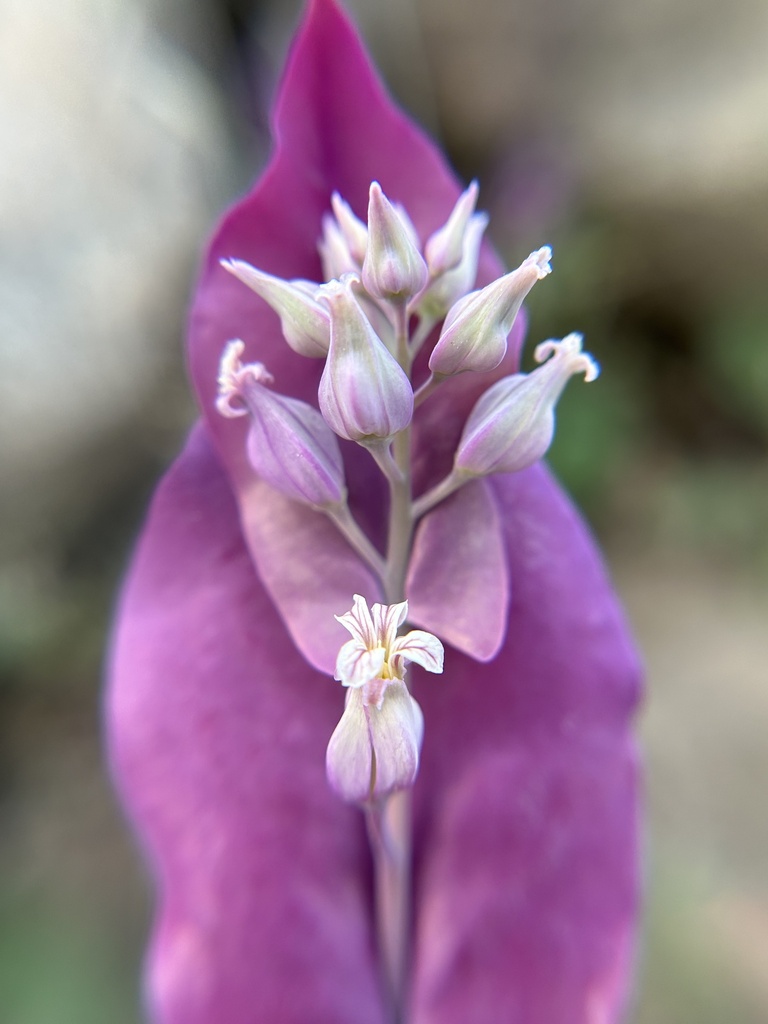
no rights reserved · CC0
Family: Brassicaceae · Type: Herb · Native
Conservation status: CNPS 4.3
Streptanthus farnsworthianus (Farnsworth's jewelflower) is a native California herb in the Brassicaceae family, recognized by 2-pinnately lobed basal leaves diagnostic.
Farnsworth's jewelflower is a rare (CNPS 4.3) California native annual found in central and southern Sierra Nevada Mountains in Madera and Fresno counties within foothill woodland at elevations of 400 to 1,400 meters. Flowering from May to June, this plant produces white flowers with violet veins, each petal 8 to 11 millimeters long and recurved with delicate crinkled edges. Growing with erect stems 20 to 100 centimeters tall that are generally green to purple-green and either simple or branched towards the top, it develops a distinctive early-deciduous basal rosette. Its leaves range from 2-pinnately lobed basal leaves to mid-stem lanceolate leaves 3 to 16 centimeters long, which clasp the stem and are often dentate towards the tip. The fruit develops as an ascending pod 6 to 12 centimeters long, containing 60 to 100 small ovate seeds.
Identification and appearance
Key characters: 22 sympatric species; 2-pinnately lobed basal leaves diagnostic
Habitat and range
Habitat: Foothill woodland
Elevation: 400-1400 m
California counties: Madera, Kern, Tulare, Fresno, Sierra
Bloom period
Streptanthus farnsworthianus blooms May-Jun.
Conservation status
CNPS 4.3
How to tell it apart
vs Caulanthus: Seed pods are flattened like sword blades versus cylindrical tubes in Caulanthus.; vs Boechera: Robust plants often over 2.5 feet with large flowers (sepals 4-8mm) versus more delicate habit.; vs Claytonia: Mustard family with 4 petals and 6 stamens versus Claytonia with 5 petals.; vs Silene: Mustard family with seed pods versus Silene with inflated capsules and opposite leaves.; vs Lonicera: Herbaceous mustard with alternate leaves versus woody vine with opposite leaves.
Frequently asked questions
Is Streptanthus farnsworthianus native to California?
Yes. Streptanthus farnsworthianus is native to California (recorded as native).
When does Streptanthus farnsworthianus bloom?
Streptanthus farnsworthianus blooms May-Jun.
Where in California does Streptanthus farnsworthianus grow?
Streptanthus farnsworthianus occurs in Madera, Kern, Tulare, Fresno, Sierra, at elevations of 400-1400 m.
What plant family does Streptanthus farnsworthianus belong to?
Streptanthus farnsworthianus is in the Brassicaceae family, genus Streptanthus.
Is Streptanthus farnsworthianus rare or endangered?
Streptanthus farnsworthianus carries California Rare Plant Rank 4.3, state rank S4.
Related species
Other California species in the same genus, family, or bioregion.
- Streptanthus fenestratus — Tehipite valley jewelflower
- Streptanthus glandulosus — Bristly jewelflower
- Streptanthus glandulosus subsp. albidus — Metcalf canyon jewelflower
- Streptanthus glandulosus subsp. arkii — Kruckeberg's bristly jewelflower
- Streptanthus glandulosus subsp. glandulosus — most beautiful jewelflower
- Streptanthus glandulosus subsp. hoffmanii — Hoffman's bristly jewelflower
Sources: Jepson eFlora · CNPS Rare Plant Inventory · Index of California Plant Names · CalPhotos · CDFW CNDDB
Last updated 2026-10-07
Data from The California Species Project — 14,000+ California species with verified data from CNPS, CDFW, USFWS, Cal-IPC, and more.