Streptanthus gracilis
Alpine jewelflower
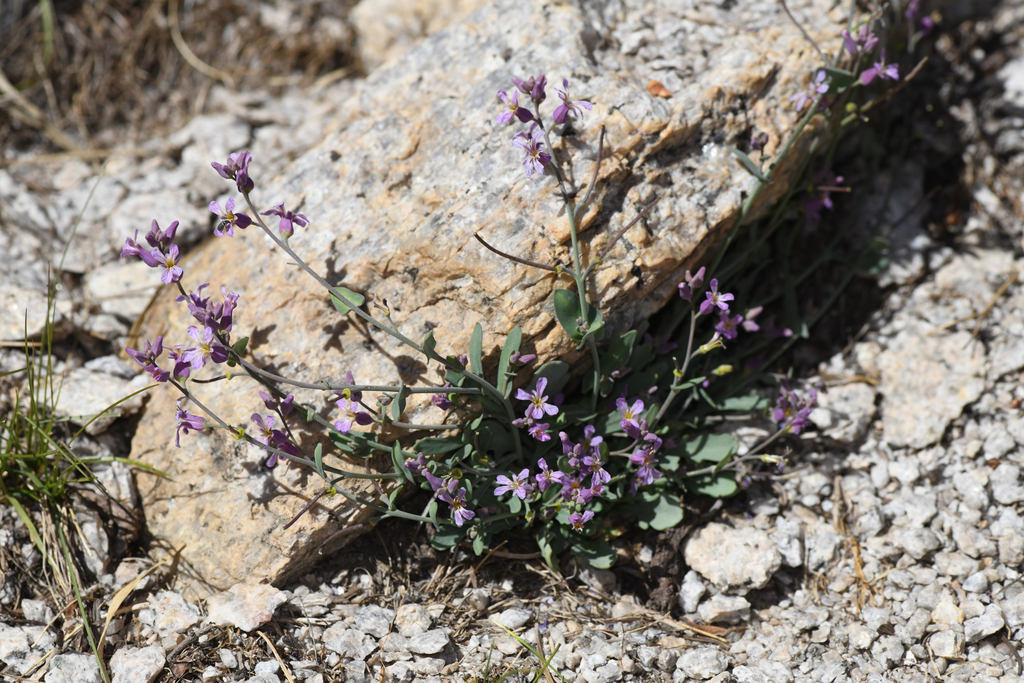
(c) Trevor Van Loon, some rights reserved (CC BY) · licence
Family: Brassicaceae · Type: Herb · Native
Conservation status: CNPS 1B.3
Streptanthus gracilis (Alpine jewelflower) is a native California herb in the Brassicaceae family, recognized by highest elevation species.
Alpine jewelflower is a rare (CNPS 1B.3) California native annual found in the southeastern Sierra Nevada Mountains (Kings-Kern Divide region) on rocky slopes at elevations of 2,600 to 3,600 meters. Flowering from June to September, this plant produces rose-purple and pink flowers approximately 7 to 10 millimeters long with delicate petals. Growing as a slender, erect plant 15 to 35 centimeters tall with branching from the base, it has a distinctive growth pattern with basal rosette leaves. Its leaves range from oblanceolate to spoon-shaped at the base, with wavy or toothed edges, transitioning to oblong or ovate mid-stem leaves that become progressively smaller and clasping toward the top of the plant. The fruit is an elongated silique 3 to 7 centimeters long, ascending from thin spreading pedicels.
Identification and appearance
Key characters: Geographically isolated with 0 sympatric species; highest elevation species
Habitat and range
Habitat: Rocky slopes
Elevation: 2600-3600 m
Bloom period
Streptanthus gracilis blooms Jun-Sep.
Conservation status
CNPS 1B.3
How to tell it apart
vs Caulanthus: Seed pods are flattened like sword blades versus cylindrical tubes in Caulanthus.; vs Boechera: Robust plants often over 2.5 feet with large flowers (sepals 4-8mm) versus more delicate habit.; vs Claytonia: Mustard family with 4 petals and 6 stamens versus Claytonia with 5 petals.; vs Silene: Mustard family with seed pods versus Silene with inflated capsules and opposite leaves.; vs Lonicera: Herbaceous mustard with alternate leaves versus woody vine with opposite leaves.
Frequently asked questions
Is Streptanthus gracilis native to California?
Yes. Streptanthus gracilis is native to California (recorded as native).
When does Streptanthus gracilis bloom?
Streptanthus gracilis blooms Jun-Sep.
What plant family does Streptanthus gracilis belong to?
Streptanthus gracilis is in the Brassicaceae family, genus Streptanthus.
Is Streptanthus gracilis rare or endangered?
Streptanthus gracilis carries California Rare Plant Rank 1B.3, state rank S3.
What habitat does Streptanthus gracilis grow in?
Streptanthus gracilis grows in Rocky slopes.
Related species
Other California species in the same genus, family, or bioregion.
- Streptanthus hesperidis — Green jewelflower
- Streptanthus hispidus — Mount diablo jewelflower
- Streptanthus howellii — Howell's jewelflower
- Streptanthus insignis — San benito jewelflower
- Streptanthus insignis subsp. insignis — plumed jewelflower
- Streptanthus insignis subsp. lyonii — Arburua ranch jewelflower
Sources: Jepson eFlora · CalPhotos · CDFW CNDDB
Last updated 2026-10-07
Data from The California Species Project — 14,000+ California species with verified data from CNPS, CDFW, USFWS, Cal-IPC, and more.