Streptanthus hesperidis
Green jewelflower
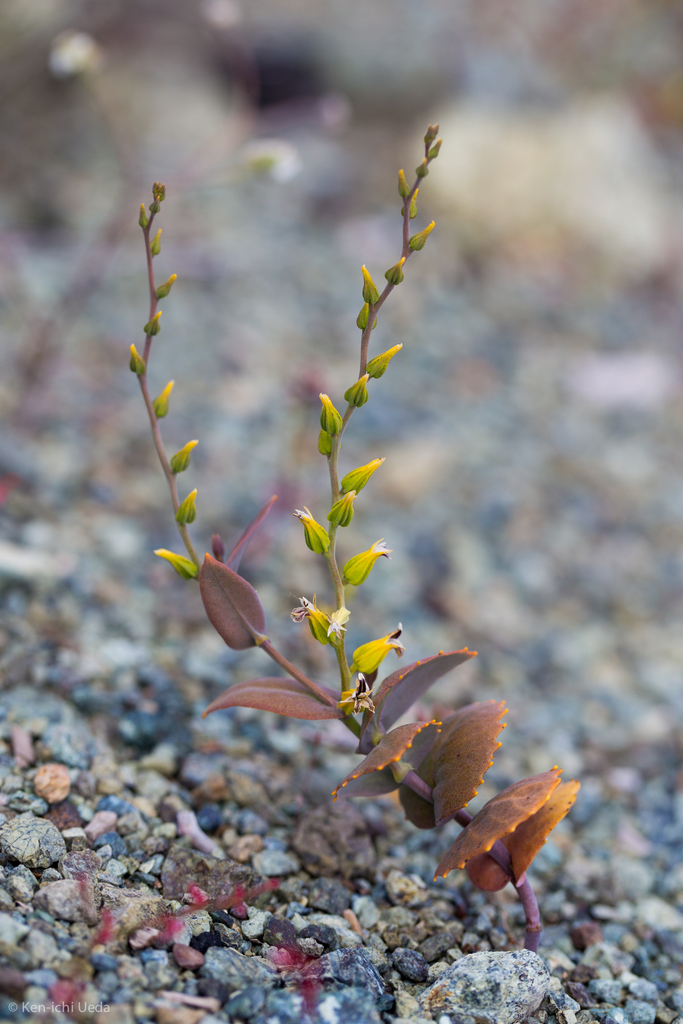
(c) Ken-ichi Ueda, some rights reserved (CC BY), uploaded by Ken-ichi Ueda · licence
Family: Brassicaceae · Type: Herb · Native
Conservation status: CNPS 1B.2
Streptanthus hesperidis (Green jewelflower) is a native California herb in the Brassicaceae family, recognized by distinctive yellow coloration and urn-shaped calyx.
Green jewelflower is a rare (CNPS 1B.2) California native annual found in southern North Coast Ranges Interior in Napa and southern Lake counties, inhabiting serpentine barrens and openings in chaparral, oak, and cypress woodlands at elevations of 250 to 600 meters. Flowering from May to July, this plant produces white flowers with purple veins, approximately 6 to 8 millimeters long, arranged in one-sided wavy inflorescences. Growing with simple or branched stems 10 to 30 centimeters tall, it has a distinctive yellow-green appearance. Its lower leaves are broadly obovate with coarse blunt teeth, while mid-stem leaves are sessile, ovate to lanceolate, and base-clasping, ranging from 1 to 4 centimeters long. The fruits are slender, spreading-ascending pods 3 to 6 centimeters long, containing 26 to 38 small oblong seeds.
Identification and appearance
Key characters: 13 sympatric species; distinctive yellow coloration and urn-shaped calyx
Habitat and range
Habitat: Serpentine barrens, associated openings in chaparral/oak woodland, cypress woodland
Elevation: 250-600 m
California counties: Lake, Napa, Sonoma, Mendocino
Bloom period
Streptanthus hesperidis blooms May-Jul.
Conservation status
CNPS 1B.2
How to tell it apart
vs Caulanthus: Seed pods are flattened like sword blades versus cylindrical tubes in Caulanthus.; vs Boechera: Robust plants often over 2.5 feet with large flowers (sepals 4-8mm) versus more delicate habit.; vs Claytonia: Mustard family with 4 petals and 6 stamens versus Claytonia with 5 petals.; vs Silene: Mustard family with seed pods versus Silene with inflated capsules and opposite leaves.; vs Lonicera: Herbaceous mustard with alternate leaves versus woody vine with opposite leaves.
Frequently asked questions
Is Streptanthus hesperidis native to California?
Yes. Streptanthus hesperidis is native to California (recorded as native).
When does Streptanthus hesperidis bloom?
Streptanthus hesperidis blooms May-Jul.
Where in California does Streptanthus hesperidis grow?
Streptanthus hesperidis occurs in Lake, Napa, Sonoma, Mendocino, at elevations of 250-600 m.
What plant family does Streptanthus hesperidis belong to?
Streptanthus hesperidis is in the Brassicaceae family, genus Streptanthus.
Is Streptanthus hesperidis rare or endangered?
Streptanthus hesperidis carries California Rare Plant Rank 1B.2, state rank S2S3.
Related species
Other California species in the same genus, family, or bioregion.
Sources: Jepson eFlora · CNPS Rare Plant Inventory · Index of California Plant Names · CalPhotos · CDFW CNDDB
Last updated 2026-10-07
Data from The California Species Project — 14,000+ California species with verified data from CNPS, CDFW, USFWS, Cal-IPC, and more.