Streptanthus insignis subsp. insignis
plumed jewelflower
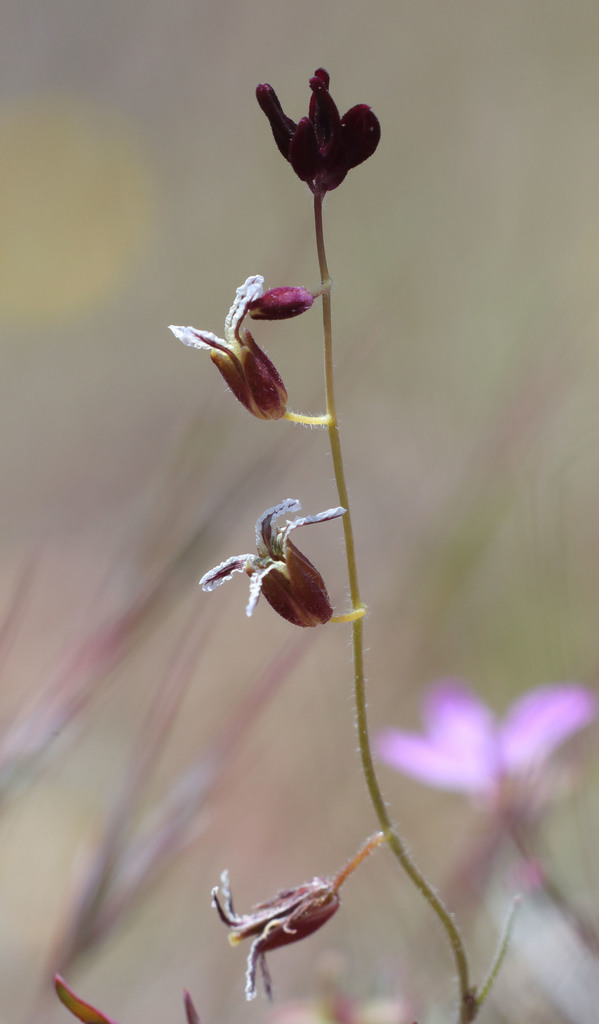
(c) Pinnacles National Park, some rights reserved (CC BY), uploaded by Pinnacles National Park · licence
Family: Brassicaceae · Type: Herb · Native
Conservation status: CNPS 4.3
Streptanthus insignis subsp. insignis (plumed jewelflower) is a native California herb in the Brassicaceae family, recognized by dark purple sterile flowers diagnostic.
Plumed jewelflower is a California native annual found in the southern Coast Ranges interior in openings of chaparral, badlands, and rocky outcrops at elevations of 300 to 1,100 meters. Flowering from March to May, this plant produces purple-white flowers with distinctive dark purple sterile flower clusters at the top of the inflorescence. Growing with delicate stems that support a slender, upright form, the plant reaches modest heights typical of annual wildflowers. Its flowers feature purple sepals and petals that transition from deep purple to white, creating a subtle color gradient across the blossoms. The fruits are notable for their sparse to dense bristly texture, adding a unique textural element to the plant's overall appearance.
Identification and appearance
Key characters: 2 sympatric species; dark purple sterile flowers diagnostic
Habitat and range
Habitat: Openings in chaparral, badlands, rock outcrops, talus, graywacke, shale, often serpentine
Elevation: 300-1100 m
California counties: San Benito, Fresno, Merced, Monterey
Bloom period
Streptanthus insignis subsp. insignis blooms Mar-May.
Conservation status
CNPS 4.3
How to tell it apart
vs Caulanthus: Seed pods are flattened like sword blades versus cylindrical tubes in Caulanthus.; vs Boechera: Robust plants often over 2.5 feet with large flowers (sepals 4-8mm) versus more delicate habit.; vs Claytonia: Mustard family with 4 petals and 6 stamens versus Claytonia with 5 petals.; vs Silene: Mustard family with seed pods versus Silene with inflated capsules and opposite leaves.; vs Lonicera: Herbaceous mustard with alternate leaves versus woody vine with opposite leaves.
Frequently asked questions
Is Streptanthus insignis subsp. insignis native to California?
Yes. Streptanthus insignis subsp. insignis is native to California (recorded as native).
When does Streptanthus insignis subsp. insignis bloom?
Streptanthus insignis subsp. insignis blooms Mar-May.
Where in California does Streptanthus insignis subsp. insignis grow?
Streptanthus insignis subsp. insignis occurs in San Benito, Fresno, Merced, Monterey, at elevations of 300-1100 m.
What plant family does Streptanthus insignis subsp. insignis belong to?
Streptanthus insignis subsp. insignis is in the Brassicaceae family, genus Streptanthus.
Is Streptanthus insignis subsp. insignis rare or endangered?
Streptanthus insignis subsp. insignis carries California Rare Plant Rank 4.3, state rank S3S4.
Related species
Other California species in the same genus, family, or bioregion.
- Streptanthus insignis subsp. lyonii — Arburua ranch jewelflower
- Streptanthus juneae — June's jewelflower
- Streptanthus longisiliquus — Long-fruit jewelflower
- Streptanthus medeirosii — Tejon jewelflower
- Streptanthus morrisonii — Morrison's jewelflower
- Streptanthus morrisonii ssp. elatus — Three Peaks jewel-flower
Sources: Jepson eFlora · Index of California Plant Names · CalPhotos · CDFW CNDDB
Last updated 2026-10-07
Data from The California Species Project — 14,000+ California species with verified data from CNPS, CDFW, USFWS, Cal-IPC, and more.