Streptanthus oblanceolatus
Trinity river jewelflower, Trinity River Jewelflower
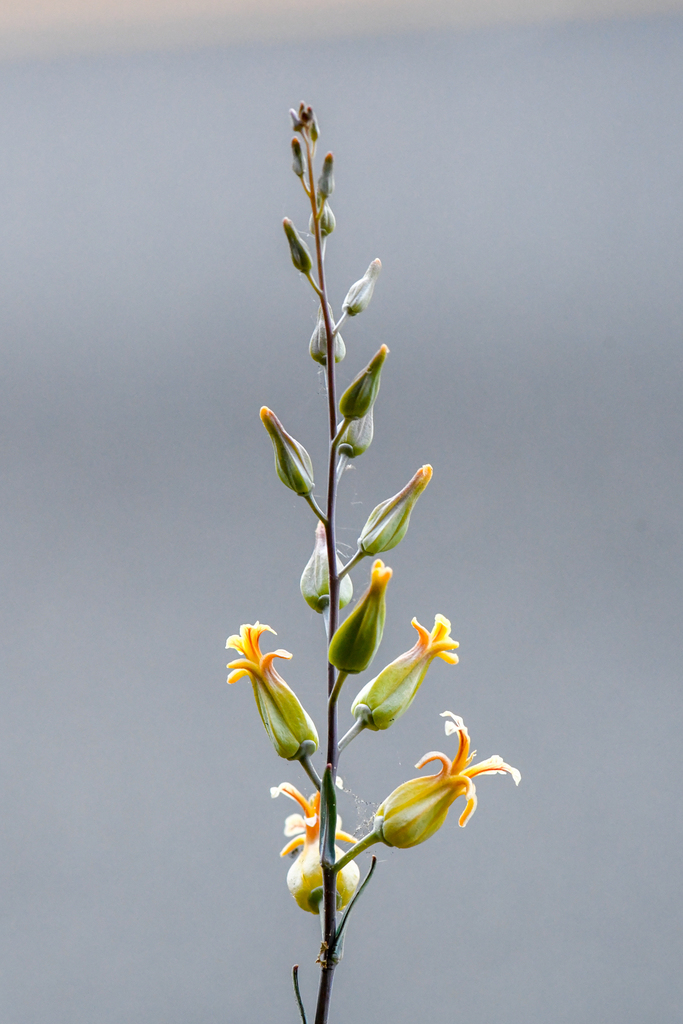
(c) Trevor Van Loon, some rights reserved (CC BY) · licence
Family: Brassicaceae · Type: Herb · Native
Conservation status: CNPS 1B.2
Streptanthus oblanceolatus (Trinity river jewelflower) is a native California herb in the Brassicaceae family, recognized by distinctive yellow flowers with unequal petal lengths.
Trinity river jewelflower is a rare (CNPS 1B.2) California native biennial found in the Klamath Ranges on cliffs, canyon walls, and in conifer forest at elevations around 400 meters. Flowering from June to July, this plant produces yellow flowers with recurved petals 12 to 16 millimeters long, forming delicate inflorescences. Growing with branched stems 50 to 100 centimeters tall, it develops a distinctive structure with multiple stem heights and varied leaf configurations. Its leaves range from basal rosettes of oblanceolate shape with coarse teeth to mid-stem lance-linear leaves 2 to 10 centimeters long, with progressively smaller upper stem leaves. The fruit develops as a slender, spreading-ascending pod 4 to 8 centimeters long, with narrow valves and seeds approximately 2 millimeters in length.
Identification and appearance
Key characters: 11 sympatric species; distinctive yellow flowers with unequal petal lengths
Habitat and range
Habitat: Cliffs, canyon walls, in conifer forest
Elevation: +- 400 m.
California counties: Trinity
Bloom period
Streptanthus oblanceolatus blooms Jun-Jul.
Conservation status
CNPS 1B.2
How to tell it apart
vs Caulanthus: Seed pods are flattened like sword blades versus cylindrical tubes in Caulanthus.; vs Boechera: Robust plants often over 2.5 feet with large flowers (sepals 4-8mm) versus more delicate habit.; vs Claytonia: Mustard family with 4 petals and 6 stamens versus Claytonia with 5 petals.; vs Silene: Mustard family with seed pods versus Silene with inflated capsules and opposite leaves.; vs Lonicera: Herbaceous mustard with alternate leaves versus woody vine with opposite leaves.
Frequently asked questions
Is Streptanthus oblanceolatus native to California?
Yes. Streptanthus oblanceolatus is native to California (recorded as native).
When does Streptanthus oblanceolatus bloom?
Streptanthus oblanceolatus blooms Jun-Jul.
Where in California does Streptanthus oblanceolatus grow?
Streptanthus oblanceolatus occurs in Trinity, at elevations of +- 400 m..
What plant family does Streptanthus oblanceolatus belong to?
Streptanthus oblanceolatus is in the Brassicaceae family, genus Streptanthus.
Is Streptanthus oblanceolatus rare or endangered?
Streptanthus oblanceolatus carries California Rare Plant Rank 1B.2, state rank S1.
Related species
Other California species in the same genus, family, or bioregion.
- Streptanthus oliganthus — Masonic mountain jewelflower
- Streptanthus polygaloides — Milkwort jewelflower
- Streptanthus polygaloides subsp. alternans — Tuolumne jewelflower
- Streptanthus polygaloides subsp. aureus — Golden jewelflower
- Streptanthus polygaloides subsp. bicolor — Red hills jewelflower
- Streptanthus polygaloides subsp. liber
Sources: Jepson eFlora · CNPS Rare Plant Inventory · Index of California Plant Names · CalPhotos · CDFW CNDDB
Last updated 2026-10-07
Data from The California Species Project — 14,000+ California species with verified data from CNPS, CDFW, USFWS, Cal-IPC, and more.