Streptanthus tortuosus var. tortuosus
Mountain jewelflower
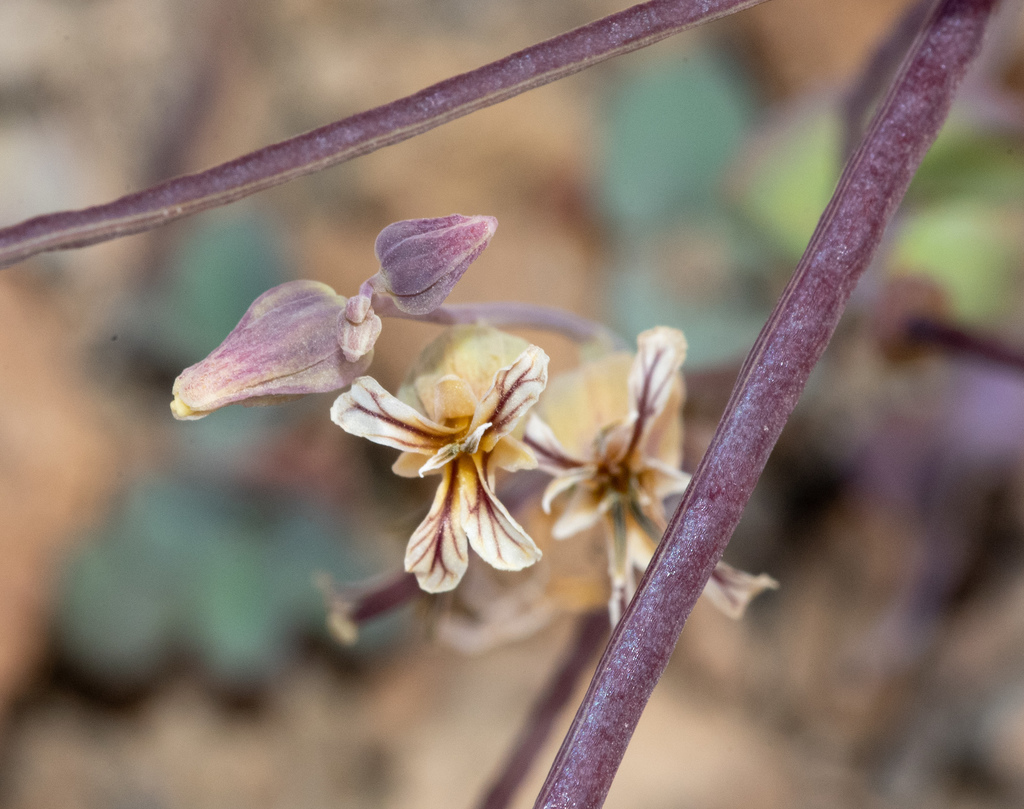
(c) Don Loarie, some rights reserved (CC BY), uploaded by Don Loarie · licence
Family: Brassicaceae · Type: Subshrub · Native
Streptanthus tortuosus var. tortuosus (Mountain jewelflower) is a native California subshrub in the Brassicaceae family, recognized by lack of specialized features of other varieties.
Mountain jewelflower is a California native perennial found in the Sierra Nevada, northern Coast Ranges, and Klamath Ranges in rocky slopes, foothill woodland, and montane conifer forest at elevations of 300 to 2,200 meters. Flowering from April to July, this plant produces yellow or purple flowers with sepals 5 to 9 millimeters long and petals 6 to 8 millimeters long. Growing with slender stems 20 to 100 centimeters tall that are simple or branched toward the top, it develops an upright, open structure. Its green leaves vary in shape, with distinctive round to oblong bracts that have obtuse tips. The fruit develops as a spreading to arched downward pod 5.5 to 10 centimeters long, supported by ascending pedicels 4 to 10.5 millimeters long.
Identification and appearance
Key characters: 42 sympatric species; distinguished by lack of specialized features of other varieties
Habitat and range
Habitat: Rocky slopes and outcrops, roadcuts, in foothill woodland, montane conifer forest, on granite, basalt, and metamorphic substrates (serpentine)
Elevation: 300-2200 m
Bloom period
Streptanthus tortuosus var. tortuosus blooms Apr-Jul.
How to tell it apart
vs Caulanthus: Seed pods are flattened like sword blades versus cylindrical tubes in Caulanthus.; vs Boechera: Robust plants often over 2.5 feet with large flowers (sepals 4-8mm) versus more delicate habit.; vs Claytonia: Mustard family with 4 petals and 6 stamens versus Claytonia with 5 petals.; vs Silene: Mustard family with seed pods versus Silene with inflated capsules and opposite leaves.; vs Lonicera: Herbaceous mustard with alternate leaves versus woody vine with opposite leaves.
Frequently asked questions
Is Streptanthus tortuosus var. tortuosus native to California?
Yes. Streptanthus tortuosus var. tortuosus is native to California (recorded as native).
When does Streptanthus tortuosus var. tortuosus bloom?
Streptanthus tortuosus var. tortuosus blooms Apr-Jul.
What plant family does Streptanthus tortuosus var. tortuosus belong to?
Streptanthus tortuosus var. tortuosus is in the Brassicaceae family, genus Streptanthus.
What habitat does Streptanthus tortuosus var. tortuosus grow in?
Streptanthus tortuosus var. tortuosus grows in Rocky slopes and outcrops, roadcuts, in foothill woodland, montane conifer forest, on granite, basalt, and metamorphic substrates (serpentine).
Related species
Other California species in the same genus, family, or bioregion.
- Streptanthus vernalis — Early jewelflower
- Streptanthus vimineus — Slender jewelflower
- Streptanthus albidus ssp. peramoenus — most beautiful jewelflower
- Streptanthus anomalus — Mount burdell jewelflower
- Streptanthus barbatus — Pacific jewelflower
- Streptanthus barbiger — Bearded jewelflower
- Strigosella africana — African mustard
- Strigosella sp.
Sources: Jepson eFlora · Index of California Plant Names · CalPhotos
Last updated 2026-10-07
Data from The California Species Project — 14,000+ California species with verified data from CNPS, CDFW, USFWS, Cal-IPC, and more.