Strombocarpa pubescens
Screwbean mesquite, Tornillo
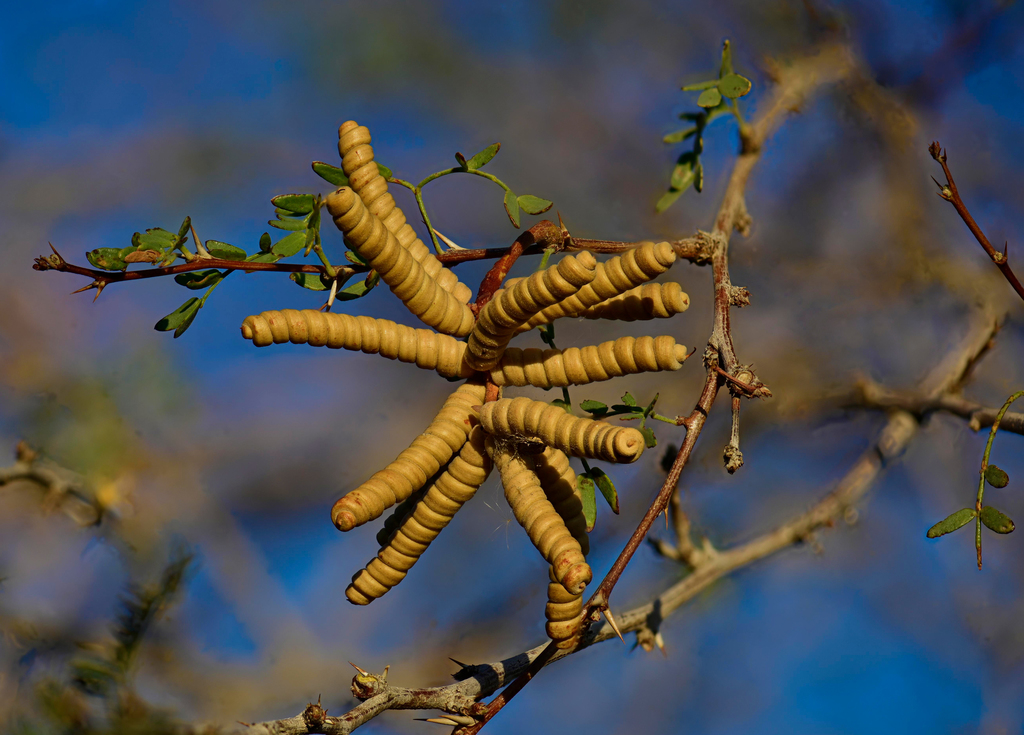
(c) Alan Rockefeller, some rights reserved (CC BY), uploaded by Alan Rockefeller · licence
Family: Fabaceae · Type: Shrub / Tree · Native
Strombocarpa pubescens (Screwbean mesquite) is a native California shrub / tree in the Fabaceae family, recognized by distinctive coiled fruits and native status.
Screwbean mesquite is a California native shrub found in the San Joaquin Valley, San Bernardino Mountains, and desert regions in creek bottoms, river washes, and gravelly ravines at elevations below 1,300 meters. Flowering from April to September, this plant produces small cream or yellow flowers in narrow, elongated clusters. Growing as a shrub with ascending branches and small spines 4 to 12 millimeters long, it develops a relatively narrow crown. Its compound leaves feature two to four primary leaflets 3 to 5 centimeters long, with 10 to 16 secondary leaflets that are oblong and 2 to 10 millimeters in length. The distinctive fruit is tightly coiled, measuring 3 to 5 centimeters long, which gives this mesquite its unique screwbean nickname.
Identification and appearance
Key characters: Geographically isolated from congeners; distinctive coiled fruits and native status
Habitat and range
Habitat: Creek, river bottoms, sandy or gravelly washes or ravines
Elevation: < 1300 m
California counties: Inyo, San Diego, Imperial, Fresno, San Bernardino, Riverside, Ventura, San Luis Obispo, Kern, Yolo
Outside California: southwestern United States, northern Mexico
Bloom period
Strombocarpa pubescens blooms Apr-Sep.
How to tell it apart
vs Prosopis: Prosopis (honey mesquite) pods are straight to gently curved and flattened; Strombocarpa pods are tightly spiraled into a coil, the 'screwbean.'; vs Acacia: Acacia has many pairs of pinnae and often globose yellow flower heads; Strombocarpa has only a single pair of primary leaflets, pale flowers in short spikes, and paired whitish nodal spines.; vs Parkinsonia: Parkinsonia is green-barked with tiny leaflets and long straight pods; Strombocarpa is spiny at the nodes with tightly coiled pods.; vs Vachellia: Vachellia has stipular spines and round flower heads with straight to curved pods; Strombocarpa is defined by its tightly coiled fruit and single pinna pair.; vs Olneya: Desert ironwood is a large tree with lavender flowers and straight beaded pods; Strombocarpa is a shrub with pale flowers and coiled pods.
Frequently asked questions
Is Strombocarpa pubescens native to California?
Yes. Strombocarpa pubescens is native to California (recorded as native).
When does Strombocarpa pubescens bloom?
Strombocarpa pubescens blooms Apr-Sep.
Where in California does Strombocarpa pubescens grow?
Strombocarpa pubescens occurs in Inyo, San Diego, Imperial, Fresno, San Bernardino, Riverside, Ventura, San Luis Obispo and other counties, at elevations of < 1300 m.
What plant family does Strombocarpa pubescens belong to?
Strombocarpa pubescens is in the Fabaceae family, genus Strombocarpa.
What habitat does Strombocarpa pubescens grow in?
Strombocarpa pubescens grows in Creek, river bottoms, sandy or gravelly washes or ravines.
Related species
Other California species in the same genus, family, or bioregion.
Sources: Jepson eFlora · Index of California Plant Names · CalPhotos
Last updated 2026-10-07
Data from The California Species Project — 14,000+ California species with verified data from CNPS, CDFW, USFWS, Cal-IPC, and more.