Stutzia covillei
Coville's orach, Coville's Orach
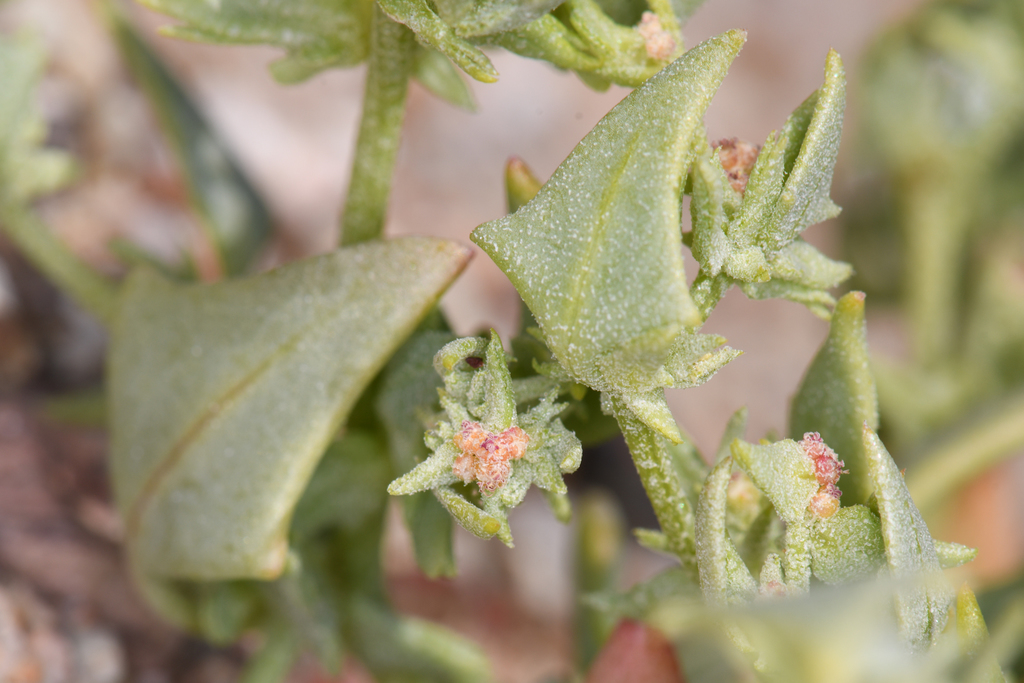
(c) Trevor Van Loon, some rights reserved (CC BY), uploaded by Trevor Van Loon · licence
Family: Chenopodiaceae · Type: Herb · Native
Stutzia covillei (Coville's orach) is a native California herb in the Chenopodiaceae family, recognized by Great Basin endemic with specialized saline-adapted morphology, recently segregated into monotypic genus from Atriplex.
Coville's orach is a California native annual found in the San Joaquin Valley, eastern Sierra Nevada, and Mojave Desert on saline soils and flats at elevations below 2,100 meters. Flowering from April to August, this plant produces small translucent flowers on many-branched green stems. Growing 10 to 45 centimeters tall with multiple branches emerging from its base, the plant has a distinctively striate stem that is glabrous or lightly scaled. Its leaves are fleshy and brittle, ranging 10 to 40 millimeters long, with lanceolate to deltate blades that taper or become hastate at the base. The fruit develops with 5 to 20 millimeter bracts that are partially fused and lanceolate to deltate in shape.
Identification and appearance
Key characters: Great Basin endemic with specialized saline-adapted morphology, recently segregated into monotypic genus from Atriplex
Habitat and range
Habitat: Saline soils, flats
Elevation: < 2100 m
California counties: Kern, Inyo, San Bernardino, Los Angeles, Mono, San Luis Obispo
Outside California: Nevada
Bloom period
Stutzia covillei blooms Apr-Aug.
How to tell it apart
vs Atriplex: Stutzia has bracts much longer than the hidden calyx; Atriplex bracts equal or shorter than calyx.; vs Blitum: Stutzia has long bracts hiding the calyx; Blitum has fleshy red fruit segments without concealing bracts.; vs Grayia: Stutzia has paired bracts with hidden calyx; Grayia has completely fused circular wings around fruit.; vs Extriplex: Stutzia bracts dramatically exceed and hide the calyx; Extriplex bracts are proportional to calyx.; vs Krascheninnikovia: Stutzia has smooth to slightly scaly bracts; Krascheninnikovia has densely woolly white-hairy bracts.
Frequently asked questions
Is Stutzia covillei native to California?
Yes. Stutzia covillei is native to California (recorded as native).
When does Stutzia covillei bloom?
Stutzia covillei blooms Apr-Aug.
Where in California does Stutzia covillei grow?
Stutzia covillei occurs in Kern, Inyo, San Bernardino, Los Angeles, Mono, San Luis Obispo, at elevations of < 2100 m.
What plant family does Stutzia covillei belong to?
Stutzia covillei is in the Chenopodiaceae family, genus Stutzia.
What habitat does Stutzia covillei grow in?
Stutzia covillei grows in Saline soils, flats.
Related species
Other California species in the same genus, family, or bioregion.
Sources: Jepson eFlora · Index of California Plant Names · CalPhotos
Last updated 2026-10-07
Data from The California Species Project — 14,000+ California species with verified data from CNPS, CDFW, USFWS, Cal-IPC, and more.