Stylocline psilocarphoides
Peck neststraw, Peck Neststraw
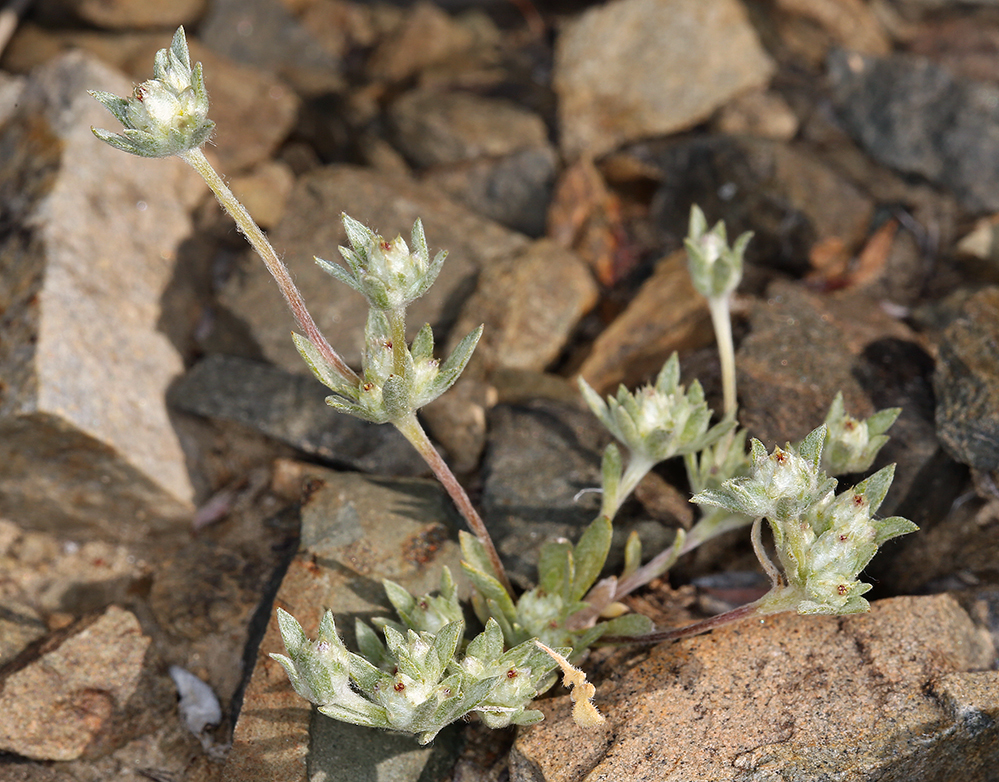
(c) Steve Matson, some rights reserved (CC BY), uploaded by Steve Matson · licence
Family: Asteraceae · Type: Herb · Native
Stylocline psilocarphoides (Peck neststraw) is a native California herb in the Asteraceae family, recognized by ovoid heads and leafless stem sections.
Peck neststraw is a California native annual found on the northern edge of the Tehachapi Range, eastern Sierra Nevada, Mojave Desert, and western edge of the Sonoran Desert in open, sandy or gravelly areas at elevations of 100 to 2,000 meters. Flowering from February to May, this plant produces small, delicate heads with pale flowers nestled among tomentose (woolly) bracts. Growing with diminutive stems just 1 to 8 centimeters tall, often appearing nearly leafless between branch points, it forms compact, low-growing clusters. Its leaves are small and distinctive, with the largest distal leaves measuring 3 to 10 millimeters long and 1 to 2 millimeters wide, shaped like tiny elliptic or spoon-like blades. The plant's most intriguing feature is its paleae, with wing-like structures that are widest in the distal third and shaped like oblanceolate or teardrop-like expansions.
Identification and appearance
Key characters: 1 sympatric species; distinguished by ovoid heads and leafless stem sections
Habitat and range
Habitat: Open, generally stable, sandy or gravelly, rock bases, drip lines
Elevation: 100-2000 m
Outside California: to southeastern Oregon, southwestern Idaho, southwestern Utah
Bloom period
Stylocline psilocarphoides blooms Feb-May.
How to tell it apart
vs Logfia: Stylocline completely lacks pappus; Logfia has fluffy white bristles on both flower types.; vs Psilocarphus: Stylocline has alternate leaves (may appear whorled); Psilocarphus has truly opposite leaves.; vs Micropus: Stylocline lacks prominent petal-like bracts; Micropus has 4-6 conspicuous spoon-shaped outer bracts.; vs Eriophyllum: Stylocline forms low woolly mats; Eriophyllum has upright stems with showy yellow flowers.; vs Gnaphalium: Stylocline has tiny heads hidden in dense leaf clusters; Gnaphalium has elongated heads on visible stems.
Frequently asked questions
Is Stylocline psilocarphoides native to California?
Yes. Stylocline psilocarphoides is native to California (recorded as native).
When does Stylocline psilocarphoides bloom?
Stylocline psilocarphoides blooms Feb-May.
What plant family does Stylocline psilocarphoides belong to?
Stylocline psilocarphoides is in the Asteraceae family, genus Stylocline.
What habitat does Stylocline psilocarphoides grow in?
Stylocline psilocarphoides grows in Open, generally stable, sandy or gravelly, rock bases, drip lines.
Related species
Other California species in the same genus, family, or bioregion.
- Stylocline sonorensis — Mesquite neststraw
- Stylocline sp. — Neststraw
- Stylocline citroleum — Oil neststraw
- Stylocline gnaphaloides — Everlasting neststraw
- Stylocline intertexta — Mojave neststraw
- Stylocline masonii — Mason's neststraw
- Symphyotrichum ascendens — Western aster
- Symphyotrichum bracteolatum — Eaton's aster
Sources: Jepson eFlora · Index of California Plant Names · CalPhotos
Last updated 2026-10-07
Data from The California Species Project — 14,000+ California species with verified data from CNPS, CDFW, USFWS, Cal-IPC, and more.