Suaeda esteroa
Estuary seablite
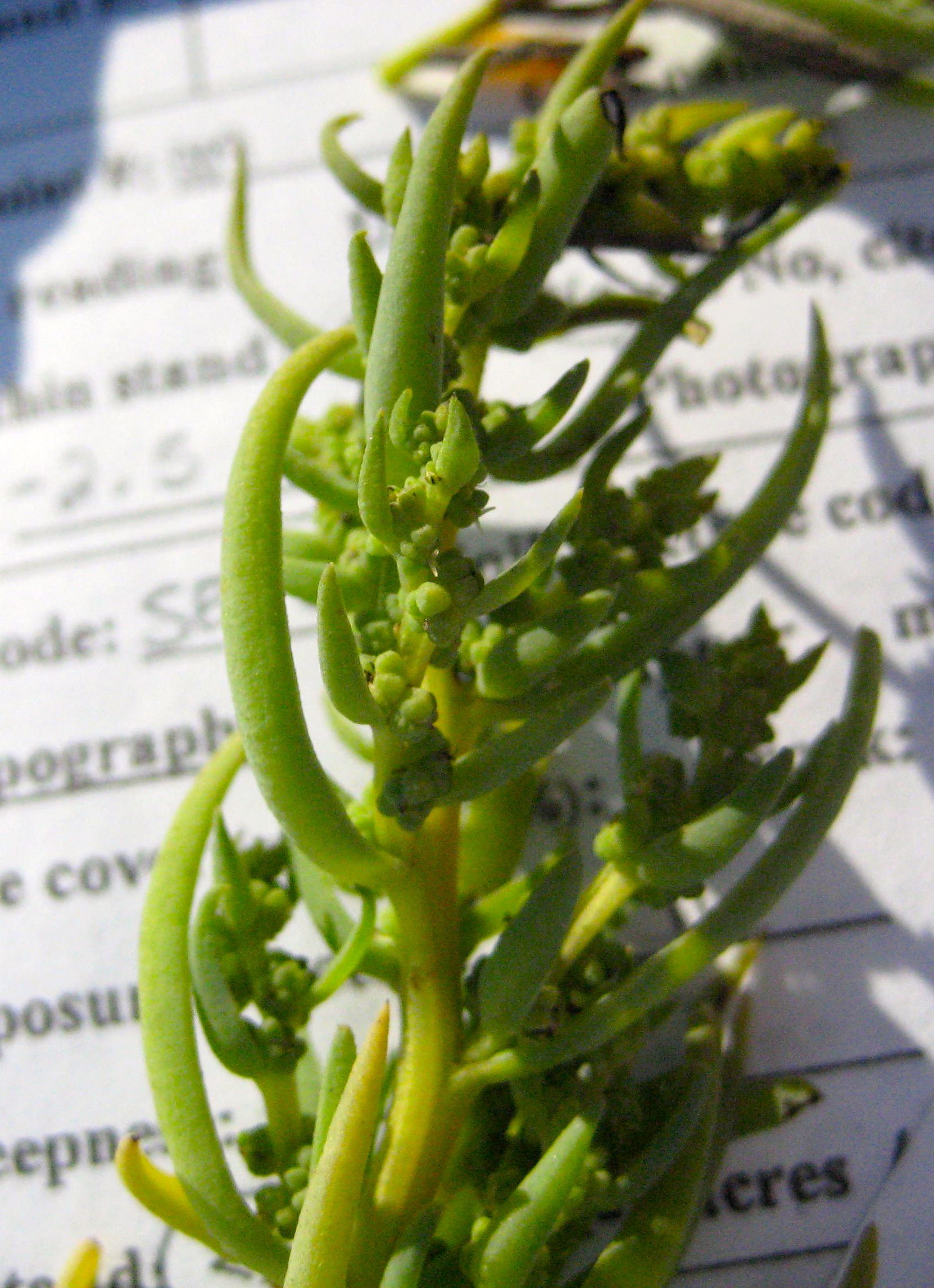
Photo by Chez Brungraber
Family: Chenopodiaceae · Type: Subshrub · Native
Conservation status: CNPS 1B.2
Suaeda esteroa (Estuary seablite) is a native California subshrub in the Chenopodiaceae family, recognized by exfoliating stems and persistent leaf remnants.
Estuary seablite is a rare (CNPS 1B.2) California native perennial found in southern coastal California in coastal salt marshes at elevations below 5 meters. Flowering from May to October, this plant produces green to reddish flowers in small clusters of 3 to 5 blooms, each flower about 1.5 to 3.5 millimeters long. Growing 1 to 6 decimeters tall with decumbent to erect stems that are generally glaucous and straw-colored, the plant has distinctive ascending branches that tend to exfoliate. Its leaves are lance-linear, ascending, and sessile, with distal leaves less than 60 millimeters long, overlapping and ranging from green to reddish and often covered in a bluish-white glaucous coating. The seeds are distinctive, ranging from 1 to 2 millimeters long and varying from shiny black to reddish or dull brown in color.
Identification and appearance
Key characters: 3 sympatric species; exfoliating stems and persistent leaf remnants are diagnostic
Habitat and range
Habitat: Coastal salt marshes
Elevation: < 5 m
California counties: Orange, San Diego, Ventura, Los Angeles, Santa Barbara
Outside California: northern Mexico
Bloom period
Suaeda esteroa blooms May-Oct.
Conservation status
CNPS 1B.2
How to tell it apart
vs Eriogonum: Suaeda has thick succulent leaves; Eriogonum has thin, often woolly leaves and clustered flowers.; vs Atriplex: Suaeda leaves are thick and succulent; Atriplex leaves are thin with scaly white coating.; vs Salsola: Suaeda leaves end in soft rounded tips; Salsola leaves taper to sharp spine tips.; vs Curio: Suaeda has simple cylindrical leaves; Curio has compound leaves or distinctive leaf shapes.; vs Frankenia: Suaeda has succulent cylindrical leaves; Frankenia has tiny opposite leaves with rolled-under edges.
Frequently asked questions
Is Suaeda esteroa native to California?
Yes. Suaeda esteroa is native to California (recorded as native).
When does Suaeda esteroa bloom?
Suaeda esteroa blooms May-Oct.
Where in California does Suaeda esteroa grow?
Suaeda esteroa occurs in Orange, San Diego, Ventura, Los Angeles, Santa Barbara, at elevations of < 5 m.
What plant family does Suaeda esteroa belong to?
Suaeda esteroa is in the Chenopodiaceae family, genus Suaeda.
Is Suaeda esteroa rare or endangered?
Suaeda esteroa carries California Rare Plant Rank 1B.2, state rank S2.
Related species
Other California species in the same genus, family, or bioregion.
Sources: Jepson eFlora · CNPS Rare Plant Inventory · Index of California Plant Names · CalPhotos · CDFW CNDDB
Last updated 2026-10-07
Data from The California Species Project — 14,000+ California species with verified data from CNPS, CDFW, USFWS, Cal-IPC, and more.