Symphoricarpos rotundifolius
Mountain snowberry
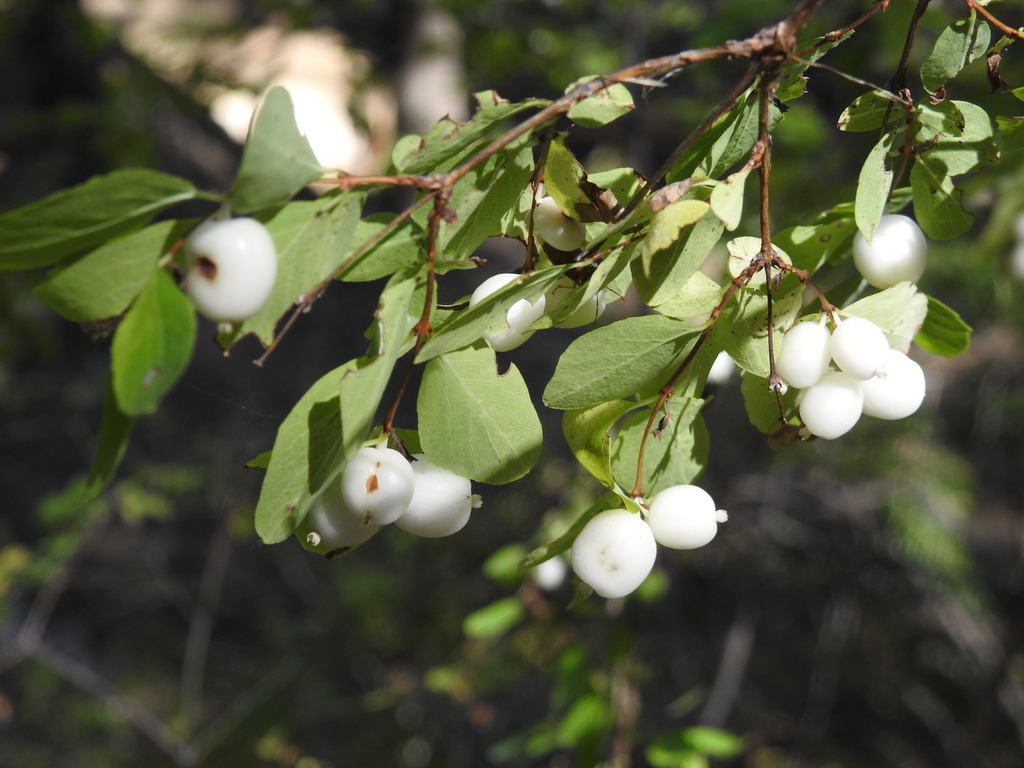
(c) Rachel Stringham, some rights reserved (CC BY), uploaded by Rachel Stringham · licence
Family: Caprifoliaceae · Type: Shrub · Native
Symphoricarpos rotundifolius (Mountain snowberry) is a native California shrub in the Caprifoliaceae family, recognized by no sympatric species.
Mountain snowberry is a California native shrub found in mountain regions, typically growing in rocky or woodland habitats. Flowering from July to September, this plant produces delicate pink or white flowers that are narrowly bell-shaped, 6 to 10 millimeters long, with slightly erect lobes. Growing 60 to 120 centimeters tall with stiff stems and shredding older bark, the shrub has a distinctive architectural form. Its leaves are relatively small, measuring 8 to 20 millimeters long, with undersides that are noticeably paler and more prominently veined. The fruit is an ovoid berry approximately 8 to 12 millimeters long, which provides food and habitat for local wildlife.
Identification and appearance
Key characters: Geographically isolated; no sympatric species
Habitat and range
California counties: Alpine, Los Angeles, San Bernardino, Mono, Inyo, Del Norte, Calaveras, Orange, Tulare, Riverside, Lassen, Kern, Ventura, El Dorado, Fresno, Mariposa, Nevada, Shasta, Modoc, Amador, Sierra, Lake, Madera, Plumas, Tehama, Tuolumne, Placer, San Diego, Santa Barbara, Siskiyou
How to tell it apart
vs Lonicera: Symphoricarpos has symmetrical bell flowers and white berries; Lonicera has lopsided tubular flowers and dark berries.; vs Gaultheria: Symphoricarpos has opposite leaves and exactly 2 seeds per berry; Gaultheria has alternate leaves and many tiny seeds.; vs Apocynum: Symphoricarpos produces white berries; Apocynum produces paired dry seed pods and has milky sap.; vs Rosa: Symphoricarpos has opposite leaves and white berries; Rosa has alternate compound leaves and red rose hips.; vs Toxicodendron: Symphoricarpos has opposite simple leaves and white berries; Toxicodendron has alternate compound leaves and whitish drupes.
Frequently asked questions
Is Symphoricarpos rotundifolius native to California?
Yes. Symphoricarpos rotundifolius is native to California (recorded as native).
Where in California does Symphoricarpos rotundifolius grow?
Symphoricarpos rotundifolius occurs in Alpine, Los Angeles, San Bernardino, Mono, Inyo, Del Norte, Calaveras, Orange and other counties.
What plant family does Symphoricarpos rotundifolius belong to?
Symphoricarpos rotundifolius is in the Caprifoliaceae family, genus Symphoricarpos.
Related species
Other California species in the same genus, family, or bioregion.
- Symphoricarpos rotundifolius var. parishii — Parish's snowberry
- Symphoricarpos rotundifolius var. rotundifolius — Long flowered snowberry
- Symphoricarpos sp. — Waxberry
- Symphoricarpos albus var. laevigatus — Snowberry
- Symphoricarpos longiflorus — Fragrant snowberry
- Symphoricarpos mollis — Creeping snowberry
- Caprifoliaceae sp. — Honeysuckle family
Sources: Jepson eFlora · Index of California Plant Names · CalPhotos
Last updated 2026-10-07
Data from The California Species Project — 14,000+ California species with verified data from CNPS, CDFW, USFWS, Cal-IPC, and more.