Symphyotrichum chilense
California aster
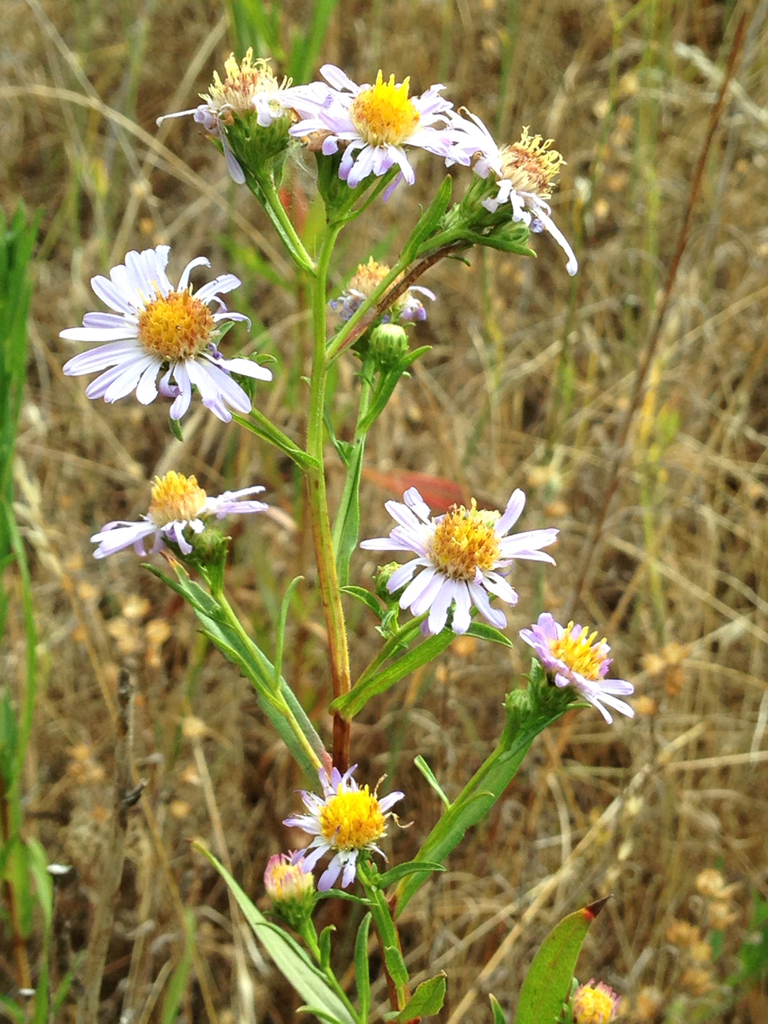
(c) Ken-ichi Ueda, some rights reserved (CC BY), uploaded by Ken-ichi Ueda · licence
Family: Asteraceae · Type: Herb · Native
Symphyotrichum chilense (California aster) is a native California herb in the Asteraceae family, recognized by coastal habitat and elevation range diagnostic.
California aster is a California native perennial found in western and central coastal regions, northern Southern California, and northern Channel Islands in grasslands, salt marshes, and disturbed areas at elevations below 500 meters. Flowering from June to October, this plant produces violet ray flowers 8 to 12 millimeters long in heads arranged in cyme-like clusters. Growing with hairy stems 40 to 100 centimeters tall, it spreads through long rhizomes that create dense clumps. Its leaves are nearly sessile, oblanceolate in shape, ranging from entire to finely serrate, with a slightly hairy surface and tapering to an acute tip. The plant's distinctive phyllaries feature green outer bracts and inner bracts with pale margins and a green oblanceolate to linear center zone.
Identification and appearance
Key characters: 3 sympatric species; coastal habitat and elevation range diagnostic
Habitat and range
Habitat: Grassland, salt marshes, disturbed places
Elevation: < 500 m
California counties: Butte, San Mateo, Del Norte, Monterey, Kern, San Francisco, Mendocino, Santa Clara, Ventura, Santa Barbara, Humboldt, Santa Cruz, Marin, San Luis Obispo, Alameda, Sonoma, Contra Costa, Colusa, Nevada, El Dorado, Lake, Solano, Los Angeles, Napa, San Bernardino, Plumas, San Diego, Tuolumne, Calaveras, Madera, Mariposa, Siskiyou, Tulare, Yuba, Shasta, Yolo, Sacramento, San Joaquin
Outside California: to British Columbia
Bloom period
Symphyotrichum chilense blooms Jun-Oct.
How to tell it apart
vs Corethrogyne: Corethrogyne has distinctive brown/reddish pappus; Symphyotrichum has white pappus; vs Erigeron: Erigeron has 50+ very thin rays per head; Symphyotrichum has fewer wider rays; vs Eurybia: Eurybia has two-toned bracts (green tips, white bases); Symphyotrichum bracts are all green; vs Aster: Aster is the old name for Symphyotrichum - they're the same plants; vs Dieteria: Dieteria has spinulose-tipped bracts; Symphyotrichum bracts lack spiny tips
Frequently asked questions
Is Symphyotrichum chilense native to California?
Yes. Symphyotrichum chilense is native to California (recorded as native).
When does Symphyotrichum chilense bloom?
Symphyotrichum chilense blooms Jun-Oct.
Where in California does Symphyotrichum chilense grow?
Symphyotrichum chilense occurs in Butte, San Mateo, Del Norte, Monterey, Kern, San Francisco, Mendocino, Santa Clara and other counties, at elevations of < 500 m.
What plant family does Symphyotrichum chilense belong to?
Symphyotrichum chilense is in the Asteraceae family, genus Symphyotrichum.
What habitat does Symphyotrichum chilense grow in?
Symphyotrichum chilense grows in Grassland, salt marshes, disturbed places.
Related species
Other California species in the same genus, family, or bioregion.
- Symphyotrichum defoliatum — San bernardino aster
- Symphyotrichum foliaceum — Alpine leafybract aster
- Symphyotrichum foliaceum var. apricum — Alpine leafybract aster
- Symphyotrichum foliaceum var. parryi — Parry's aster
- Symphyotrichum frondosum — Short rayed alkali aster
- Symphyotrichum greatae — Greata's aster
Sources: Jepson eFlora · Index of California Plant Names · CalPhotos
Last updated 2026-10-07
Data from The California Species Project — 14,000+ California species with verified data from CNPS, CDFW, USFWS, Cal-IPC, and more.