Tamarix ramosissima
Saltcedar
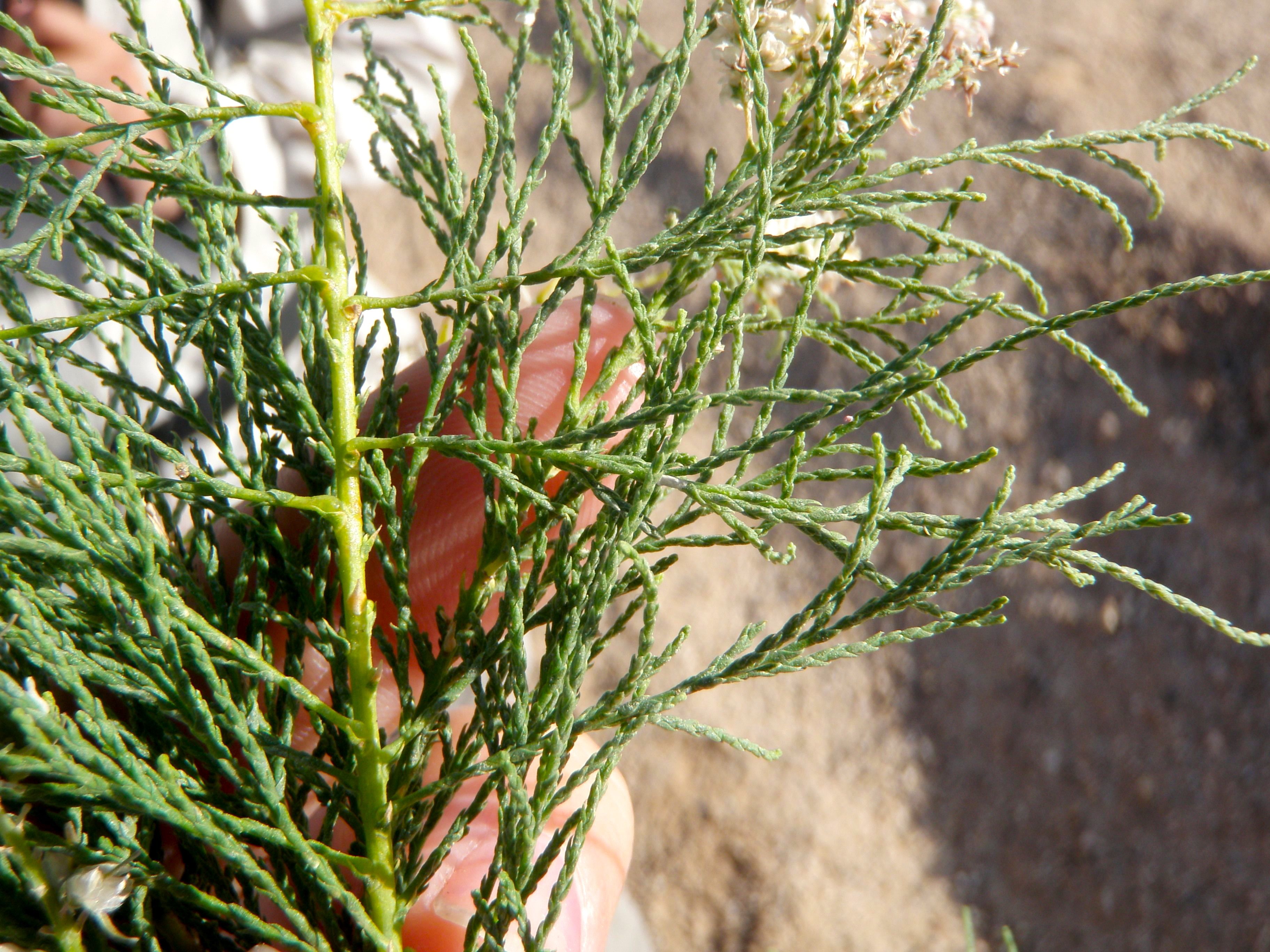
Photo by Chez Brungraber
Family: Tamaricaceae · Type: Shrub / Tree · Not Native
Conservation status: Cal-IPC Yes
Tamarix ramosissima (Saltcedar) is a non-native California shrub / tree in the Tamaricaceae family, recognized by Co-occurs with 4 other species; wide distribution and stamen attachment position diagnostic.
Saltcedar is a naturalized shrub found in diverse California bioregions including the Klamath Ranges, San Joaquin Valley, Central Coast, southern coastal ranges, southwestern California, eastern Sierra Nevada, and desert regions at elevations below 2,000 meters, commonly growing in washes and along streambanks. Flowering from April to August, this invasive plant produces delicate pink to white flowers in small clusters less than one centimeter long. Growing as a multi-stemmed shrub up to 8 meters tall with dense, intricate branching, it forms thick stands in disturbed riparian areas. Its small, tightly overlapping leaves are narrow and lanceolate, measuring 1.5 to 3.5 millimeters long with pointed tips. The plant produces minute five-petaled flowers with tiny sepals, creating a feathery, soft appearance across its dense branching structure.
Identification and appearance
Key characters: Co-occurs with 4 other species; wide distribution and stamen attachment position diagnostic
Habitat and range
Habitat: Common. Washes, streambanks
Elevation: < 2000 m
California counties: Los Angeles, Riverside, San Diego, San Bernardino, Ventura, Kern, Inyo, Imperial, San Luis Obispo, Orange, Santa Barbara, Mono, Kings, Merced, Monterey, Tuolumne, Yolo, Fresno, Glenn, Napa, Tulare, Solano, Colusa, Santa Cruz, Santa Clara
Outside California: to Washington, Louisiana, northern Mexico, native to Asia
Bloom period
Tamarix ramosissima blooms Apr-Aug.
Conservation status
Cal-IPC Yes
How to tell it apart
vs Casuarina: Tamarix has jointed green twigs with scale leaves; Casuarina has grooved twigs with whorled scale teeth.; vs Artemisia: Tamarix has bladeless scale leaves on jointed twigs; Artemisia has small but distinct lobed leaves.; vs Neltuma: Tamarix has scale-like leaves on delicate twigs; mesquite has compound leaves with distinct leaflets.; vs Pinus: Tamarix has jointed green deciduous twigs; pine has woody branches with clustered needles.; vs Acacia: Tamarix has tiny scale leaves on jointed twigs; Acacia has distinct compound leaves or flattened leaf-like stems.
Frequently asked questions
Is Tamarix ramosissima native to California?
No. Tamarix ramosissima is not native to California (recorded as not native).
When does Tamarix ramosissima bloom?
Tamarix ramosissima blooms Apr-Aug.
Where in California does Tamarix ramosissima grow?
Tamarix ramosissima occurs in Los Angeles, Riverside, San Diego, San Bernardino, Ventura, Kern, Inyo, Imperial and other counties, at elevations of < 2000 m.
What plant family does Tamarix ramosissima belong to?
Tamarix ramosissima is in the Tamaricaceae family, genus Tamarix.
Is Tamarix ramosissima invasive in California?
Tamarix ramosissima is listed by Cal-IPC with an invasiveness rating of Yes.
Related species
Other California species in the same genus, family, or bioregion.
Sources: Jepson eFlora · Index of California Plant Names · CalPhotos
Last updated 2026-10-07
Data from The California Species Project — 14,000+ California species with verified data from CNPS, CDFW, USFWS, Cal-IPC, and more.