Taxus brevifolia
Pacific yew, Pacific Yew
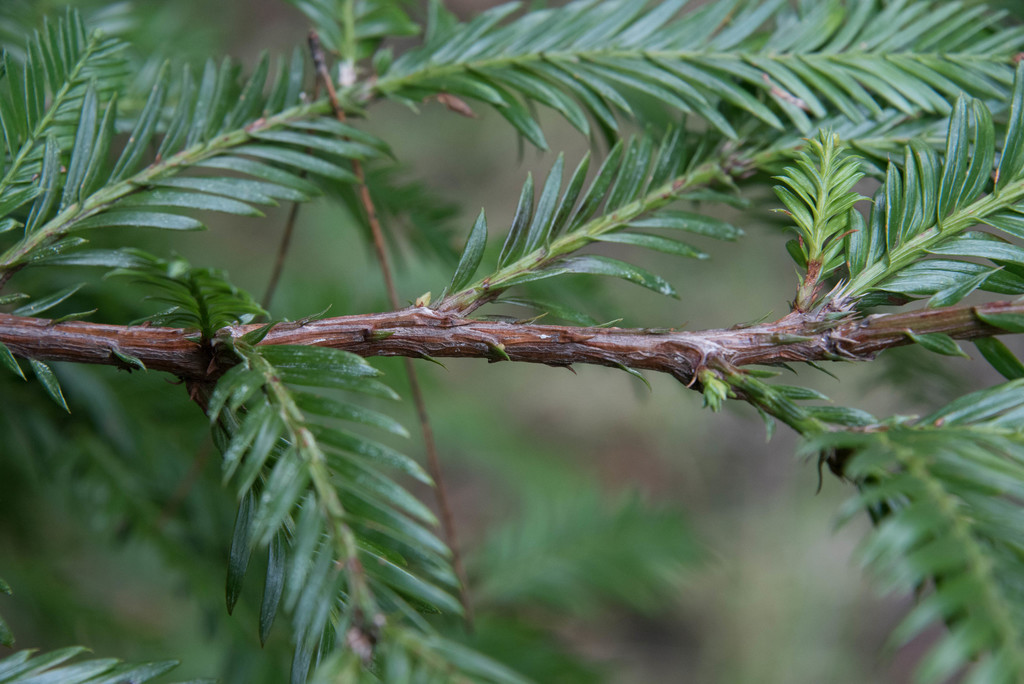
(c) Don Loarie, some rights reserved (CC BY), uploaded by Don Loarie · licence
Family: Taxaceae · Type: Tree · Native
Taxus brevifolia (Pacific yew) is a native California tree in the Taxaceae family, recognized by Only Taxus species native to western North America, representing ancient conifer lineage.
Pacific yew is a native shrub found in northwestern California, the California Cascade Range, northern and central Sierra Nevada, and San Francisco Bay Area in dense, mixed-evergreen forests and canyon bottoms at elevations of 10 to 2,150 meters. The tree produces subtle, pale green to yellow-green foliage that provides a distinctive textural appearance in forest understories. Growing as a trunk up to 18 meters tall with a diameter less than 0.6 meters, this yew features uniquely shredding bark with outer scales ranging from purple to purple-brown and inner scales in red to red-purple tones. Its leaves are pale green on top surfaces and shiny yellow-green underneath, creating a soft, layered appearance in woodland settings. The tree produces small ovoid seeds approximately 5 to 6.5 millimeters long with smooth seed coats.
Identification and appearance
Key characters: Only Taxus species native to western North America, representing ancient conifer lineage
Habitat and range
Habitat: Generally dense, mixed-evergreen forest, lower slopes or canyon bottoms
Elevation: 10-2150 m
California counties: Sacramento, Lake, El Dorado, Humboldt, Mendocino, Del Norte, Mariposa, Nevada, Placer, Trinity, Shasta, Siskiyou, San Mateo, Butte, Tehama, Calaveras, San Francisco, Plumas, Yuba, Tuolumne, Sierra, Amador, Modoc, Alameda, Santa Clara
Outside California: to Alaska, western Montana
How to tell it apart
vs Sequoia: Yew has bright red cup-shaped berries and soft needles; redwood has flat sprays of scale-like leaves and small woody cones.; vs Torreya: Yew has short, soft needles and red cup-shaped fruits; California-nutmeg has long, sharp-tipped aromatic needles and plum-like fruits.; vs Tsuga: Yew has red berry-like fruits open at top; hemlock has small woody hanging cones under 3 inches.; vs Melaleuca: Yew has needle-like leaves in flat sprays; Melaleuca has narrow alternate leaves and bottlebrush-like flower clusters.; vs Abies: Yew has red cup-shaped berries; fir has upright cones that disintegrate on tree leaving central spikes.
Frequently asked questions
Is Taxus brevifolia native to California?
Yes. Taxus brevifolia is native to California (recorded as native).
Where in California does Taxus brevifolia grow?
Taxus brevifolia occurs in Sacramento, Lake, El Dorado, Humboldt, Mendocino, Del Norte, Mariposa, Nevada and other counties, at elevations of 10-2150 m.
What plant family does Taxus brevifolia belong to?
Taxus brevifolia is in the Taxaceae family, genus Taxus.
What habitat does Taxus brevifolia grow in?
Taxus brevifolia grows in Generally dense, mixed-evergreen forest, lower slopes or canyon bottoms.
Related species
Other California species in the same genus, family, or bioregion.
Sources: Jepson eFlora · Index of California Plant Names · CalPhotos
Last updated 2026-10-07
Data from The California Species Project — 14,000+ California species with verified data from CNPS, CDFW, USFWS, Cal-IPC, and more.