Teesdalia coronopifolia
Lesser shepherds cress
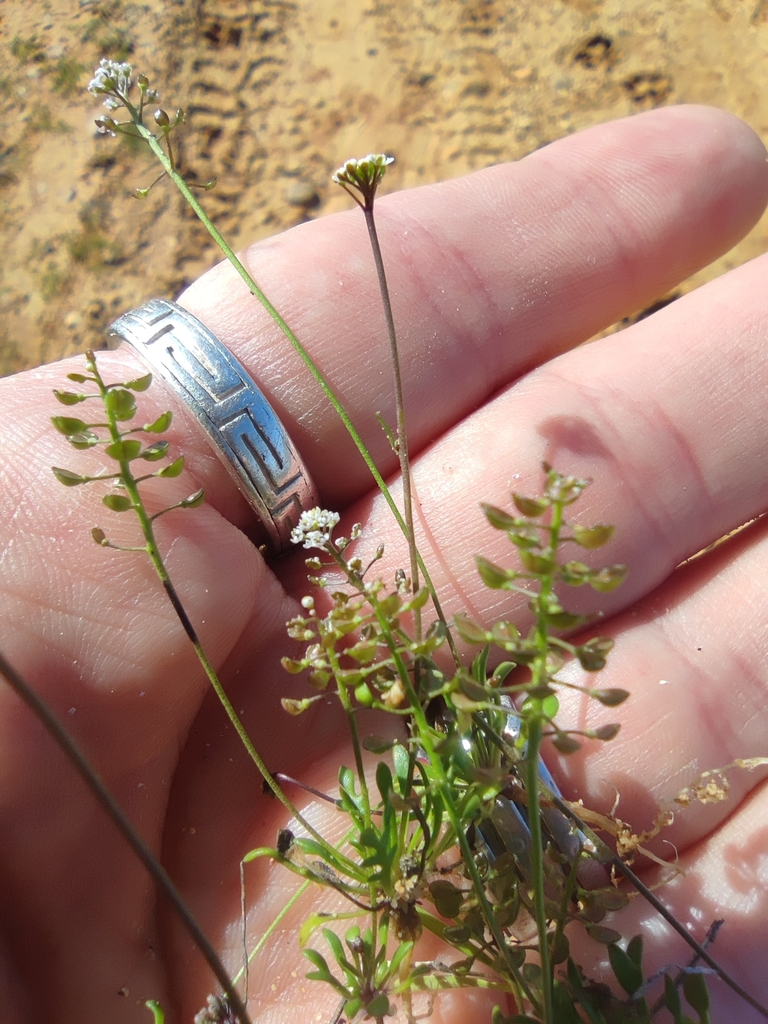
(c) Santiago Martín-Bravo, some rights reserved (CC BY) · licence
Family: Brassicaceae · Type: Herb · Not Native
Teesdalia coronopifolia (Lesser shepherds cress) is a non-native California herb in the Brassicaceae family.
Lesser shepherds cress is a naturalized perennial found in southern North Coast Ranges (Sonoma County) in wet, disturbed areas at elevations below 500 meters. Flowering from February to April, this plant produces white flowers about 1.5 millimeters long. Growing as a slender plant 10 to 28 centimeters tall, it emerges with one to many stems from its base, which remain simple and relatively unbranched. Its basal leaves are lanceolate, pinnately lobed or divided, typically 0.5 to 3 centimeters long, with sparse cauline leaves that are linear and sometimes dentate. The plant is characterized by its glabrous or sparsely hairy texture, with small fruits approximately 3 to 3.5 millimeters wide.
Identification and appearance
Key characters: 0 sympatric species - geographically isolated in NCoRO
Habitat and range
Habitat: Uncommon. Wet, disturbed areas
Elevation: < 500 m
Outside California: native to Europe
Bloom period
Teesdalia coronopifolia blooms Feb-Apr.
How to tell it apart
vs Capsella: Teesdalia fruit is a rounded, notched silicle and its 4 petals are unequal (outer pair larger); shepherd's purse (Capsella) has triangular, heart-shaped fruits and equal petals.; vs Lepidium: Teesdalia has clearly unequal petals and a basal rosette of pinnately lobed leaves on nearly leafless stems; peppergrasses (Lepidium) have equal or absent petals and usually leafier stems.; vs Draba: Teesdalia is nearly glabrous with lobed rosette leaves; Draba is typically star-hairy with entire to toothed leaves.; vs Cardamine: Teesdalia has a small, flat, notched silicle; bittercress (Cardamine) has an elongate linear silique that springs open explosively.; vs Thlaspi: Teesdalia fruit is small and only shallowly notched; pennycress (Thlaspi/Noccaea) fruit is larger with broad wings and a deep apical notch.
Frequently asked questions
Is Teesdalia coronopifolia native to California?
No. Teesdalia coronopifolia is not native to California (recorded as not native).
When does Teesdalia coronopifolia bloom?
Teesdalia coronopifolia blooms Feb-Apr.
What plant family does Teesdalia coronopifolia belong to?
Teesdalia coronopifolia is in the Brassicaceae family, genus Teesdalia.
What habitat does Teesdalia coronopifolia grow in?
Teesdalia coronopifolia grows in Uncommon. Wet, disturbed areas.
Related species
Other California species in the same genus, family, or bioregion.
Sources: Jepson eFlora · CalPhotos
Last updated 2026-10-07
Data from The California Species Project — 14,000+ California species with verified data from CNPS, CDFW, USFWS, Cal-IPC, and more.