Tetradymia axillaris
Catclaw horsebrush
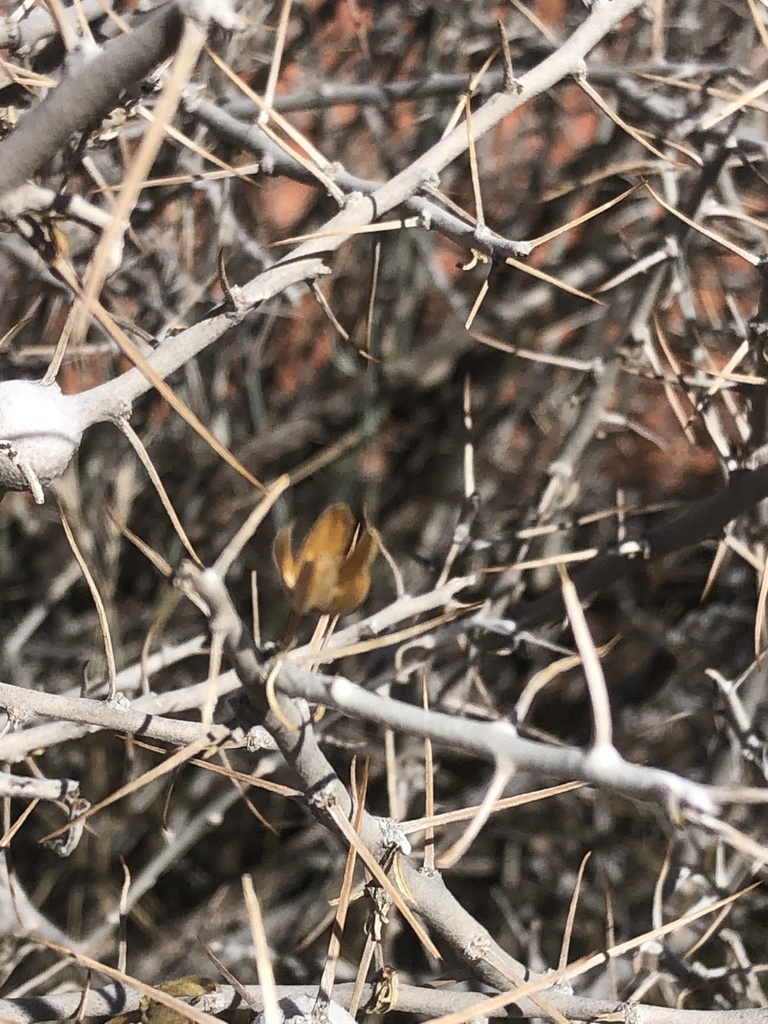
(c) Andrew Conboy, some rights reserved (CC BY) · licence
Family: Asteraceae · Type: Shrub · Native
Tetradymia axillaris (Catclaw horsebrush) is a native California shrub in the Asteraceae family.
Catclaw horsebrush is a California native shrub found in desert and montane regions at elevations ranging from low to moderate heights. Flowering from May to June, this plant produces pale yellow flowers in small clusters of 1 to 3 heads approximately 7 to 9 millimeters long. Growing as a spiny shrub up to 15 decimeters tall, it features evenly tomentose stems with distinctive straight spine-like leaves. Its leaves are complex, with main leaves 1 to 5 centimeters long that form sharp spines and become progressively less hairy with age, while clustered leaves are short, thread-like, and nearly smooth. The fruit is densely covered in long white hairs, with approximately 25 slender scales forming its distinctive pappus.
How to tell it apart
vs Ericameria: Tetradymia has 4-6 bracts in 1-2 rows; Ericameria has many bracts in 5 vertical rows.; vs Artemisia: Tetradymia has rigid spine-tipped branches; Artemisia has soft, non-spiny aromatic foliage.; vs Lycium: Tetradymia has yellow composite flowers; Lycium has tubular purple/greenish flowers with 5 petals.; vs Senecio: Tetradymia has 4-8 flowers per head with woolly appearance; Senecio has more flowers per head and often ray petals.; vs Krascheninnikovia: Tetradymia has yellow composite flowers; Krascheninnikovia has tiny greenish flowers without petals (Chenopodiaceae family).
Frequently asked questions
Is Tetradymia axillaris native to California?
Yes. Tetradymia axillaris is native to California (recorded as native).
What plant family does Tetradymia axillaris belong to?
Tetradymia axillaris is in the Asteraceae family, genus Tetradymia.
Related species
Other California species in the same genus, family, or bioregion.
Sources: Jepson eFlora · Index of California Plant Names · CalPhotos
Last updated 2026-10-07
Data from The California Species Project — 14,000+ California species with verified data from CNPS, CDFW, USFWS, Cal-IPC, and more.