Thalictrum fendleri var. polycarpum
Fendler's meadow rue
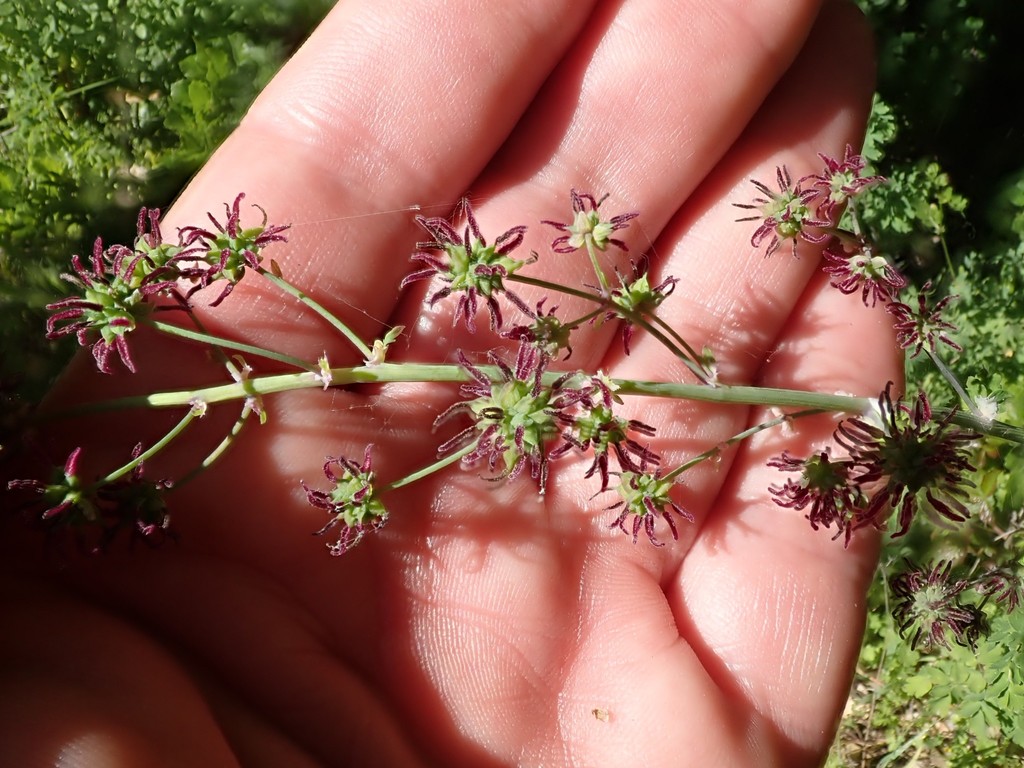
(c) joergmlpts, some rights reserved (CC BY), uploaded by joergmlpts · licence
Family: Ranunculaceae · Type: Herb · Native
Thalictrum fendleri var. polycarpum (Fendler's meadow rue) is a native California herb in the Ranunculaceae family, recognized by . Distinguished from var. fendleri by fruit compression pattern and glabrous leaves.
Fendler's meadow rue is a California native perennial found in northern coastal, western Klamath Ranges, northern coastal, Sierra Nevada, central western California, Transverse Ranges, and western Peninsular Ranges in moist, open to shaded woodland and forest habitats at elevations to 2,600 meters. Flowering from March to June, this plant produces delicate white or pale green flowers in loose, airy clusters. Growing with slender stems 30 to 80 centimeters tall, it forms elegant, multi-branched clusters with finely divided foliage. Its leaves are composed of small, rounded leaflets that are smooth and light green on the undersides, creating a soft, lacy appearance across woodland floors. The fruit develops with compressed, net-veined bodies that are subtly ribbed along the margins.
Identification and appearance
Key characters: 4 sympatric species. Distinguished from var. fendleri by fruit compression pattern and glabrous leaves.
Habitat and range
Habitat: Moist, open to shaded places, woodland, forest
Elevation: < 2600 m
California counties: Riverside, Los Angeles, Santa Barbara, San Diego, San Luis Obispo, San Bernardino, Monterey, Butte, Orange, San Mateo, Calaveras, Marin, Tulare, Sonoma, Tehama, Shasta, Placer, Kern, Napa, Alameda, San Benito, Lake, Mono, Humboldt, Trinity, Santa Clara, Contra Costa, Mendocino, Siskiyou, Ventura, Amador, El Dorado, Tuolumne, Plumas, Colusa, Santa Cruz, Inyo, Sierra
Outside California: to Washington
Bloom period
Thalictrum fendleri var. polycarpum blooms Mar-Jun.
How to tell it apart
vs Clematis: Thalictrum has herbaceous stems and tiny petal-less flowers in open clusters; Clematis has woody stems and large showy flowers.; vs Adiantum: Thalictrum has flowers with dangling stamens; Adiantum is a true fern with spores on leaf undersides, never flowers.; vs Aquilegia: Thalictrum has tiny petal-less flowers in open airy clusters; Aquilegia has large showy flowers with distinctive spurs.; vs Lomatium: Thalictrum leaves have rounded, scalloped leaflets; Lomatium leaves are finely divided into narrow linear segments.; vs Enemion: Thalictrum has petal-less flowers with dangling linear anthers; Enemion has 5 white petals and shorter stamens.
Frequently asked questions
Is Thalictrum fendleri var. polycarpum native to California?
Yes. Thalictrum fendleri var. polycarpum is native to California (recorded as native).
When does Thalictrum fendleri var. polycarpum bloom?
Thalictrum fendleri var. polycarpum blooms Mar-Jun.
Where in California does Thalictrum fendleri var. polycarpum grow?
Thalictrum fendleri var. polycarpum occurs in Riverside, Los Angeles, Santa Barbara, San Diego, San Luis Obispo, San Bernardino, Monterey, Butte and other counties, at elevations of < 2600 m.
What plant family does Thalictrum fendleri var. polycarpum belong to?
Thalictrum fendleri var. polycarpum is in the Ranunculaceae family, genus Thalictrum.
What habitat does Thalictrum fendleri var. polycarpum grow in?
Thalictrum fendleri var. polycarpum grows in Moist, open to shaded places, woodland, forest.
Related species
Other California species in the same genus, family, or bioregion.
- Thalictrum occidentale — Western meadow rue
- Thalictrum sp. — Meadow-rue
- Thalictrum sparsiflorum — Few flowered meadow rue
- Thalictrum alpinum — Arctic meadow-rue
- Thalictrum fendleri — Fendler's meadow rue
- Thalictrum fendleri var. fendleri — Fendler's meadow rue
- Trautvetteria caroliniensis — Carolina bugbane
Sources: Jepson eFlora · Index of California Plant Names · CalPhotos
Last updated 2026-10-07
Data from The California Species Project — 14,000+ California species with verified data from CNPS, CDFW, USFWS, Cal-IPC, and more.