Thysanocarpus radians
Fringe pod
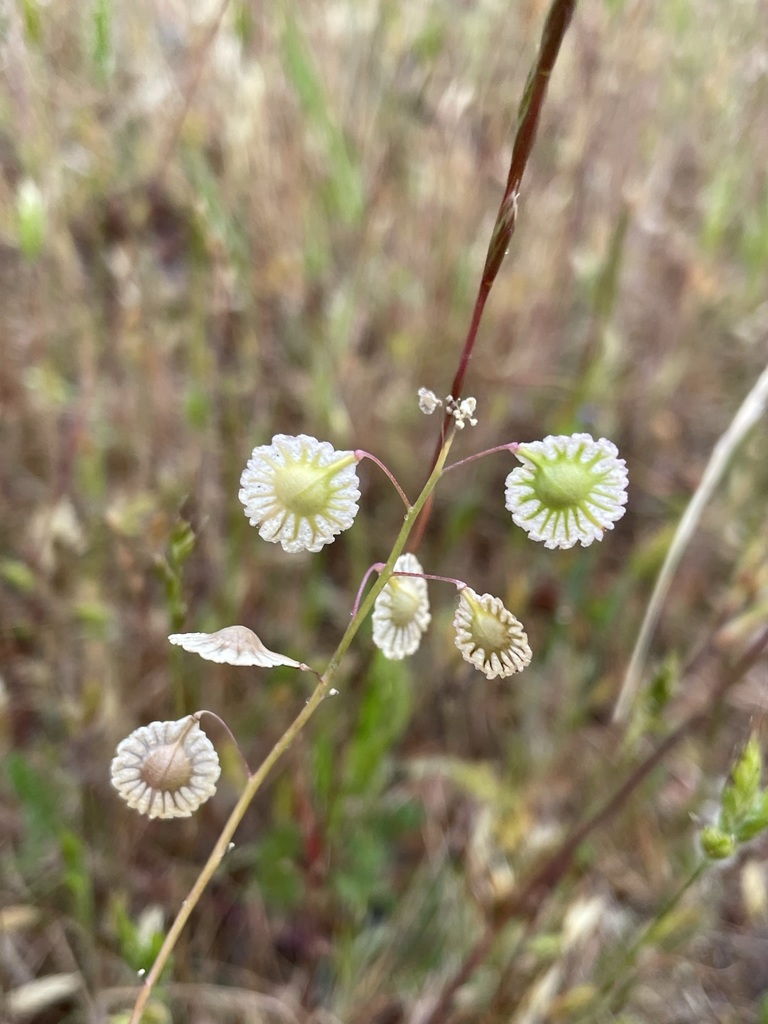
(c) Matt Berger, some rights reserved (CC BY) · licence
Family: Brassicaceae · Type: Herb · Native
Thysanocarpus radians (Fringe pod) is a native California herb in the Brassicaceae family, recognized by distinctive large fruits with distinct rays and long straight pedicels.
Fringe pod is a California native annual found in northwestern California, the northern Sierra Nevada foothills, Central Valley, San Francisco Bay Area, and southern coastal regions in moist slopes, pastures, and open meadows at elevations below 800 meters. Flowering from March to April, this plant produces small yellow flowers on open inflorescences with yellow anthers. Growing 15 to 60 centimeters tall with glabrous stems and occasional sparse rough hairs near the base, it has a delicate, upright structure. Its basal leaves are oblanceolate with wavy or lobed edges, measuring 1.5 to 4 centimeters long, while stem leaves are lance-shaped and clasp the stem with lobed bases. The distinctive round fruit measures 7 to 10 millimeters wide with a flat or slightly incurved wing, creating an intricate, delicate silhouette.
Identification and appearance
Key characters: 3 sympatric species; distinctive large fruits with distinct rays and long straight pedicels
Habitat and range
Habitat: Moist slopes, pastures, open meadows, fields
Elevation: < 800 m
California counties: Sacramento, Solano, Siskiyou, Sonoma, Napa, San Joaquin, Santa Clara, Placer, Butte, Nevada, Yuba, Sutter, Tuolumne, Calaveras, Lake, El Dorado, Mariposa, San Benito, Amador, Stanislaus, Fresno, Shasta, Merced, Contra Costa, Tehama, Mendocino, Alameda, Trinity, San Diego, Colusa, Los Angeles, Santa Barbara
Outside California: Oregon
Bloom period
Thysanocarpus radians blooms Mar-Apr.
How to tell it apart
vs Lepidium: Fruits hang downward like lanterns versus standing upright in Lepidium.; vs Athysanus: Fruits have distinctive papery wings with radiating veins versus wingless tiny fruits.; vs Capsella: Fruits are round with lacy wings versus triangular heart-shaped pods.; vs Briza: Mustard with flat winged fruits versus grass with dangling spikelets.; vs Eriogonum: Annual mustard with winged hanging fruits versus buckwheat with ball-like flower clusters.
Frequently asked questions
Is Thysanocarpus radians native to California?
Yes. Thysanocarpus radians is native to California (recorded as native).
When does Thysanocarpus radians bloom?
Thysanocarpus radians blooms Mar-Apr.
Where in California does Thysanocarpus radians grow?
Thysanocarpus radians occurs in Sacramento, Solano, Siskiyou, Sonoma, Napa, San Joaquin, Santa Clara, Placer and other counties, at elevations of < 800 m.
What plant family does Thysanocarpus radians belong to?
Thysanocarpus radians is in the Brassicaceae family, genus Thysanocarpus.
What habitat does Thysanocarpus radians grow in?
Thysanocarpus radians grows in Moist slopes, pastures, open meadows, fields.
Related species
Other California species in the same genus, family, or bioregion.
- Thysanocarpus rigidus — Rigid fringepod
- Thysanocarpus sp. — Lacepod
- Thysanocarpus conchuliferus — Santa cruz island fringepod
- Thysanocarpus curvipes — Fringe pod
- Thysanocarpus curvipes subsp. amplectens
- Thysanocarpus curvipes subsp. curvipes
- Transberingia bursifolia subsp. virgata — Virgate halimolobos
- Transberingia sp.
Sources: Jepson eFlora · Index of California Plant Names · CalPhotos
Last updated 2026-10-07
Data from The California Species Project — 14,000+ California species with verified data from CNPS, CDFW, USFWS, Cal-IPC, and more.