Tiquilia canescens var. canescens
Gray coldenia
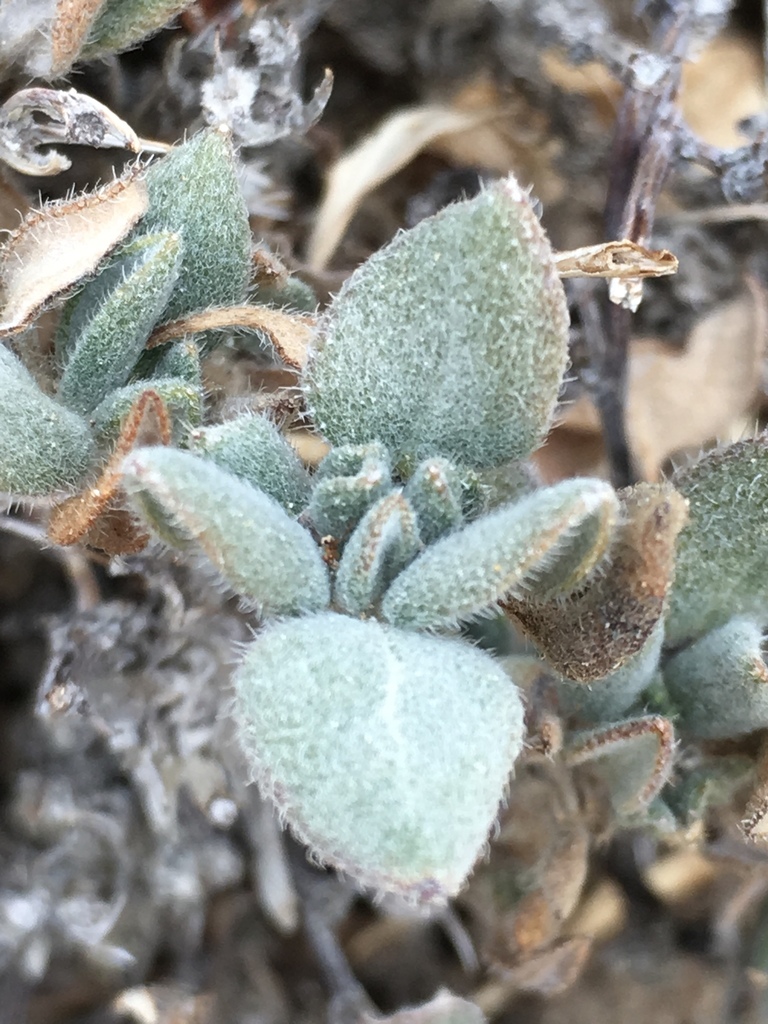
(c) W. Terry Hunefeld, some rights reserved (CC BY) · licence
Family: Ehretiaceae · Type: Subshrub · Native
Tiquilia canescens var. canescens (Gray coldenia) is a native California subshrub in the Ehretiaceae family, recognized by smaller flower size within species complex.
Gray coldenia is a California native perennial found in southeastern Mojave Desert and Sonoran Desert regions on slopes, ridges, and occasionally in washes at elevations of 300 to 1,525 meters. Flowering from March to May, this plant produces delicate lavender, pink, or white flowers with a corolla 4 to 7.5 millimeters long and a limb 2.5 to 4.5 millimeters in diameter. Growing with low-spreading stems that form dense clusters, it creates a grayish ground cover in arid landscapes. Its leaves are likely small and densely packed, helping the plant conserve moisture in its desert habitats. The plant's chromosome count of 9 suggests a compact genetic structure well-adapted to harsh desert environments.
Identification and appearance
Key characters: 4 sympatric species; distinguished by smaller flower size within species complex
Habitat and range
Habitat: Slopes, ridges, occasionally washes
Elevation: 300-1525 m
California counties: Riverside, Imperial, San Bernardino, San Diego
Outside California: southwestern North America, Texas, northern Mexico
Bloom period
Tiquilia canescens var. canescens blooms Mar-May.
How to tell it apart
vs Eriogonum: Tiquilia has opposite leaves and tubular flowers; Eriogonum has basal/alternate leaves and petal-less flowers in heads.; vs Nama: Tiquilia forms ground-hugging mats with sessile flowers at forks; Nama is more upright with stalked flowers.; vs Croton: Tiquilia has showy tubular flowers; Croton has tiny inconspicuous greenish flowers without petals.; vs Euphorbia: Tiquilia has regular tubular flowers with 5 petals; Euphorbia has specialized cup-like flower structures with milky sap.; vs Heliotropium: Tiquilia has a deeply forked style with 2 stigmas; Heliotropium has an undivided style or single stigma.
Frequently asked questions
Is Tiquilia canescens var. canescens native to California?
Yes. Tiquilia canescens var. canescens is native to California (recorded as native).
When does Tiquilia canescens var. canescens bloom?
Tiquilia canescens var. canescens blooms Mar-May.
Where in California does Tiquilia canescens var. canescens grow?
Tiquilia canescens var. canescens occurs in Riverside, Imperial, San Bernardino, San Diego, at elevations of 300-1525 m.
What plant family does Tiquilia canescens var. canescens belong to?
Tiquilia canescens var. canescens is in the Ehretiaceae family, genus Tiquilia.
What habitat does Tiquilia canescens var. canescens grow in?
Tiquilia canescens var. canescens grows in Slopes, ridges, occasionally washes.
Related species
Other California species in the same genus, family, or bioregion.
Sources: Jepson eFlora · Index of California Plant Names · CalPhotos
Last updated 2026-10-07
Data from The California Species Project — 14,000+ California species with verified data from CNPS, CDFW, USFWS, Cal-IPC, and more.