Tiquilia palmeri
Palmer's tiquilia, Palmer's Tiquilia
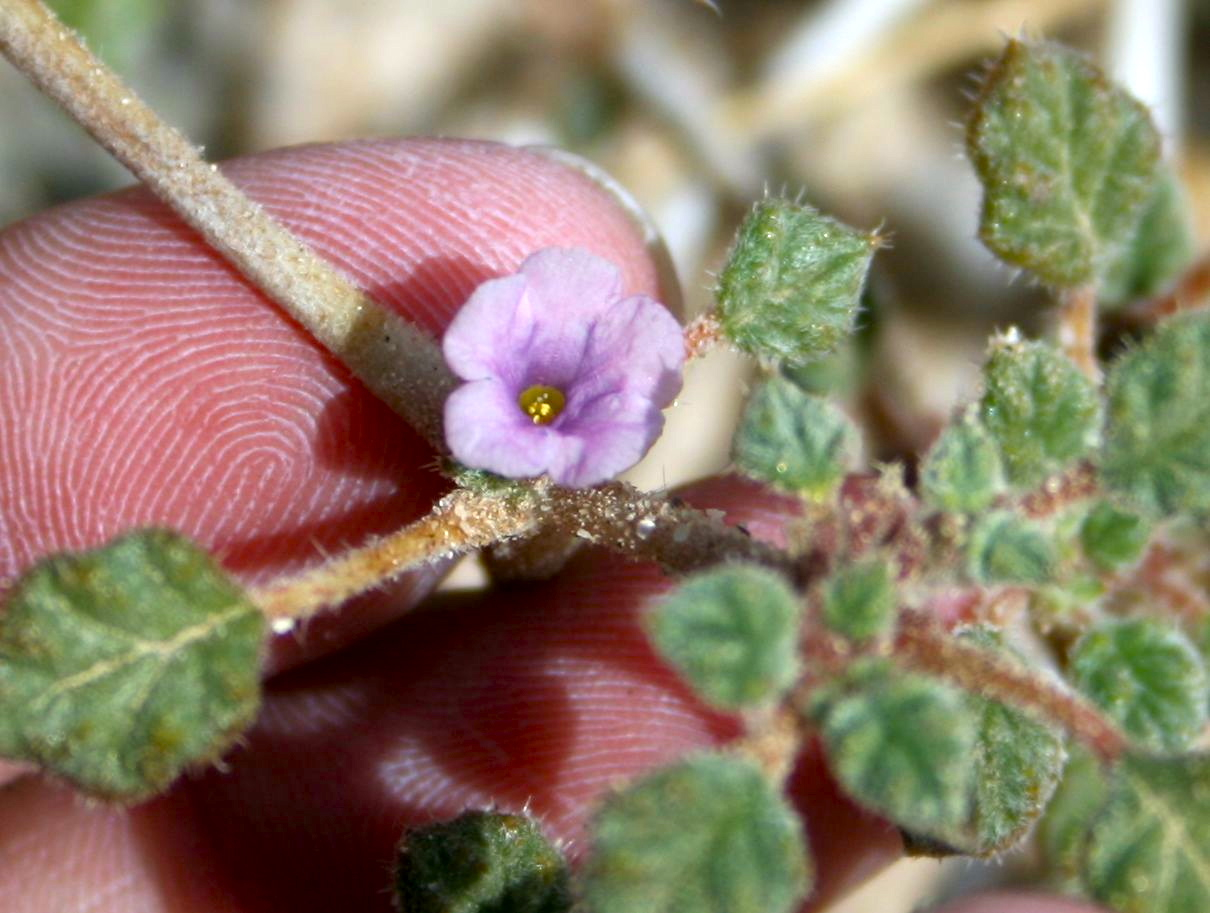
Photo by Chez Brungraber
Family: Ehretiaceae · Type: Subshrub · Native
Tiquilia palmeri (Palmer's tiquilia) is a native California subshrub in the Ehretiaceae family, recognized by white bark and scalloped leaf margins distinctive.
Palmer's tiquilia is a California native perennial found in the western edge of the desert region near the Colorado River in sandy gravel soils at elevations below 650 meters. Flowering from March to June, this plant produces blue, purple, or lavender flowers with a limb 4 to 5 millimeters in diameter clustered in leaf axils. Growing with opposite branches and somewhat woody stems covered in shaggy hairs, it forms a low-spreading plant. Its leaves are clustered and gray-strigose, with small ovate to round blades 3.5 to 11 millimeters long, featuring margins that are slightly crenate and two to three pairs of shallow lateral veins. The fruit develops as deeply 4-lobed nutlets that are spheric, smooth, and shiny.
Identification and appearance
Key characters: 5 sympatric species; white bark and scalloped leaf margins distinctive
Habitat and range
Habitat: Sandy gravel soils, on terraced flats
Elevation: < 650 m
California counties: Riverside, Imperial, San Bernardino, San Diego, Tulare, Los Angeles
Outside California: southwestern Nevada, western Arizona, northern Mexico
Bloom period
Tiquilia palmeri blooms Mar-Jun.
How to tell it apart
vs Eriogonum: Tiquilia has opposite leaves and tubular flowers; Eriogonum has basal/alternate leaves and petal-less flowers in heads.; vs Nama: Tiquilia forms ground-hugging mats with sessile flowers at forks; Nama is more upright with stalked flowers.; vs Croton: Tiquilia has showy tubular flowers; Croton has tiny inconspicuous greenish flowers without petals.; vs Euphorbia: Tiquilia has regular tubular flowers with 5 petals; Euphorbia has specialized cup-like flower structures with milky sap.; vs Heliotropium: Tiquilia has a deeply forked style with 2 stigmas; Heliotropium has an undivided style or single stigma.
Frequently asked questions
Is Tiquilia palmeri native to California?
Yes. Tiquilia palmeri is native to California (recorded as native).
When does Tiquilia palmeri bloom?
Tiquilia palmeri blooms Mar-Jun.
Where in California does Tiquilia palmeri grow?
Tiquilia palmeri occurs in Riverside, Imperial, San Bernardino, San Diego, Tulare, Los Angeles, at elevations of < 650 m.
What plant family does Tiquilia palmeri belong to?
Tiquilia palmeri is in the Ehretiaceae family, genus Tiquilia.
What habitat does Tiquilia palmeri grow in?
Tiquilia palmeri grows in Sandy gravel soils, on terraced flats.
Related species
Other California species in the same genus, family, or bioregion.
Sources: Jepson eFlora · Index of California Plant Names · CalPhotos
Last updated 2026-10-07
Data from The California Species Project — 14,000+ California species with verified data from CNPS, CDFW, USFWS, Cal-IPC, and more.