Torilis arvensis
Tall sock-destroyer, Tall Sock-Destroyer
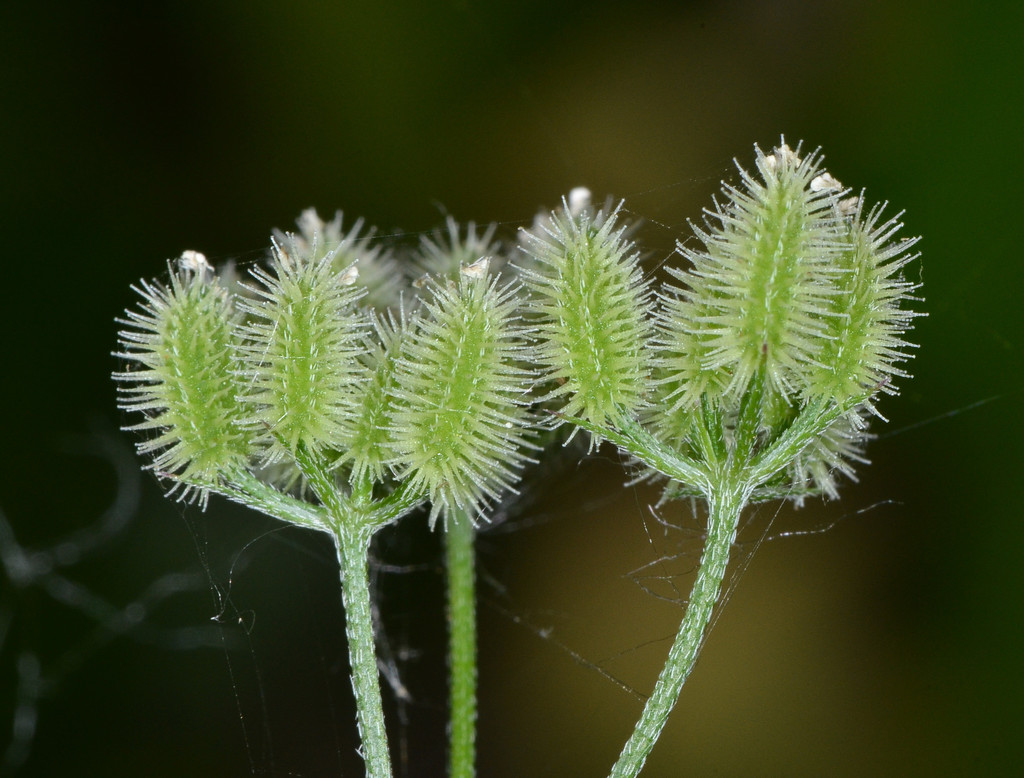
(c) Don Loarie, some rights reserved (CC BY) · licence
Family: Apiaceae · Type: Herb · Not Native
Conservation status: Cal-IPC Yes
Torilis arvensis (Tall sock-destroyer) is a non-native California herb in the Apiaceae family, recognized by clear height, inflorescence, and fruit size differences.
Tall sock-destroyer is a naturalized annual found in California's Foothills Province, especially in northwestern, northern Sierra Nevada Forest, and central western regions in disturbed places at elevations below 1,600 meters. Flowering from April to July, this plant produces small white to pale green flowers in delicate compound umbels. Growing 30 to 100 centimeters tall with slender stems, it develops a branching, upright form characteristic of weedy plants. Its complex leaves are divided into 2 to 3 pinnate sections with numerous narrow leaflets 5 to 60 millimeters long, arranged in a lacy, intricate pattern. The fruit is covered with spreading prickles roughly equal in length to the fruit's width, giving the plant its memorable common name.
Identification and appearance
Key characters: 1 sympatric species; clear height, inflorescence, and fruit size differences
Habitat and range
Habitat: Disturbed places
Elevation: < 1600 m
California counties: Humboldt, San Luis Obispo, San Diego, Butte, Shasta, Mendocino, Santa Barbara, Orange, Santa Cruz, Sonoma, Tuolumne, Riverside, Los Angeles, Placer, Tulare, Glenn, Plumas, Amador, Trinity, Kern, Calaveras, Solano, Nevada, San Mateo, San Benito, Ventura, Santa Clara, Madera, Yuba, El Dorado, Yolo, Colusa, Sierra, Fresno, Marin, Sacramento, Lake, Monterey, Tehama, Contra Costa, Napa, Alameda, Siskiyou, Merced
Outside California: widely introduced, native to central and southern Europe
Bloom period
Torilis arvensis blooms Apr-Jul.
Conservation status
Cal-IPC Yes
How to tell it apart
vs Anthriscus: Torilis fruits are covered in stiff prickles that grab clothing; Anthriscus fruits are smooth and beaked.; vs Conium: Torilis is hairy throughout with prickly fruits; Conium is smooth with purple-spotted stems.; vs Daucus: Torilis flower clusters stay open in fruit; Daucus folds into a tight bird's nest.; vs Chaerophyllum: Torilis has prickly burr fruits; Chaerophyllum has smooth elongated fruits.; vs Sanicula: Torilis has open umbels with prickly separate fruits; Sanicula has ball-like clustered burr heads.
Frequently asked questions
Is Torilis arvensis native to California?
No. Torilis arvensis is not native to California (recorded as not native).
When does Torilis arvensis bloom?
Torilis arvensis blooms Apr-Jul.
Where in California does Torilis arvensis grow?
Torilis arvensis occurs in Humboldt, San Luis Obispo, San Diego, Butte, Shasta, Mendocino, Santa Barbara, Orange and other counties, at elevations of < 1600 m.
What plant family does Torilis arvensis belong to?
Torilis arvensis is in the Apiaceae family, genus Torilis.
Is Torilis arvensis invasive in California?
Torilis arvensis is listed by Cal-IPC with an invasiveness rating of Yes.
Related species
Other California species in the same genus, family, or bioregion.
Sources: Jepson eFlora · Index of California Plant Names · CalPhotos
Last updated 2026-10-07
Data from The California Species Project — 14,000+ California species with verified data from CNPS, CDFW, USFWS, Cal-IPC, and more.