Torreyostellaria jamesiana
Tuber starwort, Tuber Starwort
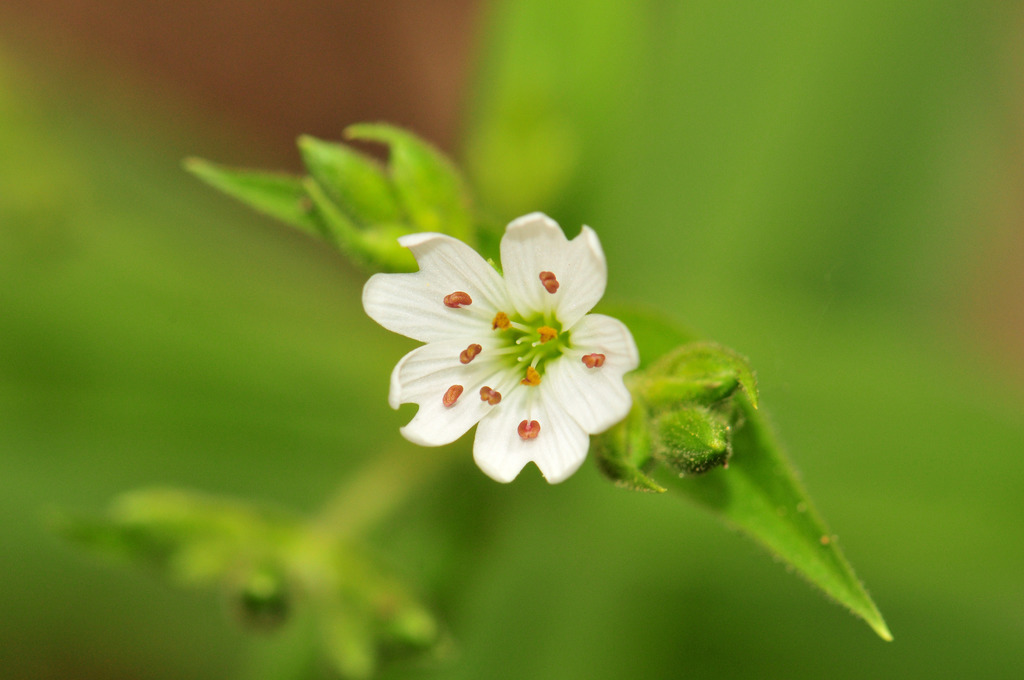
(c) Tom Kennedy, some rights reserved (CC BY) · licence
Family: Caryophyllaceae · Type: Herb · Native
Torreyostellaria jamesiana (Tuber starwort) is a native California herb in the Caryophyllaceae family, recognized by Only Torreyostellaria species in CA, distinguished from Stellaria by tuberous rhizome structures.
Tuber starwort is a California native perennial found in the Klamath Ranges, northern Coast Ranges, Cascade Range, Sierra Nevada, western Transverse Ranges, and Modoc Plateau in meadows, sagebrush-grassland, and dry conifer forest understory at elevations of 1,400 to 2,700 meters. Flowering during summer, this plant produces delicate white flowers with purple anthers, forming small clusters in leafy cymes. Growing 12 to 45 centimeters tall with ascending to erect stems that are distinctively 4-angled and glandular-hairy, it develops unique spherical to elongate tuber-like thickenings at its base. Its leaves are linear to lanceolate, 15 to 150 millimeters long, with a single vein and margins ranging from smooth to slightly roughened. The fruit is a spherical capsule with six valves, containing one to two reddish-brown seeds 2 to 3.4 millimeters long.
Identification and appearance
Key characters: Only Torreyostellaria species in CA, distinguished from Stellaria by tuberous rhizome structures
Habitat and range
Habitat: Meadows, sagebrush-grassland, dry understory of conifer forest
Elevation: 1400-2700 m
California counties: Fresno, Kern, Lake, Alpine, Modoc, Butte, Lassen, Mariposa, Mendocino, Plumas, San Bernardino, Sierra, Siskiyou, Tehama, Trinity, Tulare, Tuolumne, El Dorado, Glenn, Nevada, Shasta, Ventura, Humboldt, Madera
Outside California: to Washington, Montana, Colorado, Texas
Bloom period
Torreyostellaria jamesiana blooms Summer.
How to tell it apart
vs Stellaria: Torreyostellaria is glandular-hairy and grows from a rhizome bearing tuber-like swellings; true starworts (Stellaria) are glabrous or hairy-lined and lack tuberous roots.; vs Cerastium: Torreyostellaria petals are cleft nearly to the base into 2 narrow lobes; Cerastium petals are only shallowly notched at the tip and the plant is densely soft-hairy throughout.; vs Arenaria: Torreyostellaria has deeply 2-lobed white petals; sandworts (Arenaria) have entire, unnotched petals.; vs Eremogone: Torreyostellaria is a rhizomatous, glandular herb with cleft petals; Eremogone is a tufted, mat-forming plant with awl-like leaves and entire petals.; vs Silene: Torreyostellaria flowers have separate spreading petals above 5 small free sepals; Silene flowers sit in a tubular, often inflated calyx with clawed, appendaged petals.
Frequently asked questions
Is Torreyostellaria jamesiana native to California?
Yes. Torreyostellaria jamesiana is native to California (recorded as native).
When does Torreyostellaria jamesiana bloom?
Torreyostellaria jamesiana blooms Summer.
Where in California does Torreyostellaria jamesiana grow?
Torreyostellaria jamesiana occurs in Fresno, Kern, Lake, Alpine, Modoc, Butte, Lassen, Mariposa and other counties, at elevations of 1400-2700 m.
What plant family does Torreyostellaria jamesiana belong to?
Torreyostellaria jamesiana is in the Caryophyllaceae family, genus Torreyostellaria.
What habitat does Torreyostellaria jamesiana grow in?
Torreyostellaria jamesiana grows in Meadows, sagebrush-grassland, dry understory of conifer forest.
Related species
Other California species in the same genus, family, or bioregion.
Sources: Jepson eFlora · Index of California Plant Names · CalPhotos
Last updated 2026-10-07
Data from The California Species Project — 14,000+ California species with verified data from CNPS, CDFW, USFWS, Cal-IPC, and more.