Toxicoscordion fontanum
Marsh zigadenus
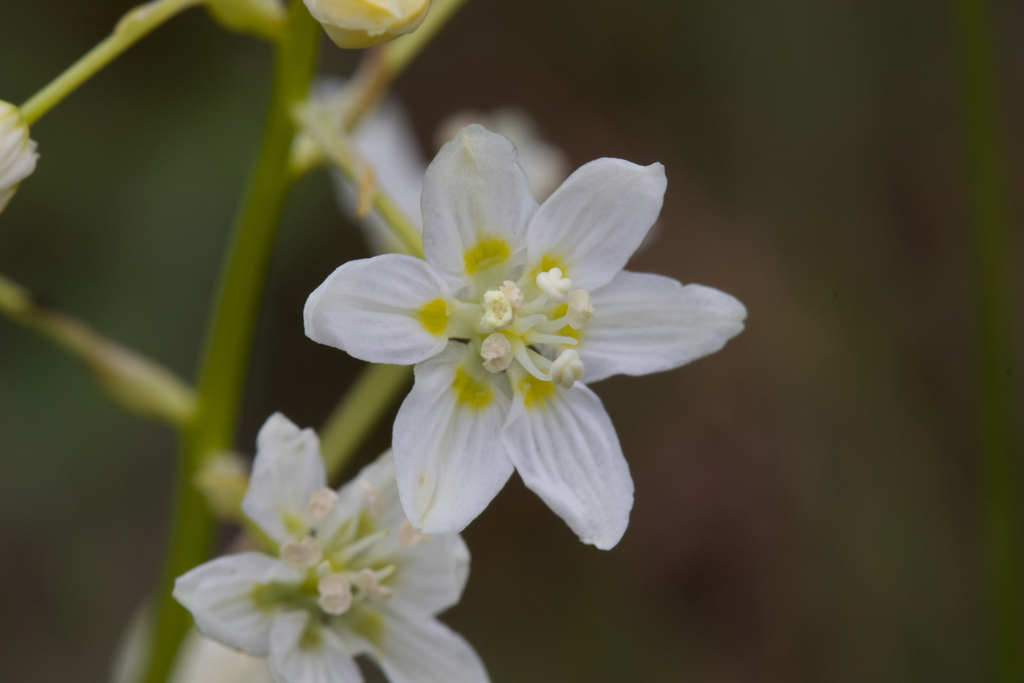
(c) Arvel Hernandez, some rights reserved (CC BY) · licence
Family: Melanthiaceae · Type: Perennial · Native
Conservation status: CNPS 4.2
Toxicoscordion fontanum (Marsh zigadenus) is a native California perennial in the Melanthiaceae family, recognized by marshy habitat and low elevation.
Marsh zigadenus is a California native perennial found in northern California coastal ranges, San Francisco Bay Area, and south-central coastal ranges in vernally moist or serpentine areas at elevations below 500 meters. Flowering from March to August, this plant produces white to cream-colored flowers with delicate ovate perianth parts 4 to 12 millimeters long. Growing with tall stems 60 to 80 centimeters high, it emerges from a substantial bulb 25 to 45 millimeters in diameter with a brown outer coating. Its leaves are erect, often exceeding the stem height and reaching 10 to 25 millimeters wide, with an elegant vertical structure. The plant develops a branching panicle inflorescence with green bracts 5 to 35 millimeters long, bearing pedicels that spread and curve upward in fruit.
Identification and appearance
Key characters: Co-occurs with 4 species; marshy habitat and low elevation are diagnostic
Habitat and range
Habitat: Vernally moist or marshy areas, often serpentine
Elevation: < 500 m
California counties: Sonoma, Marin, Lake, San Benito, San Luis Obispo, Monterey, Napa, Colusa, Santa Cruz
Bloom period
Toxicoscordion fontanum blooms Mar-Aug.
Conservation status
CNPS 4.2
How to tell it apart
vs Zigadenus: Zigadenus is an outdated synonym for Toxicoscordion - they are the same plant.; vs Chlorogalum: Toxicoscordion flowers have distinct glands at petal bases and open during the day, while soaproot flowers lack glands and open in evening.; vs Anticlea: Anticlea is another outdated synonym for Toxicoscordion - they are the same plant.; vs Nothoscordum: Toxicoscordion flowers have visible glands at petal bases and no onion smell, while false garlic lacks glands but smells mildly onion-like.; vs Allium: Crush a leaf - Allium smells strongly of onion, Toxicoscordion has no onion scent and shows glands at flower petal bases.
Frequently asked questions
Is Toxicoscordion fontanum native to California?
Yes. Toxicoscordion fontanum is native to California (recorded as native).
When does Toxicoscordion fontanum bloom?
Toxicoscordion fontanum blooms Mar-Aug.
Where in California does Toxicoscordion fontanum grow?
Toxicoscordion fontanum occurs in Sonoma, Marin, Lake, San Benito, San Luis Obispo, Monterey, Napa, Colusa and other counties, at elevations of < 500 m.
What plant family does Toxicoscordion fontanum belong to?
Toxicoscordion fontanum is in the Melanthiaceae family, genus Toxicoscordion.
Is Toxicoscordion fontanum rare or endangered?
Toxicoscordion fontanum carries California Rare Plant Rank 4.2, state rank S3.
Related species
Other California species in the same genus, family, or bioregion.
Sources: Jepson eFlora · CNPS Rare Plant Inventory · Index of California Plant Names · CalPhotos · CDFW CNDDB
Last updated 2026-09-30
Data from The California Species Project — 14,000+ California species with verified data from CNPS, CDFW, USFWS, Cal-IPC, and more.