Toxicoscordion fremontii
Fremont's death camas
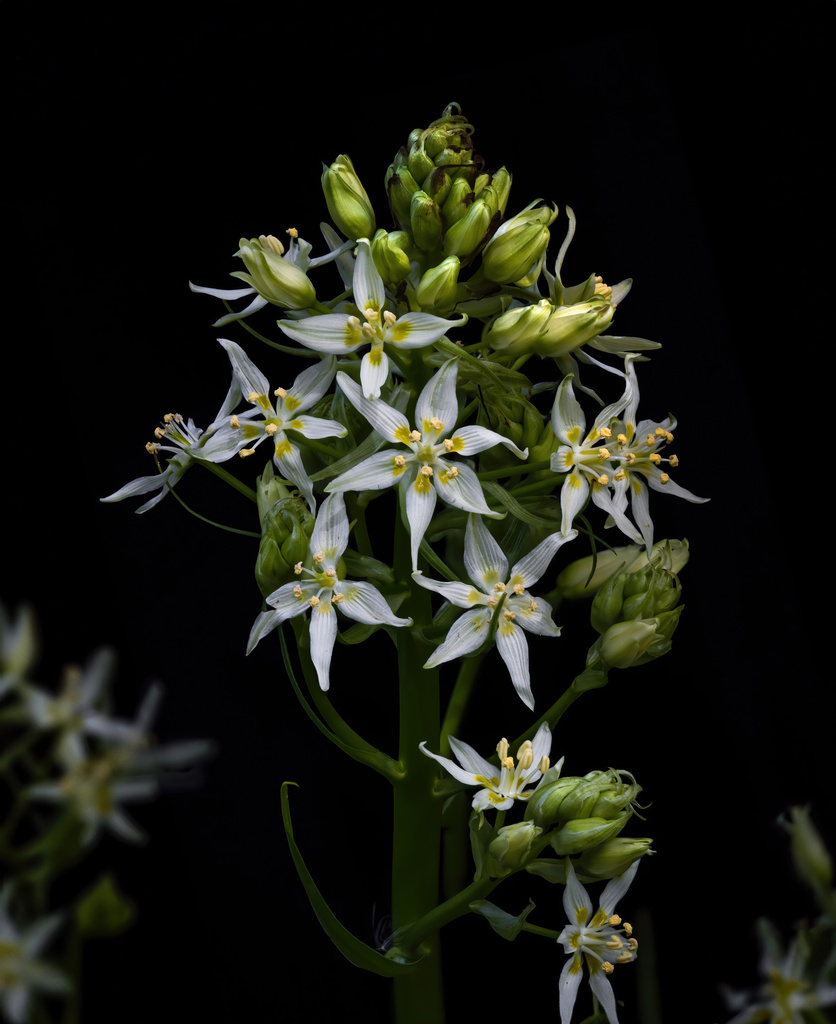
(c) Alan Rockefeller, some rights reserved (CC BY) · licence
Family: Melanthiaceae · Type: Herb · Native
Toxicoscordion fremontii (Fremont's death camas) is a native California herb in the Melanthiaceae family, recognized by curved leaves and black bulb coat are key features.
Fremont's death camas is a California native perennial found in northwestern California, central Sierra Nevada foothills, Sacramento Valley, central western, and southwestern regions in grassy or wooded slopes and outcrops at elevations below 1,000 meters. Flowering from February to June, this plant produces white to cream-colored flowers in open panicles or racemes 5 to 40 centimeters long. Growing with tall, glabrous stems 40 to 90 centimeters tall emerging from a nearly spheric black-coated bulb 20 to 35 millimeters in diameter, it has an elegant, upright structure. Its leaves are long and curved, measuring 20 to 50 centimeters in length and 8 to 30 millimeters wide, with scabrous-ciliate margins that add texture to the plant's appearance. The fruit develops as a cylindric capsule 10 to 35 millimeters long, characteristic of this distinctive death camas species.
Identification and appearance
Key characters: Co-occurs with 6 species; curved leaves and black bulb coat are key features
Habitat and range
Habitat: Grassy or wooded slopes, outcrops
Elevation: < 1000 m
California counties: Santa Barbara, San Benito, Marin, Butte, Monterey, Tehama, Mendocino, Santa Clara, Los Angeles, Colusa, Solano, Glenn, Alameda, Napa, Sonoma, Contra Costa, San Diego, San Mateo, San Luis Obispo, Ventura, Merced, Orange, San Francisco, Lake, Riverside, Santa Cruz, Yolo, Shasta, El Dorado, Nevada, Alpine
Outside California: Oregon, northern Baja California
Bloom period
Toxicoscordion fremontii blooms Feb-Jun.
How to tell it apart
vs Zigadenus: Zigadenus is an outdated synonym for Toxicoscordion - they are the same plant.; vs Chlorogalum: Toxicoscordion flowers have distinct glands at petal bases and open during the day, while soaproot flowers lack glands and open in evening.; vs Anticlea: Anticlea is another outdated synonym for Toxicoscordion - they are the same plant.; vs Nothoscordum: Toxicoscordion flowers have visible glands at petal bases and no onion smell, while false garlic lacks glands but smells mildly onion-like.; vs Allium: Crush a leaf - Allium smells strongly of onion, Toxicoscordion has no onion scent and shows glands at flower petal bases.
Frequently asked questions
Is Toxicoscordion fremontii native to California?
Yes. Toxicoscordion fremontii is native to California (recorded as native).
When does Toxicoscordion fremontii bloom?
Toxicoscordion fremontii blooms Feb-Jun.
Where in California does Toxicoscordion fremontii grow?
Toxicoscordion fremontii occurs in Santa Barbara, San Benito, Marin, Butte, Monterey, Tehama, Mendocino, Santa Clara and other counties, at elevations of < 1000 m.
What plant family does Toxicoscordion fremontii belong to?
Toxicoscordion fremontii is in the Melanthiaceae family, genus Toxicoscordion.
What habitat does Toxicoscordion fremontii grow in?
Toxicoscordion fremontii grows in Grassy or wooded slopes, outcrops.
Related species
Other California species in the same genus, family, or bioregion.
Sources: Jepson eFlora · Index of California Plant Names · CalPhotos
Last updated 2026-10-07
Data from The California Species Project — 14,000+ California species with verified data from CNPS, CDFW, USFWS, Cal-IPC, and more.