Toxicoscordion venenosum var. venenosum
Meadow deathcamas
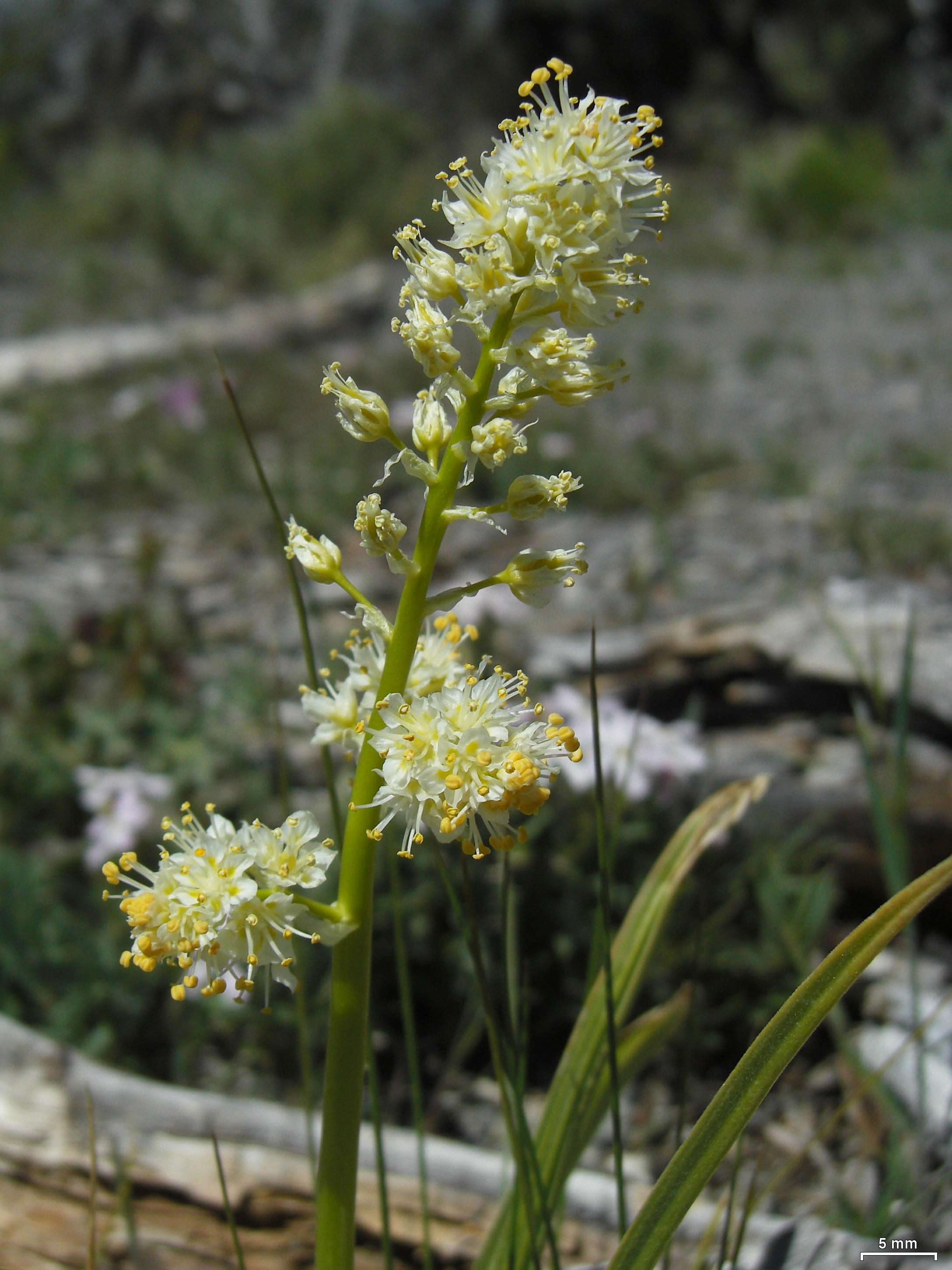
Jason Hollinger (via Wikimedia Commons) · CC BY
Family: Melanthiaceae · Type: Herb · Native
Toxicoscordion venenosum var. venenosum (Meadow deathcamas) is a native California herb in the Melanthiaceae family, recognized by raceme inflorescence and brown bulb coat help distinguish it.
Meadow deathcamas is a California native perennial found in northwestern California, Cascade Range, Sierra Nevada, central western California, western Transverse Ranges, Peninsular Ranges, Great Basin, and Desert Mountains in moist meadows to dry rocky hillsides at elevations below 2,600 meters. Flowering from May to July, this plant produces white to cream-colored flowers in elongated racemes 5 to 25 centimeters long with distinctive white-membranous to green bracts. Growing with slender stems 15 to 70 centimeters tall, it emerges from a widely ovate bulb 12 to 25 millimeters in diameter with a brownish outer coat. Its leaves are long and narrow, reaching 10 to 40 centimeters in length and 4 to 10 millimeters wide, with scabrous-ciliate margins. The fruit is a cylindric capsule 8 to 14 millimeters long, containing numerous small seeds.
Identification and appearance
Key characters: Co-occurs with 6 species; raceme inflorescence and brown bulb coat help distinguish it
Habitat and range
Habitat: Moist meadows to dry rocky hillsides
Elevation: < 2600 m
California counties: Inyo, Kern, Siskiyou, Butte, Shasta, Lassen, Plumas, Santa Clara, Glenn, Calaveras, Modoc, Amador, Nevada, Tehama, Alameda, Santa Barbara, Merced, San Luis Obispo, Monterey, San Diego, Mariposa, Del Norte, Madera, Riverside, Mono, Sierra, Tuolumne, Placer, El Dorado, Napa, Lake, Fresno, San Benito, Tulare, Colusa, Alpine
Outside California: to British Columbia, central United States, Arizona, northern Baja California
Bloom period
Toxicoscordion venenosum var. venenosum blooms May-Jul.
How to tell it apart
vs Zigadenus: Zigadenus is an outdated synonym for Toxicoscordion - they are the same plant.; vs Chlorogalum: Toxicoscordion flowers have distinct glands at petal bases and open during the day, while soaproot flowers lack glands and open in evening.; vs Anticlea: Anticlea is another outdated synonym for Toxicoscordion - they are the same plant.; vs Nothoscordum: Toxicoscordion flowers have visible glands at petal bases and no onion smell, while false garlic lacks glands but smells mildly onion-like.; vs Allium: Crush a leaf - Allium smells strongly of onion, Toxicoscordion has no onion scent and shows glands at flower petal bases.
Frequently asked questions
Is Toxicoscordion venenosum var. venenosum native to California?
Yes. Toxicoscordion venenosum var. venenosum is native to California (recorded as native).
When does Toxicoscordion venenosum var. venenosum bloom?
Toxicoscordion venenosum var. venenosum blooms May-Jul.
Where in California does Toxicoscordion venenosum var. venenosum grow?
Toxicoscordion venenosum var. venenosum occurs in Inyo, Kern, Siskiyou, Butte, Shasta, Lassen, Plumas, Santa Clara and other counties, at elevations of < 2600 m.
What plant family does Toxicoscordion venenosum var. venenosum belong to?
Toxicoscordion venenosum var. venenosum is in the Melanthiaceae family, genus Toxicoscordion.
What habitat does Toxicoscordion venenosum var. venenosum grow in?
Toxicoscordion venenosum var. venenosum grows in Moist meadows to dry rocky hillsides.
Related species
Other California species in the same genus, family, or bioregion.
- Toxicoscordion brevibracteatum — Desert death camas
- Toxicoscordion exaltatum — Giant death camas
- Toxicoscordion fontanum — Marsh zigadenus
- Toxicoscordion fremontii — Fremont's death camas
- Toxicoscordion micranthum — Small flowered star lily
- Toxicoscordion paniculatum — Foothill deathcamas
- Trillium albidum — Giant white wakerobin
- Trillium angustipetalum — Narrow petaled wakerobin
- Trillium chloropetalum — Giant trillium
- Trillium oettingeri — Salmon mountains wakerobin
Sources: Jepson eFlora · Index of California Plant Names · CalPhotos
Last updated 2026-10-07
Data from The California Species Project — 14,000+ California species with verified data from CNPS, CDFW, USFWS, Cal-IPC, and more.