Tragopogon dubius
Yellow salsify, Yellow Salsify
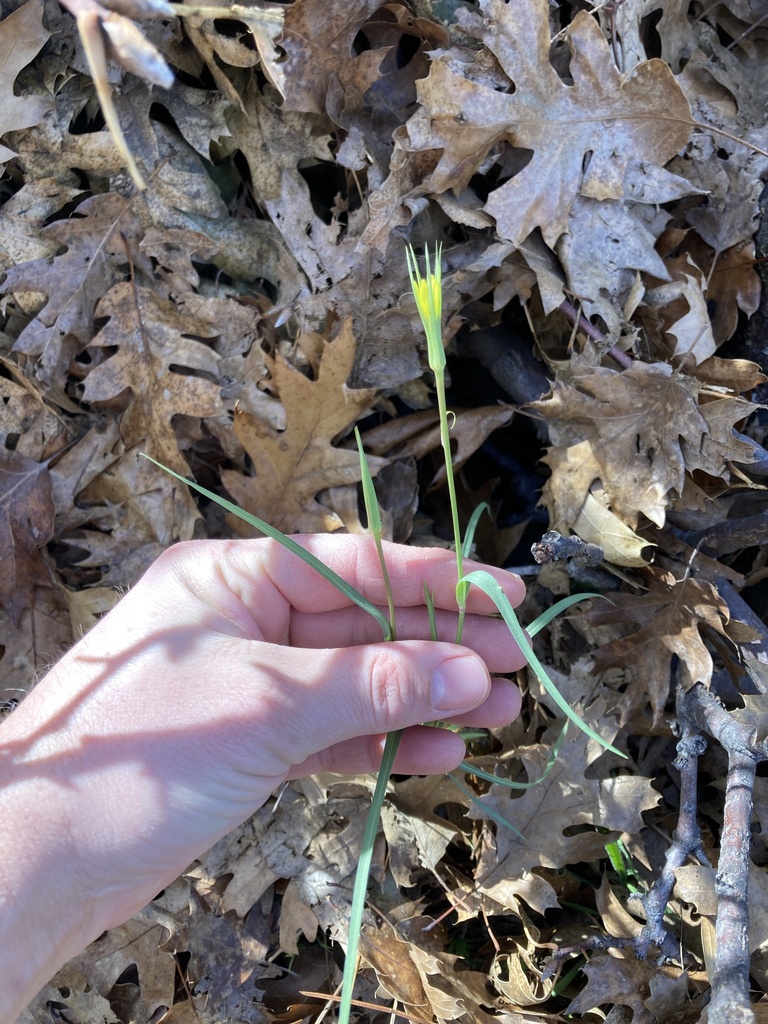
(c) Adam J. Searcy, some rights reserved (CC BY) · licence
Family: Asteraceae · Type: Herb · Not Native
Tragopogon dubius (Yellow salsify) is a non-native California herb in the Asteraceae family, recognized by pale yellow flowers and phyllaries much exceeding flowers.
Yellow salsify is a naturalized annual found in the Klamath Ranges, northern California mountains, Sierra Nevada, Central Valley, central western California, southern California coastal areas, Transverse Ranges, Peninsular Ranges, and Great Basin in disturbed places at elevations below 2,700 meters. Flowering from May to September, this plant produces pale lemon-yellow flowers in large heads up to 4 centimeters wide that dramatically expand when forming fruit. Growing with tall, slender stems 30 to 100 centimeters high, it develops elongated stems that become noticeably wider at the tip. Its leaves are long and narrow, extending 20 to 50 centimeters with straight tips that are initially slightly hairy but quickly become smooth. The mature fruit develops into a distinctive white-plumed seed head approximately 25 to 35 millimeters long, characteristic of the salsify genus.
Identification and appearance
Key characters: 2 sympatric species; key features are pale yellow flowers and phyllaries much exceeding flowers
Habitat and range
Habitat: Uncommon. Disturbed places
Elevation: < 2700 m
Outside California: native to Europe
Bloom period
Tragopogon dubius blooms May-Sep.
How to tell it apart
vs Agoseris: Tragopogon has grass-like leaves that clasp the stem; Agoseris has basal rosettes of broader leaves; vs Taraxacum: Tragopogon grows tall with grass-like stem-clasping leaves; dandelion has only basal leaves in a rosette; vs Uropappus: Tragopogon has single row of bracts extending past petals; Uropappus has shorter overlapping bracts; vs Stebbinsoseris: Tragopogon has tall grass-like leaves clasping stem; Stebbinsoseris has small basal leaves only; vs Allium: Tragopogon flowers close by midday and lack onion smell; Allium stays open and smells like onion
Frequently asked questions
Is Tragopogon dubius native to California?
No. Tragopogon dubius is not native to California (recorded as not native).
When does Tragopogon dubius bloom?
Tragopogon dubius blooms May-Sep.
What plant family does Tragopogon dubius belong to?
Tragopogon dubius is in the Asteraceae family, genus Tragopogon.
What habitat does Tragopogon dubius grow in?
Tragopogon dubius grows in Uncommon. Disturbed places.
Related species
Other California species in the same genus, family, or bioregion.
Sources: Jepson eFlora · Index of California Plant Names · CalPhotos
Last updated 2026-10-07
Data from The California Species Project — 14,000+ California species with verified data from CNPS, CDFW, USFWS, Cal-IPC, and more.