Trautvetteria caroliniensis
Carolina bugbane
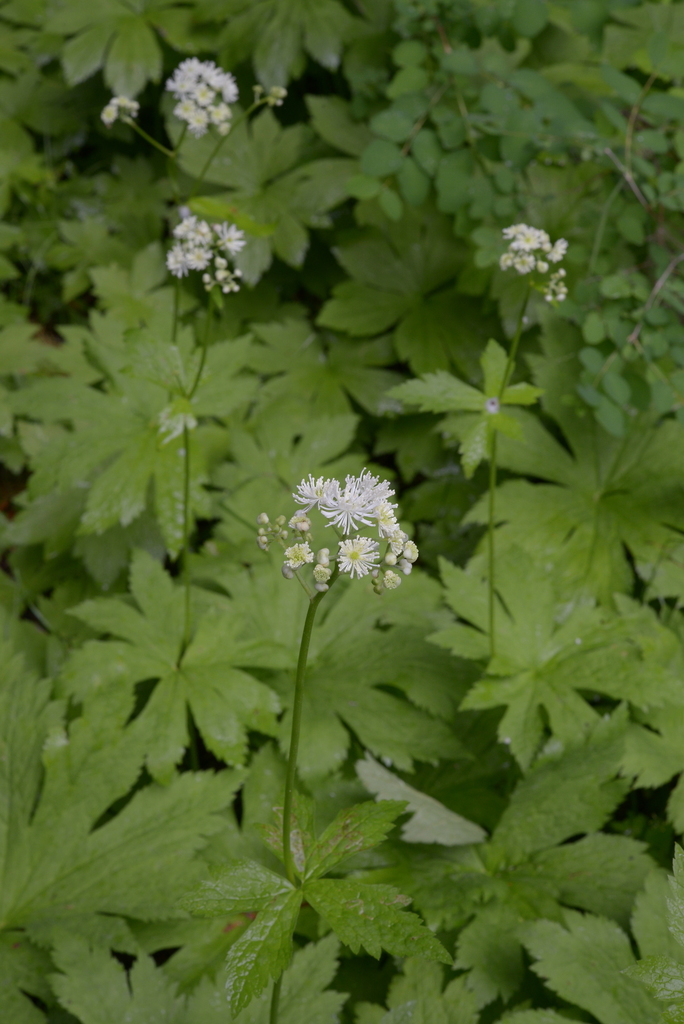
(c) Ed Alverson, some rights reserved (CC BY), uploaded by Ed Alverson · licence
Family: Ranunculaceae · Type: Herb · Native
Trautvetteria caroliniensis (Carolina bugbane) is a native California herb in the Ranunculaceae family, recognized by Disjunct western population of primarily eastern North American genus.
Carolina bugbane is a California native perennial found in the Klamath Ranges and northern California Mountains in moist, shaded places and streambanks at elevations of 640 to 2,100 meters. Flowering from July to August, this plant produces white-green flowers in small clusters with delicate, cup-like sepals. Growing impressively tall at 1 to 1.5 meters with generally glabrous stems, it develops a striking vertical form. Its large basal leaves have 5 to 11 wedge-shaped lobes with teeth near the tips, supported by long petioles up to 45 centimeters long. The plant produces small, 4-angled fruits approximately 2.5 to 4.5 millimeters long.
Identification and appearance
Key characters: Disjunct western population of primarily eastern North American genus
Habitat and range
Habitat: Moist, shaded places, streambanks
Elevation: 640-2100 m
California counties: Fresno, Butte, Calaveras, Del Norte, Humboldt, Plumas, Trinity, Siskiyou, Yuba
Outside California: to British Columbia, Montana, Wyoming, New Mexico, also eastern United States, eastern Asia
Bloom period
Trautvetteria caroliniensis blooms Jul-Aug.
How to tell it apart
vs Thalictrum: Trautvetteria has simple deeply lobed leaves; Thalictrum has compound leaves with distinct separate leaflets.; vs Adonis: Trautvetteria has no petals and simple lobed leaves; Adonis has colorful yellow-orange petals and feathery fern-like foliage.; vs Ranunculus: Trautvetteria lacks petals entirely and has large simple lobed leaves; Ranunculus has glossy petals with nectaries.; vs Clematis: Trautvetteria is an upright herb with simple lobed leaves; Clematis is a woody vine with compound opposite leaves.; vs Anemone: Trautvetteria has large simple lobed leaves; Anemone has basal leaves with a whorl of bracts below flowers.
Frequently asked questions
Is Trautvetteria caroliniensis native to California?
Yes. Trautvetteria caroliniensis is native to California (recorded as native).
When does Trautvetteria caroliniensis bloom?
Trautvetteria caroliniensis blooms Jul-Aug.
Where in California does Trautvetteria caroliniensis grow?
Trautvetteria caroliniensis occurs in Fresno, Butte, Calaveras, Del Norte, Humboldt, Plumas, Trinity, Siskiyou and other counties, at elevations of 640-2100 m.
What plant family does Trautvetteria caroliniensis belong to?
Trautvetteria caroliniensis is in the Ranunculaceae family, genus Trautvetteria.
What habitat does Trautvetteria caroliniensis grow in?
Trautvetteria caroliniensis grows in Moist, shaded places, streambanks.
Related species
Other California species in the same genus, family, or bioregion.
Sources: Jepson eFlora · Index of California Plant Names · CalPhotos
Last updated 2026-10-07
Data from The California Species Project — 14,000+ California species with verified data from CNPS, CDFW, USFWS, Cal-IPC, and more.