Triantha occidentalis subsp. occidentalis
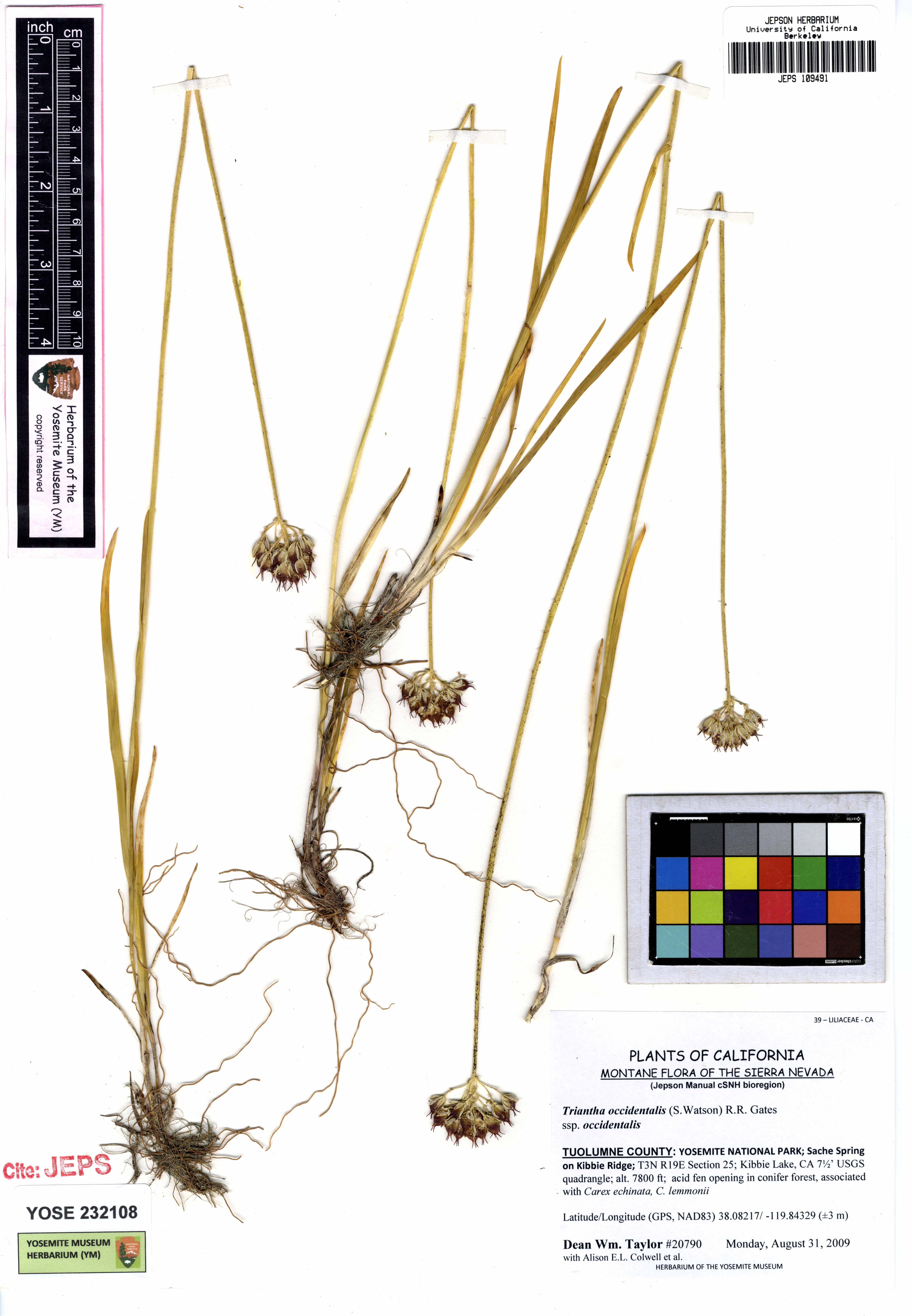
Dean Wm. Taylor (via Wikimedia Commons) · CC BY
Family: Tofieldiaceae · Type: Herb · Native
Triantha occidentalis subsp. occidentalis is a native California herb in the Tofieldiaceae family, recognized by Family Tofieldiaceae has very few representatives in California; northern disjunct distribution.
western triantha is a California native perennial found in northwestern California, the Cascade Range, and Sierra Nevada Mountains in wet meadows and bogs at elevations below 3,100 meters. Flowering from July to September, this plant produces small spheric to ovoid-cylindric flower clusters with delicate white or pale perianth parts. Growing with slender stems 5 to 20 centimeters tall, it forms compact clusters in moist mountain environments. Its narrow leaves measure 3 to 8 millimeters wide and extend 5 to 20 centimeters in length, with distinctive oblong-ovate perianth segments. The fruit contains generally one reddish-brown seed approximately 0.5 to 1.5 millimeters long.
Identification and appearance
Key characters: Family Tofieldiaceae has very few representatives in California; northern disjunct distribution
Habitat and range
Habitat: Wet meadows, bogs
Elevation: < 3100 m
California counties: Mendocino, Tulare, Siskiyou, Butte, El Dorado, Glenn, Lake, Madera, Marin, Mariposa, Mono, Placer, Sierra, Tuolumne, Del Norte, Fresno, Humboldt, Inyo, Sonoma, Shasta, Trinity, Nevada, Plumas, Lassen, Tehama
Outside California: southwestern Oregon
Bloom period
Triantha occidentalis subsp. occidentalis blooms Jul-Sep.
How to tell it apart
vs Toxicoscordion: Triantha has flat, iris-like (equitant) basal leaves and a glandular-sticky flower stalk; death camas (Toxicoscordion) grows from a bulb with keeled, channeled leaves and a smooth stem.; vs Sisyrinchium: Triantha bears many small, white, 6-tepaled flowers packed in a dense head; blue-eyed grass (Sisyrinchium) has few, larger, blue-purple flowers on a winged stem.; vs Narthecium: Triantha crowds its flowers into a short spheric to ovoid cluster; bog asphodel (Narthecium) has yellow flowers in an elongate raceme with woolly filaments.; vs Xerophyllum: Triantha is a small bog plant a few dm tall; beargrass (Xerophyllum) is a large plant with a huge, dense club of flowers over wiry, grass-like foliage.; vs Tofieldia: Triantha bears seeds with tail-like appendages at each end and its flowers come in small clusters of about three, whereas true Tofieldia (absent from the western range) has plainer seeds; the two share the head-like cluster and iris-like leaves.
Frequently asked questions
Is Triantha occidentalis subsp. occidentalis native to California?
Yes. Triantha occidentalis subsp. occidentalis is native to California (recorded as native).
When does Triantha occidentalis subsp. occidentalis bloom?
Triantha occidentalis subsp. occidentalis blooms Jul-Sep.
Where in California does Triantha occidentalis subsp. occidentalis grow?
Triantha occidentalis subsp. occidentalis occurs in Mendocino, Tulare, Siskiyou, Butte, El Dorado, Glenn, Lake, Madera and other counties, at elevations of < 3100 m.
What plant family does Triantha occidentalis subsp. occidentalis belong to?
Triantha occidentalis subsp. occidentalis is in the Tofieldiaceae family, genus Triantha.
What habitat does Triantha occidentalis subsp. occidentalis grow in?
Triantha occidentalis subsp. occidentalis grows in Wet meadows, bogs.
Related species
Other California species in the same genus, family, or bioregion.
Sources: Jepson eFlora · Index of California Plant Names · CalPhotos
Last updated 2026-10-07
Data from The California Species Project — 14,000+ California species with verified data from CNPS, CDFW, USFWS, Cal-IPC, and more.