Tribulus terrestris
Puncture vine
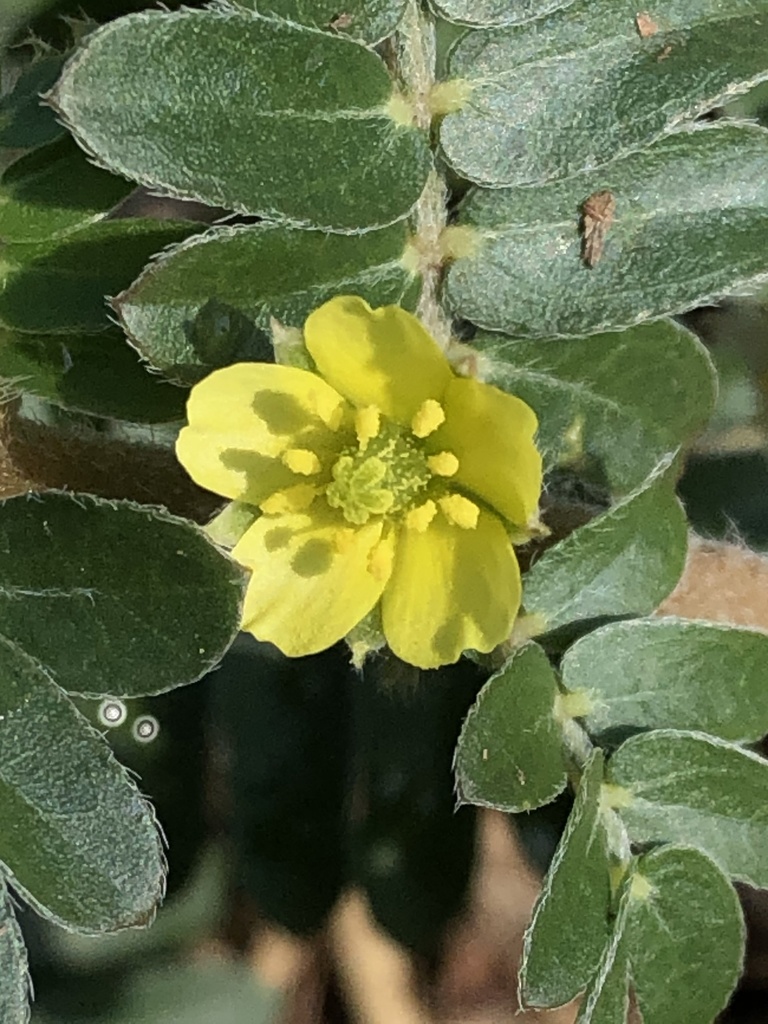
(c) Antonio W. Salas, some rights reserved (CC BY), uploaded by Antonio W. Salas · licence
Family: Zygophyllaceae · Type: Herb · Not Native
Conservation status: Cal-IPC Yes
Tribulus terrestris (Puncture vine) is a non-native California herb in the Zygophyllaceae family, recognized by Introduced Mediterranean species; distinctive spiny fruit morphology unique to Zygophyllaceae.
Puncture vine is a naturalized annual plant found in California's dry, disturbed areas including roadsides, railways, and vacant lots at elevations generally below 1,000 meters. Flowering from April to October, this plant produces small yellow flowers less than 5 millimeters wide with delicate pedicels. Growing with spreading stems that are silky or appressed-hairy and sharply bristly, it forms low-spreading ground cover. Its compound leaves have 6 to 12 leaflets with small stipules 1 to 5 millimeters long. The distinctive fruit is a flat, hairy structure about 5 millimeters wide with 4 to 7 millimeter spreading spines that easily attach to clothing or animal fur.
Identification and appearance
Key characters: Introduced Mediterranean species; distinctive spiny fruit morphology unique to Zygophyllaceae
Habitat and range
Habitat: Dry, disturbed areas including roadsides, railways, vacant lots
Elevation: generally < 1000 m
California counties: San Bernardino, Los Angeles, Ventura, San Diego, Imperial, Riverside, Fresno, Siskiyou, Santa Clara, Merced, Orange, Kern, Inyo, Mariposa, Monterey, Mendocino, San Luis Obispo, Modoc, Tulare, Santa Barbara, Butte, Stanislaus, Yolo, Sutter, Amador, San Joaquin, Mono, El Dorado, Nevada, Marin, Tehama, Sonoma, Sacramento, Madera, Humboldt, Solano, Alameda, Placer, Contra Costa, Lassen, Glenn, Yuba, Shasta, Plumas, San Mateo, Kings, Santa Cruz
Outside California: to Wyoming, eastern United States, central Mexico, native to Mediterranean
Bloom period
Tribulus terrestris blooms Apr-Oct.
Conservation status
Cal-IPC Yes
How to tell it apart
vs Kallstroemia: Tribulus fruits have 2-4 stout puncturing spines; Kallstroemia fruits are merely bumpy without spines.; vs Euphorbia: Tribulus has compound feather-like leaves; Euphorbia has simple leaves and milky sap when broken.; vs Erodium: Tribulus fruits have short stout spines; Erodium fruits have long corkscrew-like beaks.; vs Malva: Tribulus has feather-like compound leaves; Malva has rounded lobed simple leaves.; vs Argentina: Tribulus has compound leaves with many small leaflets; Argentina has pinnate leaves with larger toothed leaflets.
Frequently asked questions
Is Tribulus terrestris native to California?
No. Tribulus terrestris is not native to California (recorded as not native).
When does Tribulus terrestris bloom?
Tribulus terrestris blooms Apr-Oct.
Where in California does Tribulus terrestris grow?
Tribulus terrestris occurs in San Bernardino, Los Angeles, Ventura, San Diego, Imperial, Riverside, Fresno, Siskiyou and other counties, at elevations of generally < 1000 m.
What plant family does Tribulus terrestris belong to?
Tribulus terrestris is in the Zygophyllaceae family, genus Tribulus.
Is Tribulus terrestris invasive in California?
Tribulus terrestris is listed by Cal-IPC with an invasiveness rating of Yes.
Related species
Other California species in the same genus, family, or bioregion.
Sources: Jepson eFlora · Index of California Plant Names · CalPhotos
Last updated 2026-10-07
Data from The California Species Project — 14,000+ California species with verified data from CNPS, CDFW, USFWS, Cal-IPC, and more.