Tricardia watsonii
Three hearts
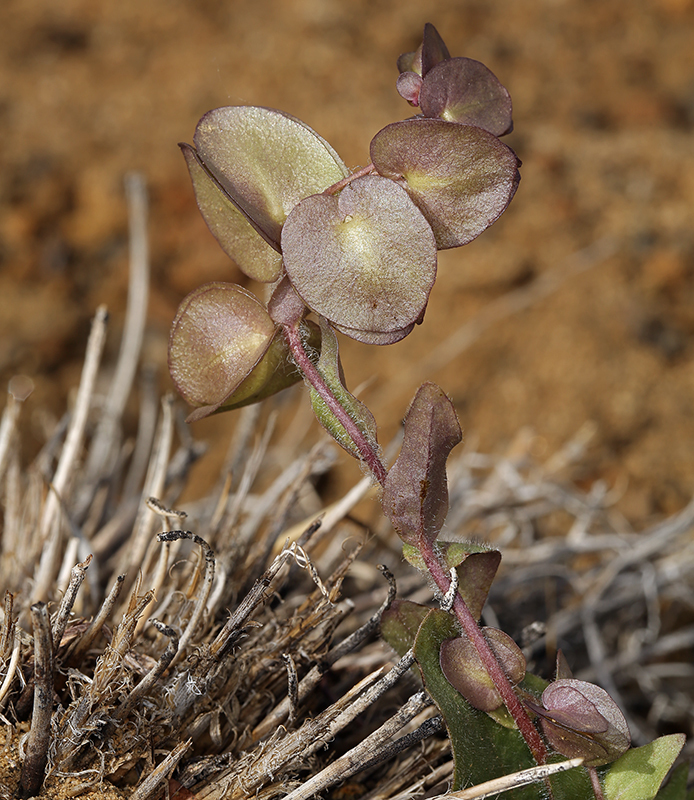
(c) Steve Matson, some rights reserved (CC BY), uploaded by Steve Matson · licence
Family: Hydrophyllaceae · Type: Herb · Native
Tricardia watsonii (Three hearts) is a native California herb in the Hydrophyllaceae family, recognized by Monotypic genus endemic to southwestern North America; distinctive calyx morphology.
Three hearts is a California native perennial found in southern California deserts, eastern Sierra Nevada, and Mojave Desert regions on sandy or gravelly desert slopes at elevations of 100 to 2,300 meters. Flowering from March to June, this plant produces white to cream flowers with lavender markings, bell-shaped and approximately 6 to 8 millimeters in diameter. Growing with erect stems 5 to 40 centimeters tall, it forms clusters of 1 to several stems from a woody taproot topped by a branched caudex. Its leaves are primarily arranged in a basal rosette, measuring 2 to 9 centimeters long with variable widths, and characterized by long soft hairs that become somewhat glabrous with age. The fruit develops into an oblong structure 7 to 9 millimeters long, containing 4 to 8 rough, brown seeds.
Identification and appearance
Key characters: Monotypic genus endemic to southwestern North America; distinctive calyx morphology
Habitat and range
Habitat: Sandy or gravelly desert slopes, flats, mountains, generally under shrubs
Elevation: 100-2300 m
California counties: Inyo, Kern, San Bernardino, Mono, Riverside, Alameda
Outside California: to Utah, Arizona
Bloom period
Tricardia watsonii blooms Mar-Jun.
How to tell it apart
vs Phacelia: Tricardia's 3 outer sepals enlarge into big, papery, net-veined heart shapes in fruit; Phacelia sepals stay small and narrow and its flowers uncoil from a scorpioid axis.; vs Emmenanthe: Tricardia has open flowers backed by heart-shaped sepals; whispering bells (Emmenanthe) has nodding pale-yellow bells with a papery persistent corolla and unmodified sepals.; vs Nemophila: Tricardia forms an erect, leafy-based plant with cordate, enlarging sepals; Nemophila is a weak, spreading annual with bowl-shaped, often spotted flowers and small sepals.; vs Eucrypta: Tricardia has entire leaves and heart-shaped fruiting sepals; Eucrypta has dissected, lobed leaves and small, unmodified sepals.; vs Hesperochiron: Tricardia is a hairy, erect desert plant with enlarged heart-shaped sepals; Hesperochiron is a small, stemless plant of wet meadows with flat rosette leaves and solitary saucer flowers.
Frequently asked questions
Is Tricardia watsonii native to California?
Yes. Tricardia watsonii is native to California (recorded as native).
When does Tricardia watsonii bloom?
Tricardia watsonii blooms Mar-Jun.
Where in California does Tricardia watsonii grow?
Tricardia watsonii occurs in Inyo, Kern, San Bernardino, Mono, Riverside, Alameda, at elevations of 100-2300 m.
What plant family does Tricardia watsonii belong to?
Tricardia watsonii is in the Hydrophyllaceae family, genus Tricardia.
What habitat does Tricardia watsonii grow in?
Tricardia watsonii grows in Sandy or gravelly desert slopes, flats, mountains, generally under shrubs.
Related species
Other California species in the same genus, family, or bioregion.
Sources: Jepson eFlora · Index of California Plant Names · CalPhotos
Last updated 2026-10-07
Data from The California Species Project — 14,000+ California species with verified data from CNPS, CDFW, USFWS, Cal-IPC, and more.