Trifolium albopurpureum
Indian clover
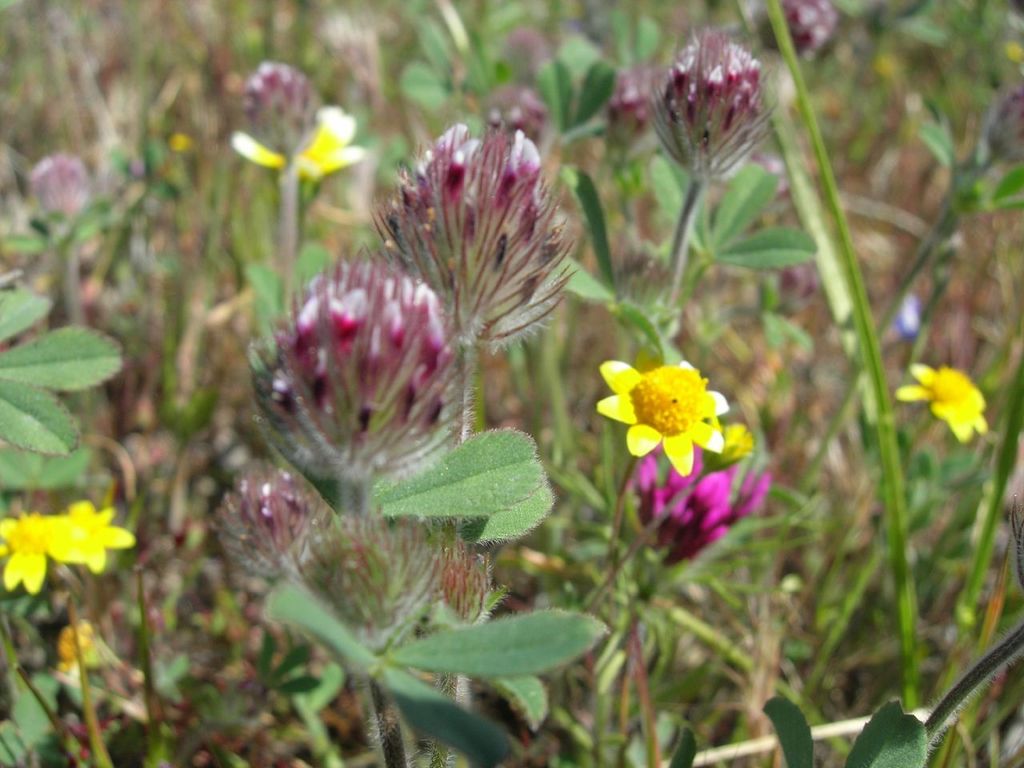
(c) Joe Decruyenaere, some rights reserved (CC BY-SA) · licence
Family: Fabaceae · Type: Herb · Native
Trifolium albopurpureum (Indian clover) is a native California herb in the Fabaceae family, recognized by distinctive bicolor flowers and plumose calyx diagnostic.
Indian clover is a California native annual herb found in the California Floristic Province in coastal dunes, grasslands, wet meadows, open slopes, oak chaparral, pine woodlands, and disturbed areas at elevations below 2,100 meters. Flowering from March to June, this plant produces distinctive two-colored flowers with purple and white petals in dense ovate spikes 5 to 20 millimeters wide. Growing with hairy stems that are decumbent to erect, typically 10 to 30 centimeters tall, it has a delicate branching habit. Its leaves have three leaflets, each 1 to 3 centimeters long, oblanceolate to obovate in shape, with small stipules at the leaf base. Small clusters of flowers feature calyxes 4 to 8 millimeters long with plumose lobes that are longer than the flower tube.
Identification and appearance
Key characters: 68 sympatric species; distinctive bicolor flowers and plumose calyx diagnostic
Habitat and range
Habitat: Abundant. Coastal dunes, grassland, wet meadows, open slopes, oak chaparral, pine woodland, roadsides, disturbed areas
Elevation: < 2100 m
California counties: Humboldt, Kern, San Diego, Riverside, Los Angeles, Santa Barbara, Tulare, San Luis Obispo, Ventura, San Bernardino, Monterey, Madera, Mariposa, Fresno, Tuolumne, Lake, Marin, Calaveras, Colusa, Amador, Santa Clara, San Mateo, Kings, Tehama, Napa, Trinity, Butte, Contra Costa, Siskiyou, Alameda, Santa Cruz, Solano, San Joaquin, El Dorado, Sutter, Sonoma, Merced, Shasta, Glenn, Yolo, Sacramento, Stanislaus, Mendocino, Del Norte, San Benito, Yuba, Nevada, Orange
Outside California: to British Columbia, Baja California
Bloom period
Trifolium albopurpureum blooms Mar-Jun.
How to tell it apart
vs Medicago: Trifolium flowers persist around fruits; Medicago flowers fall off leaving exposed coiled fruits.; vs Oxalis: Trifolium has pea-shaped flowers; wood-sorrels (Oxalis) have 5-petaled star-shaped flowers and heart-notched leaflets.; vs Melilotus: Trifolium flowers persist enclosing fruits; Melilotus flowers fall off leaving exposed ridged pods.; vs Castilleja: Trifolium has pea flowers and 3 toothed leaflets; paintbrush (Castilleja) has tubular flowers in colorful bracts.; vs Acmispon: Trifolium leaflets have toothed edges; Acmispon leaflets have smooth untoothed margins.
Frequently asked questions
Is Trifolium albopurpureum native to California?
Yes. Trifolium albopurpureum is native to California (recorded as native).
When does Trifolium albopurpureum bloom?
Trifolium albopurpureum blooms Mar-Jun.
Where in California does Trifolium albopurpureum grow?
Trifolium albopurpureum occurs in Humboldt, Kern, San Diego, Riverside, Los Angeles, Santa Barbara, Tulare, San Luis Obispo and other counties, at elevations of < 2100 m.
What plant family does Trifolium albopurpureum belong to?
Trifolium albopurpureum is in the Fabaceae family, genus Trifolium.
What habitat does Trifolium albopurpureum grow in?
Trifolium albopurpureum grows in Abundant. Coastal dunes, grassland, wet meadows, open slopes, oak chaparral, pine woodland, roadsides, disturbed areas.
Related species
Other California species in the same genus, family, or bioregion.
Sources: Jepson eFlora · Index of California Plant Names · CalPhotos
Last updated 2026-10-07
Data from The California Species Project — 14,000+ California species with verified data from CNPS, CDFW, USFWS, Cal-IPC, and more.