Trifolium campestre
Hop clover, Hop Clover
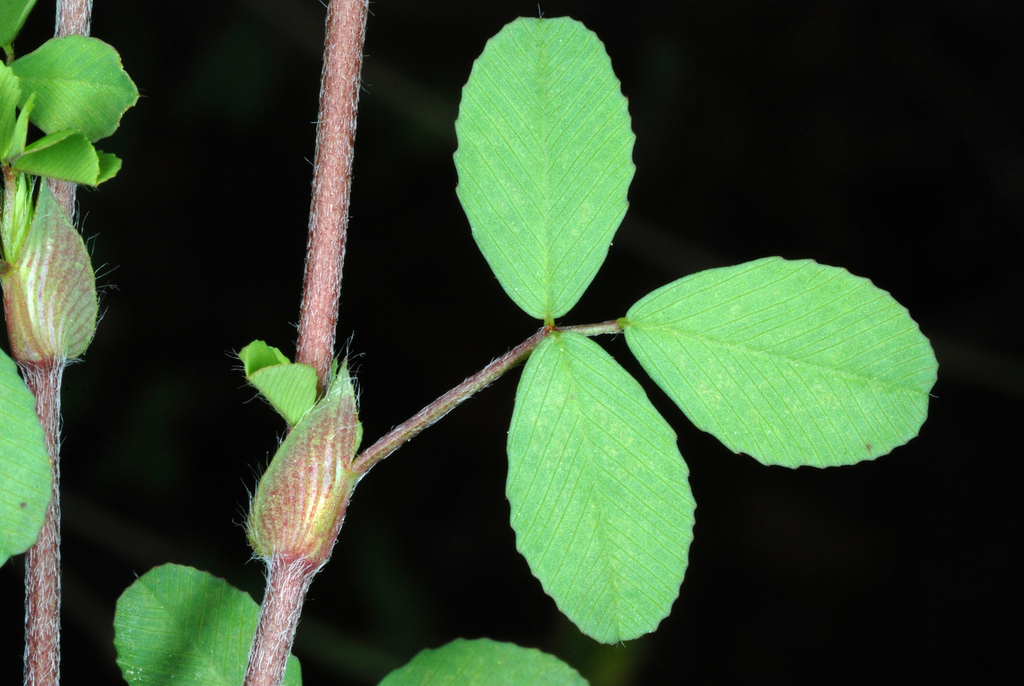
(c) Douglas Goldman, some rights reserved (CC BY-SA), uploaded by Douglas Goldman · licence
Family: Fabaceae · Type: Herb · Not Native
Trifolium campestre (Hop clover) is a non-native California herb in the Fabaceae family, recognized by general range description limits certainty.
Hop clover is a naturalized annual herb found in northern California's Central Valley and Foothill Provinces in disturbed areas and roadsides at elevations below 300 meters. Flowering from April to May, this plant produces bright yellow flowers in dense, spherical heads 8 to 13 millimeters wide that quickly turn brown with age. Growing with decumbent to erect puberulent stems, it spreads low across the ground in loose, sprawling clusters. Its leaves are compound with three leaflets, each obovate and measuring 0.6 to 1.5 centimeters long, supported by ovate stipules with petioles longer than the leaflets. The small, fragile fruits retain a persistent style less than one millimeter long.
Identification and appearance
Key characters: Geographically isolated; general range description limits certainty
Habitat and range
Habitat: Disturbed areas, roadsides
Elevation: especially < 300 m
California counties: Contra Costa, Marin, Amador, Humboldt, Los Angeles, San Francisco, Tulare, Santa Clara, San Mateo, Mendocino, Santa Barbara, Sacramento, Placer, Santa Cruz, Solano, Monterey, Butte, Tehama, Stanislaus, Glenn, San Luis Obispo, San Diego, Plumas, Napa, Riverside, Sonoma, Yolo, El Dorado, Shasta, Fresno
Outside California: most United States except Rocky Mountains, southwestern, native to Europe
Bloom period
Trifolium campestre blooms Apr-May.
How to tell it apart
vs Medicago: Trifolium flowers persist around fruits; Medicago flowers fall off leaving exposed coiled fruits.; vs Oxalis: Trifolium has pea-shaped flowers; wood-sorrels (Oxalis) have 5-petaled star-shaped flowers and heart-notched leaflets.; vs Melilotus: Trifolium flowers persist enclosing fruits; Melilotus flowers fall off leaving exposed ridged pods.; vs Castilleja: Trifolium has pea flowers and 3 toothed leaflets; paintbrush (Castilleja) has tubular flowers in colorful bracts.; vs Acmispon: Trifolium leaflets have toothed edges; Acmispon leaflets have smooth untoothed margins.
Frequently asked questions
Is Trifolium campestre native to California?
No. Trifolium campestre is not native to California (recorded as not native).
When does Trifolium campestre bloom?
Trifolium campestre blooms Apr-May.
Where in California does Trifolium campestre grow?
Trifolium campestre occurs in Contra Costa, Marin, Amador, Humboldt, Los Angeles, San Francisco, Tulare, Santa Clara and other counties, at elevations of especially < 300 m.
What plant family does Trifolium campestre belong to?
Trifolium campestre is in the Fabaceae family, genus Trifolium.
What habitat does Trifolium campestre grow in?
Trifolium campestre grows in Disturbed areas, roadsides.
Related species
Other California species in the same genus, family, or bioregion.
Sources: Jepson eFlora · Index of California Plant Names · CalPhotos
Last updated 2026-10-07
Data from The California Species Project — 14,000+ California species with verified data from CNPS, CDFW, USFWS, Cal-IPC, and more.