Trifolium depauperatum var. truncatum
Truncate sack clover, Truncate Sack Clover
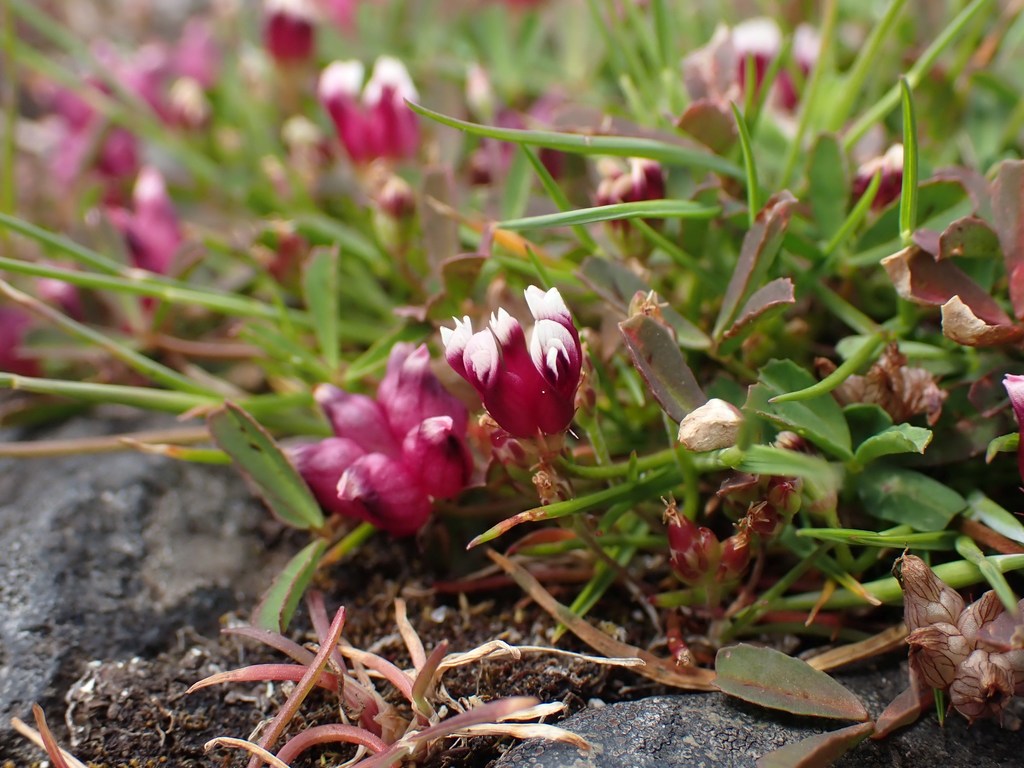
no rights reserved, uploaded by Ellyne Geurts · CC0
Family: Fabaceae · Type: Annual · Native
Trifolium depauperatum var. truncatum (Truncate sack clover) is a native California annual in the Fabaceae family, recognized by truncate leaflet tips and small involucre bracts diagnostic.
Truncate sack clover is a California native annual herb found in North Coast Ranges, Cascade Range, Sierra Nevada Foothills, Tehachapi Mountains, Central Valley, Central Western California, Southern California Coast, Channel Islands, and Peninsular Ranges in grassy flats, disturbed slopes, and woodland openings at elevations below 800 meters. Flowering from April to June, this plant produces small white to pale pink flowers in compact clusters with distinctive truncate leaflet tips. Growing with slender stems 10 to 30 centimeters tall, it forms delicate branching clusters across open grasslands. Its leaves have three leaflets that characteristically end in flattened or truncate tips with small teeth along the edges. The small ovate fruit is approximately 2 to 3 millimeters long, nearly equal in length to its style.
Identification and appearance
Key characters: 59 sympatric species; truncate leaflet tips and small involucre bracts diagnostic
Habitat and range
Habitat: Grassy flats, disturbed slopes, openings in woodland
Elevation: < 800 m
California counties: Los Angeles, Kern, Riverside, San Diego, Merced, Butte, Monterey, Contra Costa, San Benito, Tulare, San Luis Obispo, Sacramento, San Francisco, Sonoma, Orange, Madera, Santa Barbara, Santa Clara, Alameda, Ventura, San Bernardino, Marin, San Joaquin, Napa, Solano, Santa Cruz, Glenn, Colusa, Tehama, Shasta, El Dorado, Calaveras, Yolo, Fresno, Stanislaus, Lake, Tuolumne, San Mateo, Alpine
Bloom period
Trifolium depauperatum var. truncatum blooms Apr-Jun.
How to tell it apart
vs Medicago: Trifolium flowers persist around fruits; Medicago flowers fall off leaving exposed coiled fruits.; vs Oxalis: Trifolium has pea-shaped flowers; wood-sorrels (Oxalis) have 5-petaled star-shaped flowers and heart-notched leaflets.; vs Melilotus: Trifolium flowers persist enclosing fruits; Melilotus flowers fall off leaving exposed ridged pods.; vs Castilleja: Trifolium has pea flowers and 3 toothed leaflets; paintbrush (Castilleja) has tubular flowers in colorful bracts.; vs Acmispon: Trifolium leaflets have toothed edges; Acmispon leaflets have smooth untoothed margins.
Frequently asked questions
Is Trifolium depauperatum var. truncatum native to California?
Yes. Trifolium depauperatum var. truncatum is native to California (recorded as native).
When does Trifolium depauperatum var. truncatum bloom?
Trifolium depauperatum var. truncatum blooms Apr-Jun.
Where in California does Trifolium depauperatum var. truncatum grow?
Trifolium depauperatum var. truncatum occurs in Los Angeles, Kern, Riverside, San Diego, Merced, Butte, Monterey, Contra Costa and other counties, at elevations of < 800 m.
What plant family does Trifolium depauperatum var. truncatum belong to?
Trifolium depauperatum var. truncatum is in the Fabaceae family, genus Trifolium.
What habitat does Trifolium depauperatum var. truncatum grow in?
Trifolium depauperatum var. truncatum grows in Grassy flats, disturbed slopes, openings in woodland.
Related species
Other California species in the same genus, family, or bioregion.
Sources: Jepson eFlora · Index of California Plant Names · CalPhotos
Last updated 2026-10-06
Data from The California Species Project — 14,000+ California species with verified data from CNPS, CDFW, USFWS, Cal-IPC, and more.