Trifolium microcephalum
Small-head clover, Small-Head Clover
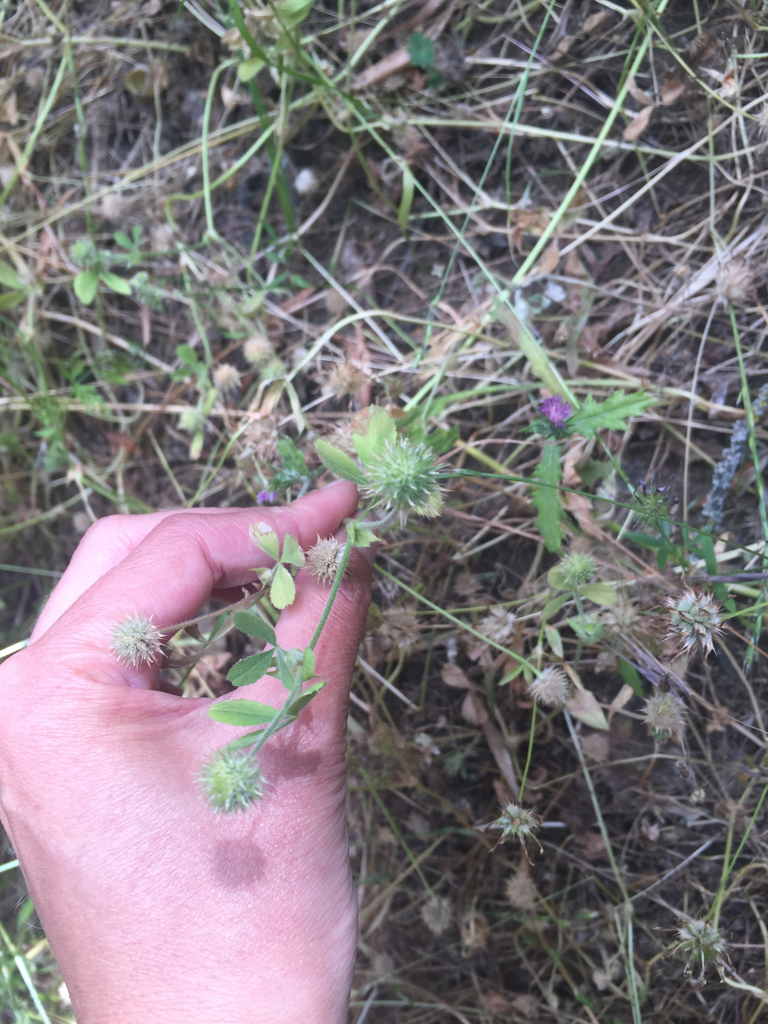
no rights reserved, uploaded by Kate Lusby · CC0
Family: Fabaceae · Type: Herb · Native
Trifolium microcephalum (Small-head clover) is a native California herb in the Fabaceae family, recognized by small bur-like fruiting heads and wavy hairs.
Small-head clover is a California native annual found in northwestern California, Sierra Nevada, Sacramento Valley, San Francisco Bay Area, southern Coast Ranges, southern California Coast, Channel Islands, western Transverse Ranges, San Bernardino Mountains, Peninsular Ranges, and Mojave Desert in streambanks, moist areas, roadsides, serpentine soils, and conifer forests at elevations of 0 to 2,700 meters. Flowering from April to August, this plant produces pink to lavender flowers in small, bur-like heads that become densely clustered. Growing with decumbent to erect stems that have finely wavy hairs, it reaches heights typical of annual clovers. Its leaves have three leaflets, each 0.8 to 2 centimeters long, generally obovate with a distinctively notched tip and stipules that are bristle-tipped. The flowers have a calyx 4 to 6 millimeters long with entire, bristle-tipped lobes that extend more than half the length of the tube.
Identification and appearance
Key characters: 65 sympatric species; small bur-like fruiting heads and wavy hairs
Habitat and range
Habitat: Streambanks, moist, disturbed areas, roadsides, serpentine, conifer forest
Elevation: 0-2700 m
California counties: El Dorado, San Luis Obispo, Kern, San Bernardino, Los Angeles, San Diego, Riverside, Fresno, Santa Barbara, Mariposa, Tulare, Modoc, Lake, San Mateo, Merced, Mendocino, Santa Clara, Madera, Napa, Monterey, Glenn, Santa Cruz, Humboldt, Butte, Inyo, San Francisco, Alameda, Amador, Marin, Trinity, Sacramento, Del Norte, Siskiyou, Tehama, Yolo, Placer, Orange, Tuolumne, Ventura, Solano, Plumas, Contra Costa, Alpine, Sutter, Nevada, Colusa, Calaveras, Sonoma, Shasta, Yuba, Sierra, San Benito, Stanislaus, San Joaquin, Lassen, Mono
Outside California: to British Columbia, Idaho, Arizona, Mexico
Bloom period
Trifolium microcephalum blooms Apr-Aug.
How to tell it apart
vs Medicago: Trifolium flowers persist around fruits; Medicago flowers fall off leaving exposed coiled fruits.; vs Oxalis: Trifolium has pea-shaped flowers; wood-sorrels (Oxalis) have 5-petaled star-shaped flowers and heart-notched leaflets.; vs Melilotus: Trifolium flowers persist enclosing fruits; Melilotus flowers fall off leaving exposed ridged pods.; vs Castilleja: Trifolium has pea flowers and 3 toothed leaflets; paintbrush (Castilleja) has tubular flowers in colorful bracts.; vs Acmispon: Trifolium leaflets have toothed edges; Acmispon leaflets have smooth untoothed margins.
Frequently asked questions
Is Trifolium microcephalum native to California?
Yes. Trifolium microcephalum is native to California (recorded as native).
When does Trifolium microcephalum bloom?
Trifolium microcephalum blooms Apr-Aug.
Where in California does Trifolium microcephalum grow?
Trifolium microcephalum occurs in El Dorado, San Luis Obispo, Kern, San Bernardino, Los Angeles, San Diego, Riverside, Fresno and other counties, at elevations of 0-2700 m.
What plant family does Trifolium microcephalum belong to?
Trifolium microcephalum is in the Fabaceae family, genus Trifolium.
What habitat does Trifolium microcephalum grow in?
Trifolium microcephalum grows in Streambanks, moist, disturbed areas, roadsides, serpentine, conifer forest.
Related species
Other California species in the same genus, family, or bioregion.
Sources: Jepson eFlora · Index of California Plant Names · CalPhotos
Last updated 2026-10-07
Data from The California Species Project — 14,000+ California species with verified data from CNPS, CDFW, USFWS, Cal-IPC, and more.