Triglochin maritima
Common arrow-grass, Common Arrow-Grass
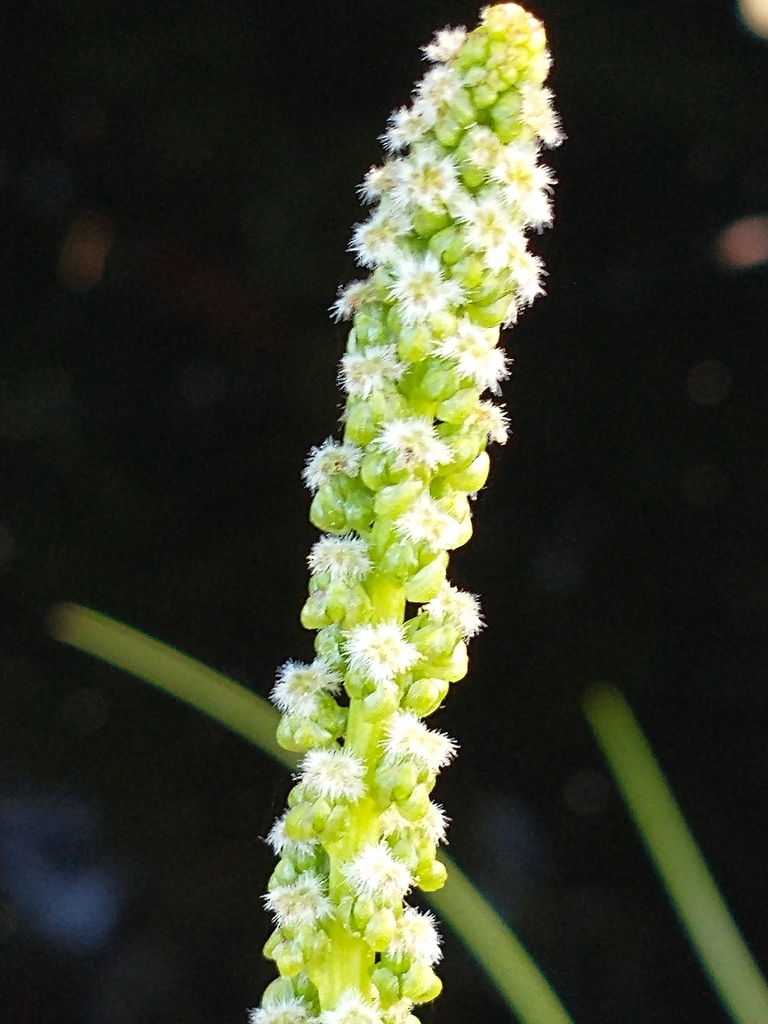
(c) Tom Norton, some rights reserved (CC BY) · licence
Family: Juncaginaceae · Type: Grass · Native
Triglochin maritima (Common arrow-grass) is a native California grass in the Juncaginaceae family, recognized by distinguished primarily by large size and robust habit.
Common arrow-grass is a California native perennial found in coastal regions including Northern California Coast, Klamath Ranges, California Ranges, Sierra Nevada, southwestern Sacramento Valley, Central Coast, San Francisco Bay Area, Southern California Coast, San Bernardino Mountains, and Great Basin in coastal salt marshes and interior saline environments at elevations below 2,800 meters. Flowering from April to August, this plant produces small greenish-white flowers in aerial racemes taller than its leaves. Growing in dense tufts with stout rhizomes, it reaches heights of 10 to 110 centimeters with thick, elliptical leaves 2 to 5 millimeters wide. Its leaves are characterized by a ligule 1 to 5 millimeters long with an entire to slightly notched tip, growing in dense clusters. The fruit consists of six mericarps 3 to 8 millimeters long that fully separate when mature.
Identification and appearance
Key characters: 4 sympatric species; distinguished primarily by large size and robust habit
Habitat and range
Habitat: Coastal salt marshes, interior saline, brackish, alkaline marshes
Elevation: < 2800 m
California counties: Mono, Inyo, Fresno, Humboldt, Santa Clara, Marin, Santa Barbara, San Diego, Orange, Tulare, Modoc, San Bernardino, Tuolumne, Los Angeles, Lassen, Solano, Sonoma, Alameda, Siskiyou, Ventura, Mendocino, Kern, Alpine, Contra Costa, Del Norte, Nevada, Plumas, San Luis Obispo, Monterey, Napa, San Mateo, Trinity, Shasta, Sierra, Mariposa, Tehama, San Francisco, Colusa
Outside California: circumboreal, South America
Bloom period
Triglochin maritima blooms Apr-Aug.
How to tell it apart
vs Plantago: Triglochin has bractless flower spikes with scale-like flowers; Plantago has obvious leafy bracts below the flower cluster.; vs Typha: Triglochin has a slender spike of tiny greenish flowers; Typha has dense, brown, sausage-shaped flower heads.; vs Juncus: Triglochin leaves are semicircular in cross-section with a groove above; Juncus leaves are round or flat without a groove.; vs Rumex: Triglochin leaves are undivided grass-like blades; Rumex has broader leaves with a distinct midvein and papery sheaths.; vs Lomandra: Triglochin has tiny greenish flowers in a slender spike; Lomandra has larger cream-yellow flowers in dense clusters.
Frequently asked questions
Is Triglochin maritima native to California?
Yes. Triglochin maritima is native to California (recorded as native).
When does Triglochin maritima bloom?
Triglochin maritima blooms Apr-Aug.
Where in California does Triglochin maritima grow?
Triglochin maritima occurs in Mono, Inyo, Fresno, Humboldt, Santa Clara, Marin, Santa Barbara, San Diego and other counties, at elevations of < 2800 m.
What plant family does Triglochin maritima belong to?
Triglochin maritima is in the Juncaginaceae family, genus Triglochin.
What habitat does Triglochin maritima grow in?
Triglochin maritima grows in Coastal salt marshes, interior saline, brackish, alkaline marshes.
Related species
Other California species in the same genus, family, or bioregion.
Sources: Jepson eFlora · Index of California Plant Names · CalPhotos
Last updated 2026-10-07
Data from The California Species Project — 14,000+ California species with verified data from CNPS, CDFW, USFWS, Cal-IPC, and more.