Triglochin striata
Three-ribbed arrow-grass
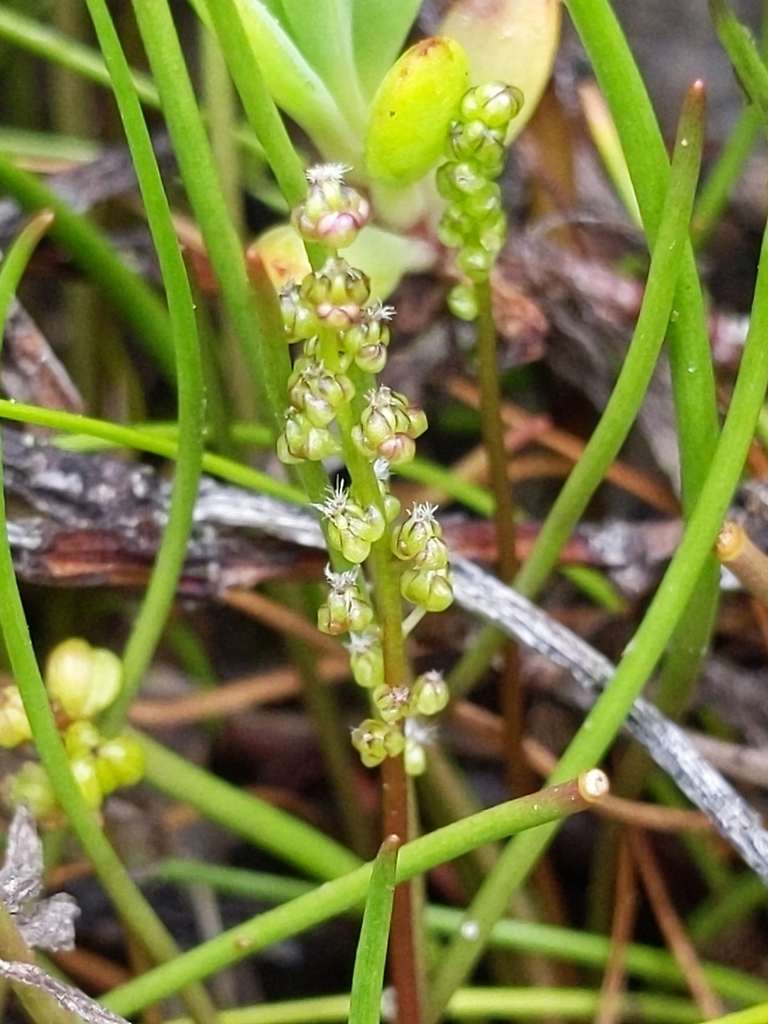
(c) Ken-ichi Ueda, some rights reserved (CC BY), uploaded by Ken-ichi Ueda · licence
Family: Juncaginaceae · Type: Grass · Native
Triglochin striata (Three-ribbed arrow-grass) is a native California grass in the Juncaginaceae family, recognized by mat-forming habit and strongly ridged fruits.
Three-ribbed arrow-grass is a California native perennial found in northern coastal, central coastal, and northern southern coastal bioregions in brackish to freshwater coastal marshes and springs at elevations below 30 meters. Flowering from May to September, this plant produces small greenish-white flowers in aerial racemes that can exceed leaf length. Growing as a mat-forming herb with slender spreading rhizomes, it reaches 10 to 40 centimeters tall with thin, nearly elliptical leaves approximately 1 to 2 millimeters wide. Its leaves are 5 to 20 centimeters long with rounded to pointed ligules, characteristic of its delicate marsh-dwelling nature. The fruit consists of three distinct mericarps, each 1 to 1.5 millimeters long with strong three-keeled surfaces.
Identification and appearance
Key characters: 3 sympatric species; distinguished by mat-forming habit and strongly ridged fruits
Habitat and range
Habitat: Uncommon. Brackish to freshwater coastal marshes, springs
Elevation: < 30 m
California counties: Santa Barbara, Monterey, Ventura, Mendocino, Humboldt, San Luis Obispo, Contra Costa, Marin, Santa Cruz, Sonoma, Del Norte, Alameda
Outside California: to Washington, southeastern United States, Chile, Australasia, Africa, Madagascar, naturalized western Europe
Bloom period
Triglochin striata blooms May-Sep.
How to tell it apart
vs Plantago: Triglochin has bractless flower spikes with scale-like flowers; Plantago has obvious leafy bracts below the flower cluster.; vs Typha: Triglochin has a slender spike of tiny greenish flowers; Typha has dense, brown, sausage-shaped flower heads.; vs Juncus: Triglochin leaves are semicircular in cross-section with a groove above; Juncus leaves are round or flat without a groove.; vs Rumex: Triglochin leaves are undivided grass-like blades; Rumex has broader leaves with a distinct midvein and papery sheaths.; vs Lomandra: Triglochin has tiny greenish flowers in a slender spike; Lomandra has larger cream-yellow flowers in dense clusters.
Frequently asked questions
Is Triglochin striata native to California?
Yes. Triglochin striata is native to California (recorded as native).
When does Triglochin striata bloom?
Triglochin striata blooms May-Sep.
Where in California does Triglochin striata grow?
Triglochin striata occurs in Santa Barbara, Monterey, Ventura, Mendocino, Humboldt, San Luis Obispo, Contra Costa, Marin and other counties, at elevations of < 30 m.
What plant family does Triglochin striata belong to?
Triglochin striata is in the Juncaginaceae family, genus Triglochin.
What habitat does Triglochin striata grow in?
Triglochin striata grows in Uncommon. Brackish to freshwater coastal marshes, springs.
Related species
Other California species in the same genus, family, or bioregion.
- Triglochin concinna — Arrow grass
- Triglochin concinna var. concinna — Seaside arrow-grass
- Triglochin concinna var. debilis — Slender arrow grass
- Triglochin maritima — Common arrow-grass
- Triglochin palustris — Marsh arrow-grass
- Triglochin scilloides — Flowering-quillwort
- Juncaginaceae sp. — Arrow-grass family
Sources: Jepson eFlora · Index of California Plant Names · CalPhotos
Last updated 2026-10-07
Data from The California Species Project — 14,000+ California species with verified data from CNPS, CDFW, USFWS, Cal-IPC, and more.