Trillium albidum
Giant white wakerobin
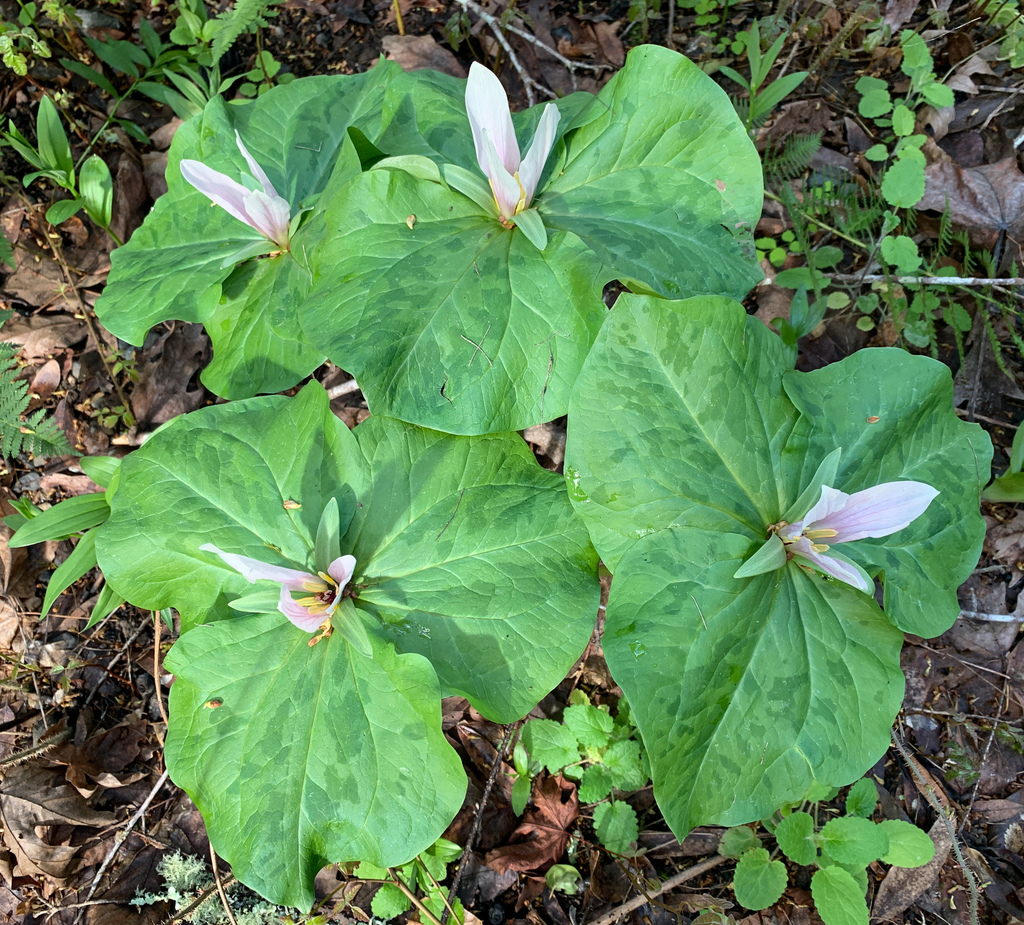
(c) Don Loarie, some rights reserved (CC BY) · licence
Family: Melanthiaceae · Type: Herb · Native
Trillium albidum (Giant white wakerobin) is a native California herb in the Melanthiaceae family, recognized by white petals, spreading orientation, and sweet fragrance.
Giant white wakerobin is a California native perennial found in northwestern California, Cascade Range, northern Sierra Nevada, and San Francisco Bay Area in redwood and mixed-evergreen forests, coastal scrub, and chaparral at elevations below 2,000 meters. Flowering from February to June, this plant produces white to pale pink flowers with occasionally purple bases, 4 to 8 centimeters long, with an attractive sweet rose-like or spicy fragrance. Growing 20 to 60 centimeters tall with green stems, it features distinctive large leaves that are sessile, rounded to obtuse at the tip, and often subtly spotted in brown or green. Its broad leaves measure 7 to 20 centimeters long and 12 to 15 centimeters wide, creating a dramatic appearance in forest understories. The fruit is pulpy and juicy, ranging in color from green to purplish green.
Identification and appearance
Key characters: 2 sympatric species; key features are white petals, spreading orientation, and sweet fragrance
Habitat and range
Habitat: Common. Edges of redwood or mixed-evergreen forest, coastal scrub, chaparral, moist canyon slopes, ravine banks
Elevation: < 2000 m
California counties: Butte, Siskiyou, Mendocino, Trinity, Humboldt, Shasta, Sonoma, Lake, Glenn, Napa, Marin, Nevada, Placer, San Francisco, Tehama, Plumas, Yuba, Del Norte, San Mateo, Colusa
Outside California: to Washington
Bloom period
Trillium albidum blooms Feb-Jun.
How to tell it apart
vs Pseudotrillium: Trillium leaves attach directly to stem and feel thin; Pseudotrillium leaves have short stalks and feel thick and leathery.; vs Lysimachia: Trillium has three leaves in one whorl; Lysimachia has multiple leaves in pairs or whorls along the stem.; vs Asarum: Trillium has three leaves above ground with a flower above; Asarum has two leaves at ground level with flower at base.; vs Scoliopus: Trillium has three broad leaves in a whorl; Scoliopus has two basal leaves with mottling.; vs Viola: Trillium has three leaves in a single whorl; Viola has heart-shaped leaves arising separately from the base.
Frequently asked questions
Is Trillium albidum native to California?
Yes. Trillium albidum is native to California (recorded as native).
When does Trillium albidum bloom?
Trillium albidum blooms Feb-Jun.
Where in California does Trillium albidum grow?
Trillium albidum occurs in Butte, Siskiyou, Mendocino, Trinity, Humboldt, Shasta, Sonoma, Lake and other counties, at elevations of < 2000 m.
What plant family does Trillium albidum belong to?
Trillium albidum is in the Melanthiaceae family, genus Trillium.
What habitat does Trillium albidum grow in?
Trillium albidum grows in Common. Edges of redwood or mixed-evergreen forest, coastal scrub, chaparral, moist canyon slopes, ravine banks.
Related species
Other California species in the same genus, family, or bioregion.
Sources: Jepson eFlora · Index of California Plant Names · CalPhotos
Last updated 2026-10-07
Data from The California Species Project — 14,000+ California species with verified data from CNPS, CDFW, USFWS, Cal-IPC, and more.