Trillium angustipetalum
Narrow petaled wakerobin
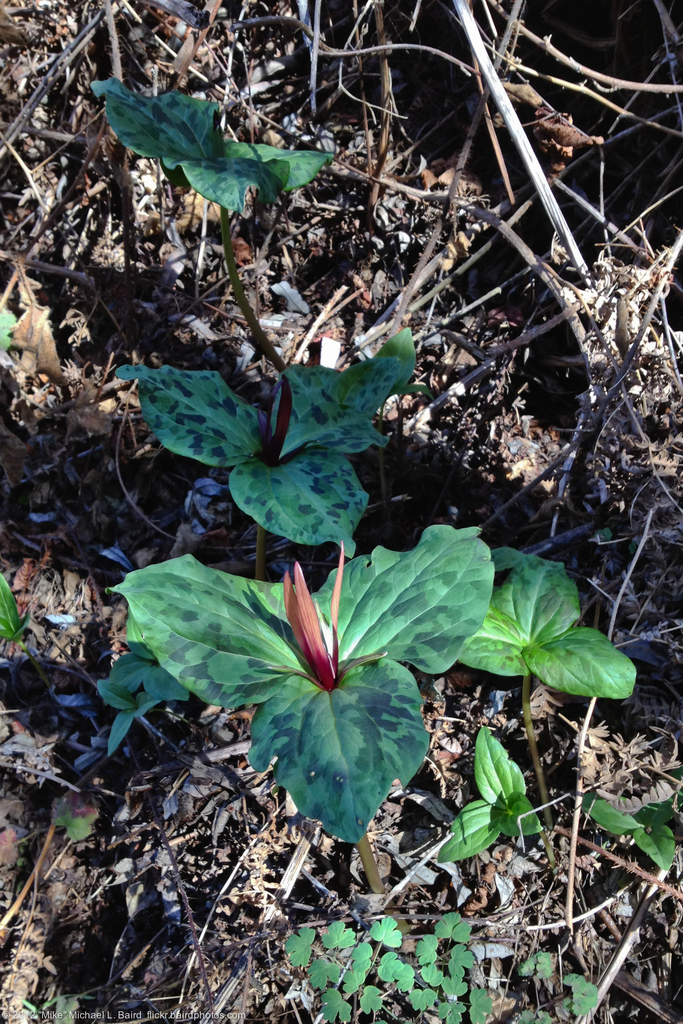
(c) Mike Baird, some rights reserved (CC BY) · licence
Family: Melanthiaceae · Type: Herb · Native
Trillium angustipetalum (Narrow petaled wakerobin) is a native California herb in the Melanthiaceae family, recognized by narrow dark purple petals and fetid odor.
Narrow petaled wakerobin is a California native perennial found in western Klamath Ranges, Sierra Nevada (excluding Tehachapi), southern Central Coast, and southern Coast Ranges in montane conifer forest, foothill woodland, chaparral, and riparian woodland at elevations of 30 to 2,000 meters. Flowering from March to April, this plant produces dark purple flowers with linear petals 5 to 11 centimeters long, emerging with a distinctive musty or fetid odor. Growing with stems 20 to 70 centimeters tall, it develops broad leaves 9 to 25 centimeters long with subtle light or dark green spotting. Its leaves are nearly stalkless, rounded to blunt at the tip, and arranged in a distinctive whorl. The fruit develops as a fleshy, six-angled spherical structure that is slightly winged.
Identification and appearance
Key characters: 2 sympatric species; key features are narrow dark purple petals and fetid odor
Habitat and range
Habitat: Montane conifer forest, foothill woodland, chaparral, riparian woodland
Elevation: 30-2000 m
California counties: San Luis Obispo, Amador, Placer, Santa Clara, Madera, Lake, Santa Barbara, El Dorado, Alameda, Calaveras, Del Norte, Humboldt, Mariposa, Nevada, Trinity, Yuba, Tuolumne, Siskiyou, Fresno, Colusa, Shasta
Outside California: southern Oregon
Bloom period
Trillium angustipetalum blooms Mar-Apr.
How to tell it apart
vs Pseudotrillium: Trillium leaves attach directly to stem and feel thin; Pseudotrillium leaves have short stalks and feel thick and leathery.; vs Lysimachia: Trillium has three leaves in one whorl; Lysimachia has multiple leaves in pairs or whorls along the stem.; vs Asarum: Trillium has three leaves above ground with a flower above; Asarum has two leaves at ground level with flower at base.; vs Scoliopus: Trillium has three broad leaves in a whorl; Scoliopus has two basal leaves with mottling.; vs Viola: Trillium has three leaves in a single whorl; Viola has heart-shaped leaves arising separately from the base.
Frequently asked questions
Is Trillium angustipetalum native to California?
Yes. Trillium angustipetalum is native to California (recorded as native).
When does Trillium angustipetalum bloom?
Trillium angustipetalum blooms Mar-Apr.
Where in California does Trillium angustipetalum grow?
Trillium angustipetalum occurs in San Luis Obispo, Amador, Placer, Santa Clara, Madera, Lake, Santa Barbara, El Dorado and other counties, at elevations of 30-2000 m.
What plant family does Trillium angustipetalum belong to?
Trillium angustipetalum is in the Melanthiaceae family, genus Trillium.
What habitat does Trillium angustipetalum grow in?
Trillium angustipetalum grows in Montane conifer forest, foothill woodland, chaparral, riparian woodland.
Related species
Other California species in the same genus, family, or bioregion.
Sources: Jepson eFlora · Index of California Plant Names · CalPhotos
Last updated 2026-10-07
Data from The California Species Project — 14,000+ California species with verified data from CNPS, CDFW, USFWS, Cal-IPC, and more.