Triodanis perfoliata
Clasping venus looking glass
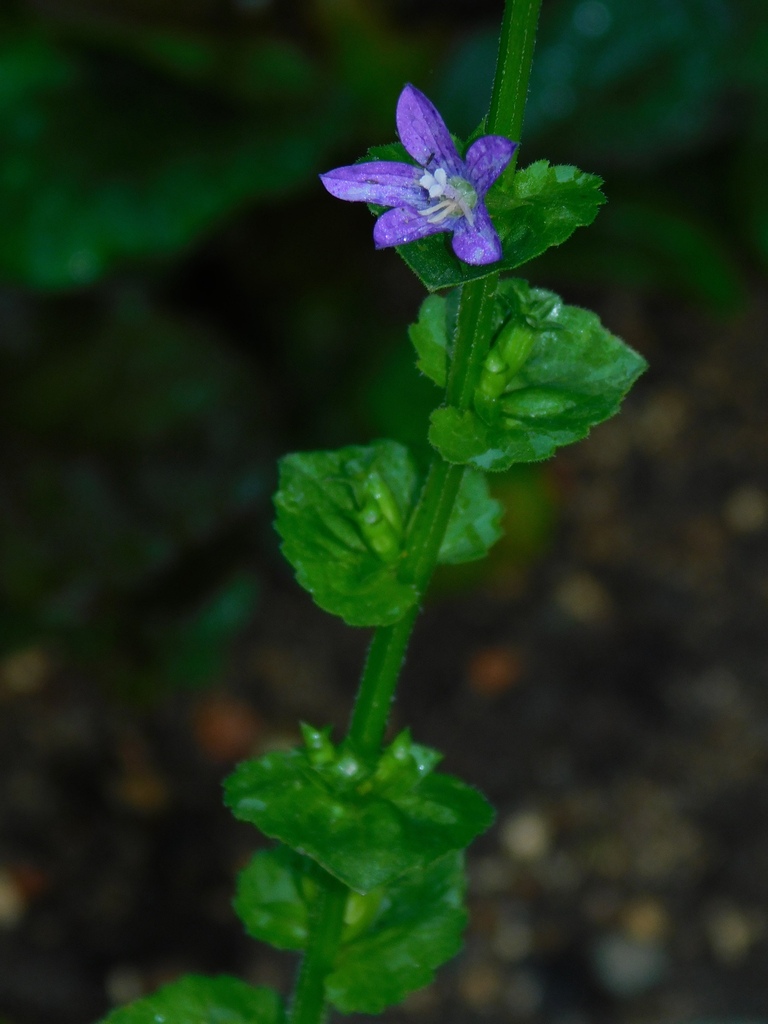
(c) Michael J. Papay, some rights reserved (CC BY), uploaded by Michael J. Papay · licence
Family: Campanulaceae · Type: Herb · Native
Triodanis perfoliata (Clasping venus looking glass) is a native California herb in the Campanulaceae family.
Clasping venus looking glass is a California native annual found in northwestern Sierra Nevada, northern Sierra Valley, Sutter Buttes, and southwestern California in disturbed areas at elevations up to 1,500 meters. Flowering from June to July, this delicate plant produces small white to pale blue flowers approximately 8 to 10 millimeters long with distinctive 6 to 8 millimeter lobes. Growing with slender stems 10 to 30 centimeters tall, it spreads in loose clusters across open ground. Its leaves are broadly clasping, approximately 8 to 11 millimeters long with conspicuous veins and blunt tips. The fruit contains small pores near its lower half, helping the plant disperse seeds in disturbed landscapes.
Identification and appearance
Key characters: 1 sympatric species; key differentiators are leaf venation, leaf tip shape, and number of flowering nodes
Habitat and range
Habitat: Disturbed areas
Elevation: < +- 1500 m
California counties: Tulare, Riverside, Los Angeles, Sutter, Butte, Colusa, Humboldt, Del Norte, Santa Barbara, Stanislaus, Siskiyou, Plumas, Monterey, Orange
Outside California: to eastern United States, South America
Bloom period
Triodanis perfoliata blooms Jun-Jul.
How to tell it apart
vs Campanula: Campanula is perennial with stalked bells; Triodanis is annual with flat wheels pressed directly to stem.; vs Brodiaea: Brodiaea grows from a corm with 6-petaled flowers; Triodanis is an annual with 5-lobed wheels.; vs Asyneuma: Asyneuma has multiple star flowers per node; Triodanis has single flat wheels pressed to stem.; vs Heterocodon: Heterocodon flowers are tiny tubes 3-5mm with big leafy sepals; Triodanis has 5-10mm flat wheels.; vs Githopsis: Githopsis flowers sit at stem tips; Triodanis flowers press directly against stem in leaf joints.
Frequently asked questions
Is Triodanis perfoliata native to California?
Yes. Triodanis perfoliata is native to California (recorded as native).
When does Triodanis perfoliata bloom?
Triodanis perfoliata blooms Jun-Jul.
Where in California does Triodanis perfoliata grow?
Triodanis perfoliata occurs in Tulare, Riverside, Los Angeles, Sutter, Butte, Colusa, Humboldt, Del Norte and other counties, at elevations of < +- 1500 m.
What plant family does Triodanis perfoliata belong to?
Triodanis perfoliata is in the Campanulaceae family, genus Triodanis.
What habitat does Triodanis perfoliata grow in?
Triodanis perfoliata grows in Disturbed areas.
Related species
Other California species in the same genus, family, or bioregion.
Sources: Jepson eFlora · Index of California Plant Names · CalPhotos
Last updated 2026-10-07
Data from The California Species Project — 14,000+ California species with verified data from CNPS, CDFW, USFWS, Cal-IPC, and more.