Triphysaria versicolor subsp. versicolor
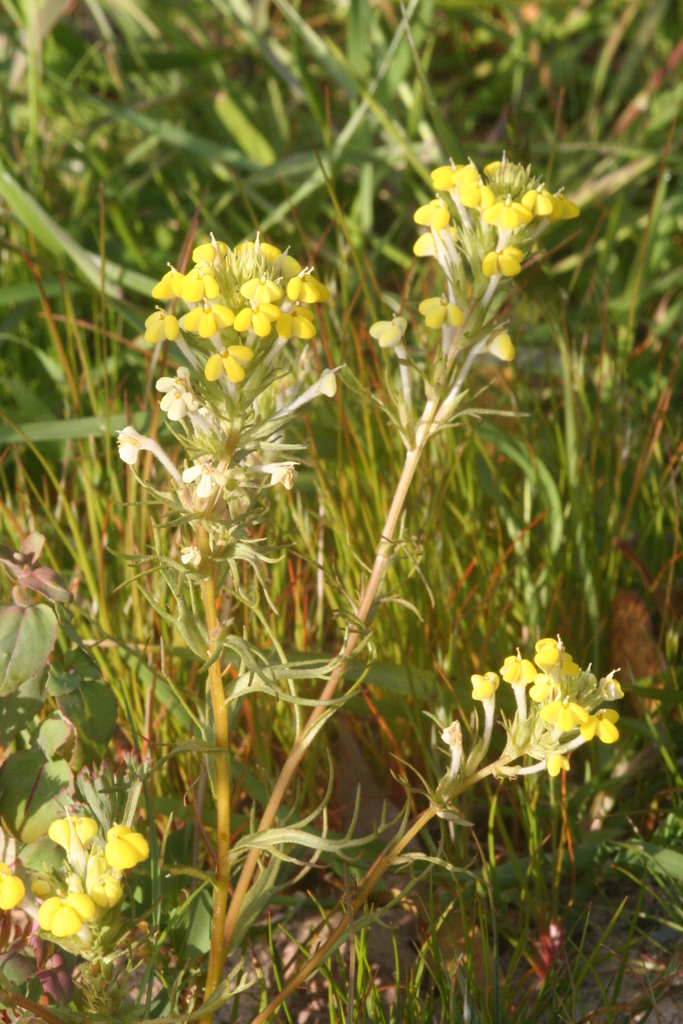
Photo: parent species Triphysaria versicolor · (c) runcator, some rights reserved (CC BY) · licence
Family: Orobanchaceae · Type: Herb · Native
Triphysaria versicolor subsp. versicolor is a native California herb in the Orobanchaceae family, recognized by white flowers fading rose-pink, tall stature, glabrous habit, very low elevation coastal habitat.
Yellow-white owl's clover is a California native annual found in the northern Coast and central Coast bioregions in grassland habitats at elevations below 100 meters. Flowering from April to June, this plant produces white flowers that fade to rose-pink, creating a delicate color transition. Growing with slender, branching stems typically 10 to 30 centimeters tall, it has a delicate and spreading growth habit. Its leaves are finely divided, creating a feathery texture that complements the plant's subtle color changes. The flowers are small and clustered, characteristic of the owl's clover genus.
Identification and appearance
Key characters: 8 sympatric species; key features are white flowers fading rose-pink, tall stature, glabrous habit, very low elevation coastal habitat
Habitat and range
Habitat: Grassland
Elevation: < 100 m
California counties: Humboldt, Santa Cruz, Monterey, San Mateo, Sonoma, Marin, Del Norte, Mendocino, Napa, San Benito, Amador, San Francisco, Colusa, Alameda
Outside California: southern Oregon
Bloom period
Triphysaria versicolor subsp. versicolor blooms Apr-Jun.
How to tell it apart
vs Castilleja: Triphysaria has sharp throat fold above lower lip; Castilleja has smooth throat without fold.; vs Linaria: Triphysaria has open beak with throat fold; Linaria has closed tube with spur projecting backward.; vs Trifolium: Triphysaria has tubular two-lipped flowers; Trifolium has round heads of pea-like flowers with three leaflets.; vs Bellardia: Triphysaria has throat fold and yellow-white flowers; Bellardia lacks throat fold and has purple-yellow flowers.; vs Orthocarpus: Triphysaria has open beak with throat fold; Orthocarpus has closed hood completely covering stamens.
Frequently asked questions
Is Triphysaria versicolor subsp. versicolor native to California?
Yes. Triphysaria versicolor subsp. versicolor is native to California (recorded as native).
When does Triphysaria versicolor subsp. versicolor bloom?
Triphysaria versicolor subsp. versicolor blooms Apr-Jun.
Where in California does Triphysaria versicolor subsp. versicolor grow?
Triphysaria versicolor subsp. versicolor occurs in Humboldt, Santa Cruz, Monterey, San Mateo, Sonoma, Marin, Del Norte, Mendocino and other counties, at elevations of < 100 m.
What plant family does Triphysaria versicolor subsp. versicolor belong to?
Triphysaria versicolor subsp. versicolor is in the Orobanchaceae family, genus Triphysaria.
What habitat does Triphysaria versicolor subsp. versicolor grow in?
Triphysaria versicolor subsp. versicolor grows in Grassland.
Related species
Other California species in the same genus, family, or bioregion.
- Triphysaria eriantha — Butter-and-eggs
- Triphysaria eriantha subsp. eriantha
- Triphysaria eriantha subsp. rosea
- Triphysaria floribunda — San francisco owl's-clover
- Triphysaria micrantha — Little butter 'n' eggs
- Triphysaria pusilla — Dwarf owl's clover
- Aphyllon californicum
- Aphyllon californicum subsp. californicum
- Aphyllon californicum subsp. condensum
- Aphyllon californicum subsp. feudgei
Sources: Jepson eFlora · Index of California Plant Names · CalPhotos
Last updated 2026-10-07
Data from The California Species Project — 14,000+ California species with verified data from CNPS, CDFW, USFWS, Cal-IPC, and more.