Tripterocalyx crux-maltae
Kellogg's sand-verbena, Kellogg's Sand-Verbena
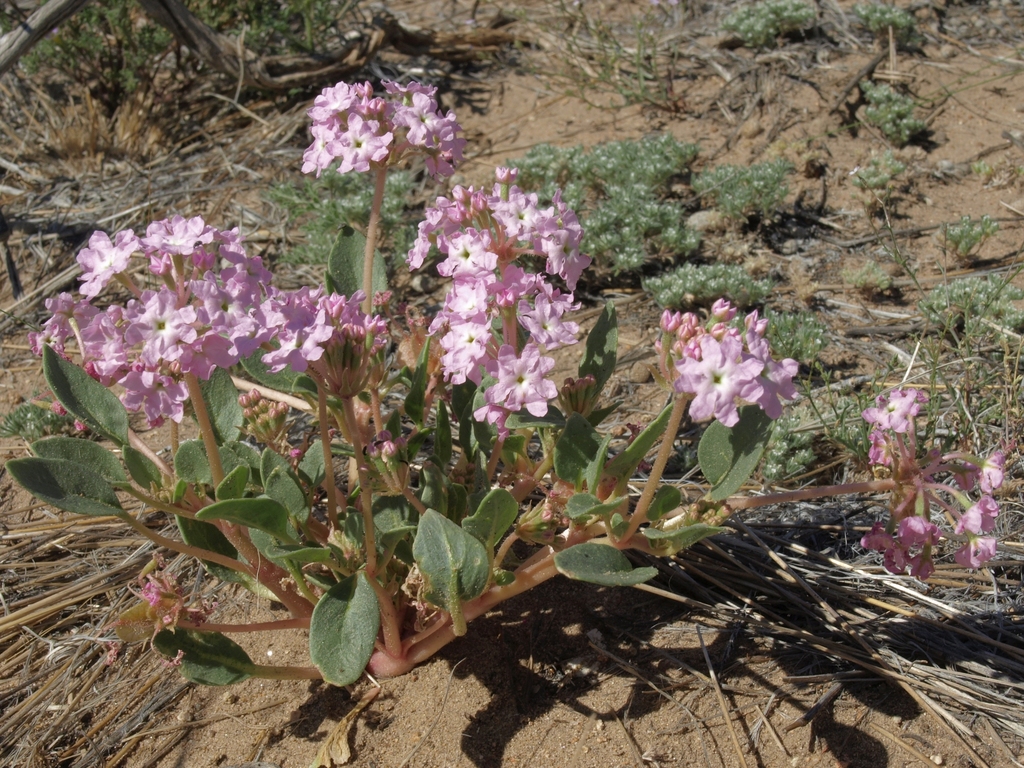
(c) Jim Morefield, some rights reserved (CC BY) · licence
Family: Nyctaginaceae · Type: Herb · Native
Conservation status: CNPS 2B.2
Tripterocalyx crux-maltae (Kellogg's sand-verbena) is a native California herb in the Nyctaginaceae family.
Kellogg's sand-verbena is a rare (CNPS 2B.2) California native perennial found in the Modoc Plateau in Lassen County's sagebrush scrub at elevations of 1,200 to 1,500 meters. Flowering from May to June, this plant produces pink to magenta flowers in distinctive clusters with glandular-sticky characteristics. Growing with stems less than 30 centimeters tall and covered in glandular hairs, it forms a compact ground-hugging habit. Its leaves are ovate to elliptic, measuring 2.5 to 7 centimeters long, with a slightly glandular and hairy surface that adds texture to the plant. The fruit features raised ribs that extend into delicate wing-like projections, giving the plant an intricate structural detail.
Identification and appearance
Key characters: Geographically isolated species with no sympatric congeners
Habitat and range
Habitat: Sagebrush scrub
Elevation: 1200-1500 m
California counties: Lassen
Outside California: northwestern Nevada
Bloom period
Tripterocalyx crux-maltae blooms May-Jun.
Conservation status
CNPS 2B.2
How to tell it apart
vs Abronia: Tripterocalyx fruits have translucent see-through wings; Abronia fruits have thick opaque wings or no wings.; vs Allionia: Tripterocalyx has translucent winged fruits and many-flowered heads; Allionia has exactly 3 asymmetrical flowers per cluster.; vs Mirabilis: Tripterocalyx has translucent-winged fruits in rounded heads; Mirabilis has wingless fruits in cup-like bracts.; vs Acleisanthes: Tripterocalyx has small flowers in heads with translucent-winged fruits; Acleisanthes has giant trumpet flowers.; vs Boerhavia: Tripterocalyx has large translucent-winged fruits; Boerhavia has tiny club-shaped fruits under 4mm.
Frequently asked questions
Is Tripterocalyx crux-maltae native to California?
Yes. Tripterocalyx crux-maltae is native to California (recorded as native).
When does Tripterocalyx crux-maltae bloom?
Tripterocalyx crux-maltae blooms May-Jun.
Where in California does Tripterocalyx crux-maltae grow?
Tripterocalyx crux-maltae occurs in Lassen, at elevations of 1200-1500 m.
What plant family does Tripterocalyx crux-maltae belong to?
Tripterocalyx crux-maltae is in the Nyctaginaceae family, genus Tripterocalyx.
Is Tripterocalyx crux-maltae rare or endangered?
Tripterocalyx crux-maltae carries California Rare Plant Rank 2B.2, state rank S1.
Related species
Other California species in the same genus, family, or bioregion.
Sources: Jepson eFlora · CNPS Rare Plant Inventory · Index of California Plant Names · CalPhotos · CDFW CNDDB
Last updated 2026-10-07
Data from The California Species Project — 14,000+ California species with verified data from CNPS, CDFW, USFWS, Cal-IPC, and more.