Trisetum cernuum
Nodding false oat, Nodding False Oat
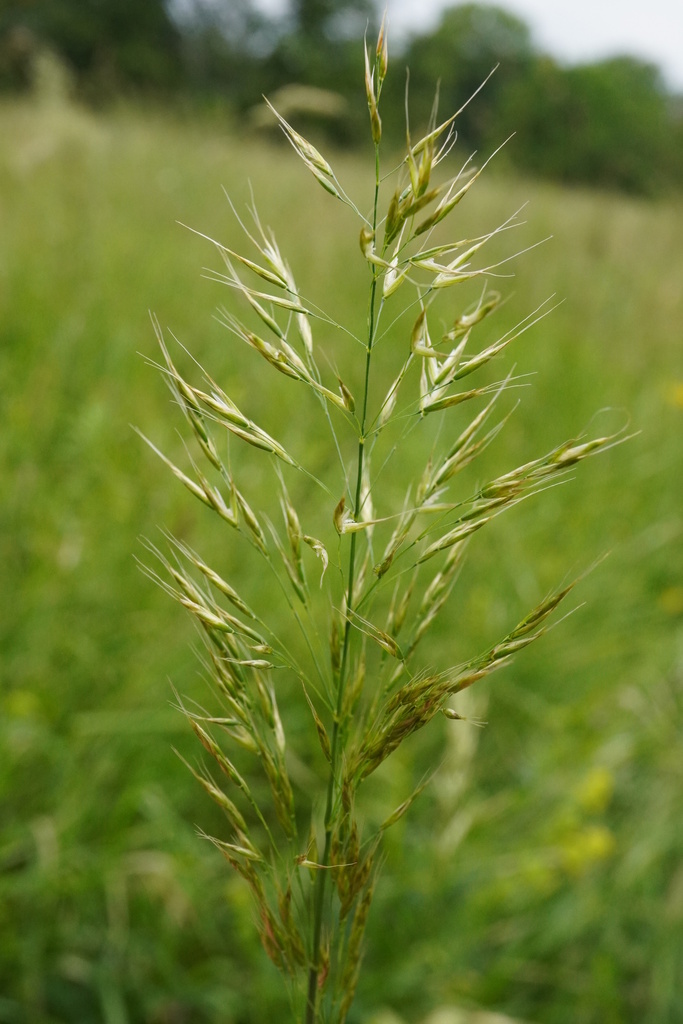
(c) Patrick Hacker, some rights reserved (CC BY) · licence
Family: Poaceae · Type: Perennial · Native
Trisetum cernuum (Nodding false oat) is a native California perennial in the Poaceae family, recognized by coastal habitat restriction, open triangular inflorescence with spreading branches.
Nodding false oat is a native perennial found in northern California Coast and northern California Coast Ranges in moist, shaded redwood and conifer forests at elevations below 1,000 meters. Flowering from May to July, this plant produces delicate, nodding panicles with open, triangular-shaped flower clusters. Growing with slender stems 40 to 100 centimeters tall, it forms loose clumps with wiry, spreading branches. Its leaves have broad blades 6 to 12 millimeters wide with small ligules 1 to 3 millimeters long. The plant's distinctive lemmas bear bent awns 7 to 12 millimeters long, giving the spikelets an elegant, drooping appearance.
Identification and appearance
Key characters: 1 sympatric species; distinguished by coastal habitat restriction, open triangular inflorescence with spreading branches
Habitat and range
Habitat: Moist, shaded sites, redwood, conifer forest
Elevation: < 1000 m
California counties: Mendocino, Alameda, Butte, Del Norte, Nevada, Placer, Plumas, San Mateo, Santa Clara, Santa Cruz, Tuolumne, Sierra, Yuba, Humboldt, Trinity, Siskiyou, Sonoma, Madera, San Bernardino, Sacramento
Outside California: to Alaska, Montana
Bloom period
Trisetum cernuum blooms May-Jul.
How to tell it apart
vs Schismus: Trisetum has hairy spikelet axes extending beyond flowers; Schismus has no extension or hairs.; vs Koeleria: Trisetum has dull spikelets with wide-spaced flowers; Koeleria has shiny, compact spikelets.; vs Aira: Trisetum is perennial with hairy axis extensions; Aira is annual with no axis extension.; vs Vahlodea: Trisetum's axis extension is clearly hairy (1-2mm); Vahlodea's is nearly hairless and tiny.; vs Deschampsia: Trisetum has obviously hairy spikelet axes; Deschampsia's axes are smooth or barely hairy.
Frequently asked questions
Is Trisetum cernuum native to California?
Yes. Trisetum cernuum is native to California (recorded as native).
When does Trisetum cernuum bloom?
Trisetum cernuum blooms May-Jul.
Where in California does Trisetum cernuum grow?
Trisetum cernuum occurs in Mendocino, Alameda, Butte, Del Norte, Nevada, Placer, Plumas, San Mateo and other counties, at elevations of < 1000 m.
What plant family does Trisetum cernuum belong to?
Trisetum cernuum is in the Poaceae family, genus Trisetum.
What habitat does Trisetum cernuum grow in?
Trisetum cernuum grows in Moist, shaded sites, redwood, conifer forest.
Related species
Other California species in the same genus, family, or bioregion.
Sources: Jepson eFlora · Index of California Plant Names · CalPhotos
Last updated 2026-10-06
Data from The California Species Project — 14,000+ California species with verified data from CNPS, CDFW, USFWS, Cal-IPC, and more.