Trisetum projectum
Interrupted false oat, Interrupted False Oat
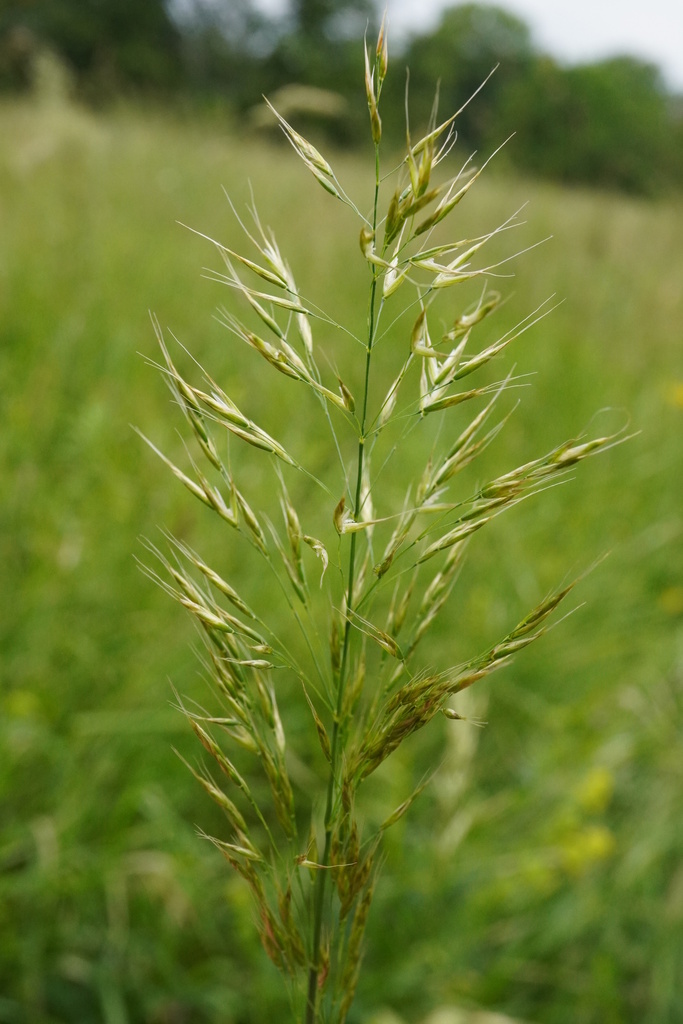
(c) Patrick Hacker, some rights reserved (CC BY) · licence
Family: Poaceae · Type: Perennial · Native
Trisetum projectum (Interrupted false oat) is a native California perennial in the Poaceae family, recognized by interrupted spike-like inflorescence and green coloration.
Interrupted false oat is a California native perennial found in southern California Ranges and the Sierra Nevada Mountains in dry to moist meadows, streambanks, and open conifer forest areas at elevations of 1,220 to 2,870 meters. Flowering from July to September, this plant produces green spikelets with delicate curved awns arranged in an interrupted spike-like inflorescence. Growing in dense clumps with stems 35 to 90 centimeters tall, it develops soft, densely hairy stems. Its leaves are narrow, about 2 to 3 millimeters wide, with soft hairs and tiny ciliate ligules less than 1.5 millimeters long. The plant's distinctive interrupted inflorescence features branches 5 to 30 millimeters long, with spikelets extending from base to tip.
Identification and appearance
Key characters: 3 sympatric species; distinguished by interrupted spike-like inflorescence and green coloration
Habitat and range
Habitat: dry to moist sites, meadows, streambanks, open areas in conifer forest
Elevation: 1220-2870 m
California counties: Mariposa, Nevada, El Dorado, Placer, Tuolumne, Fresno, Tulare, Mono, Alpine, Plumas, Yuba, Sierra, Butte, Shasta, Madera, Amador
Outside California: western Nevada
Bloom period
Trisetum projectum blooms Jul-Sep.
How to tell it apart
vs Schismus: Trisetum has hairy spikelet axes extending beyond flowers; Schismus has no extension or hairs.; vs Koeleria: Trisetum has dull spikelets with wide-spaced flowers; Koeleria has shiny, compact spikelets.; vs Aira: Trisetum is perennial with hairy axis extensions; Aira is annual with no axis extension.; vs Vahlodea: Trisetum's axis extension is clearly hairy (1-2mm); Vahlodea's is nearly hairless and tiny.; vs Deschampsia: Trisetum has obviously hairy spikelet axes; Deschampsia's axes are smooth or barely hairy.
Frequently asked questions
Is Trisetum projectum native to California?
Yes. Trisetum projectum is native to California (recorded as native).
When does Trisetum projectum bloom?
Trisetum projectum blooms Jul-Sep.
Where in California does Trisetum projectum grow?
Trisetum projectum occurs in Mariposa, Nevada, El Dorado, Placer, Tuolumne, Fresno, Tulare, Mono and other counties, at elevations of 1220-2870 m.
What plant family does Trisetum projectum belong to?
Trisetum projectum is in the Poaceae family, genus Trisetum.
What habitat does Trisetum projectum grow in?
Trisetum projectum grows in dry to moist sites, meadows, streambanks, open areas in conifer forest.
Related species
Other California species in the same genus, family, or bioregion.
Sources: Jepson eFlora · Index of California Plant Names · CalPhotos
Last updated 2026-09-30
Data from The California Species Project — 14,000+ California species with verified data from CNPS, CDFW, USFWS, Cal-IPC, and more.