Triticum aestivum
Common wheat
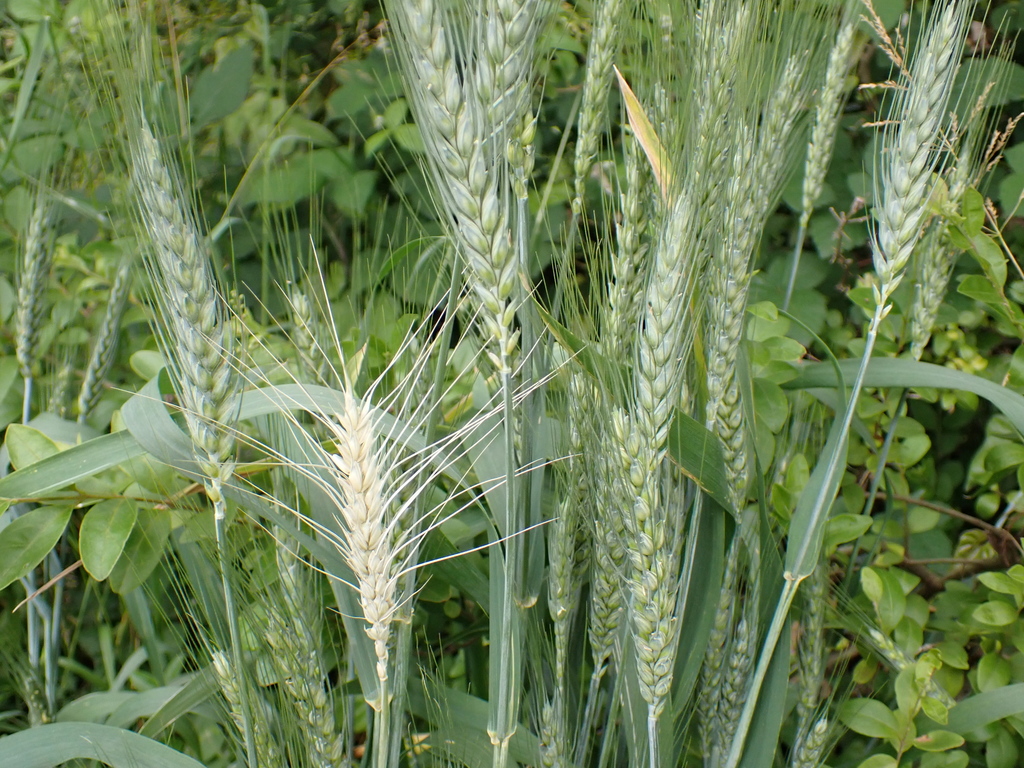
(c) Cole Shoemaker, some rights reserved (CC BY), uploaded by Cole Shoemaker · licence
Family: Poaceae · Type: Grass · Not Native
Triticum aestivum (Common wheat) is a non-native California grass in the Poaceae family, recognized by Cultivated species occasionally escaping; distinctive among California grasses.
Common wheat is a naturalized annual found in northern coastal, Sacramento Valley, central western, southwestern, and desert California regions in disturbed places like roadsides at elevations generally below 500 meters. Flowering from April to July, this plant produces small, clustered spikelets with whitish to pale green flowers. Growing with robust, dense stems 60 to 150 centimeters tall, it forms thick tufted clumps characteristic of cereal grasses. Its long leaves are broad, measuring 10 to 60 centimeters in length with distinctive claw-like appendages, and feature blades 10 to 15 millimeters wide. The mature plant develops prominent spikelets with toothed glumes and lemmas that can be awned up to 12 centimeters long.
Identification and appearance
Key characters: Cultivated species occasionally escaping; distinctive among California grasses
Habitat and range
Habitat: Escaped cereal crop along roadsides and in disturbed places
Elevation: generally < 500 m
California counties: Santa Cruz, Los Angeles, Tulare, San Bernardino, Colusa, San Diego, Orange, Riverside, San Francisco, Ventura, Santa Barbara, Yolo, Lassen, Kern, Imperial, Placer, Amador, Yuba, Nevada, Sacramento, Solano, Sutter, Modoc, Calaveras, Contra Costa, El Dorado, Fresno, Marin, Merced, Monterey, San Mateo, Santa Clara, Shasta, Sonoma, Tuolumne, Butte, Plumas, San Luis Obispo, Glenn, Humboldt, Tehama, Alameda, Mendocino, Madera, Stanislaus, Mariposa
Outside California: North America, native to Near East
Bloom period
Triticum aestivum blooms Apr-Jul.
How to tell it apart
vs Hordeum: Triticum has broad, keeled glumes; Hordeum has all glumes narrow and bristle-like.; vs × Triticosecale: Triticum has shorter awns (to 4 cm); Triticosecale has longer awns (to 15 cm) like rye.; vs Bromus: Triticum has one spikelet per node in a spike; Bromus has branched, open flower clusters.; vs Secale: Triticum lacks fringes on lemma keels; Secale has distinctly hairy-fringed keel edges.; vs Danthonia: Triticum has keeled glumes in a spike; Danthonia has rounded glumes in an open panicle.
Frequently asked questions
Is Triticum aestivum native to California?
No. Triticum aestivum is not native to California (recorded as not native).
When does Triticum aestivum bloom?
Triticum aestivum blooms Apr-Jul.
Where in California does Triticum aestivum grow?
Triticum aestivum occurs in Santa Cruz, Los Angeles, Tulare, San Bernardino, Colusa, San Diego, Orange, Riverside and other counties, at elevations of generally < 500 m.
What plant family does Triticum aestivum belong to?
Triticum aestivum is in the Poaceae family, genus Triticum.
What habitat does Triticum aestivum grow in?
Triticum aestivum grows in Escaped cereal crop along roadsides and in disturbed places.
Related species
Other California species in the same genus, family, or bioregion.
Sources: Jepson eFlora · Index of California Plant Names · CalPhotos
Last updated 2026-10-07
Data from The California Species Project — 14,000+ California species with verified data from CNPS, CDFW, USFWS, Cal-IPC, and more.