Tropidocarpum capparideum
Caper-fruited tropidocarpum
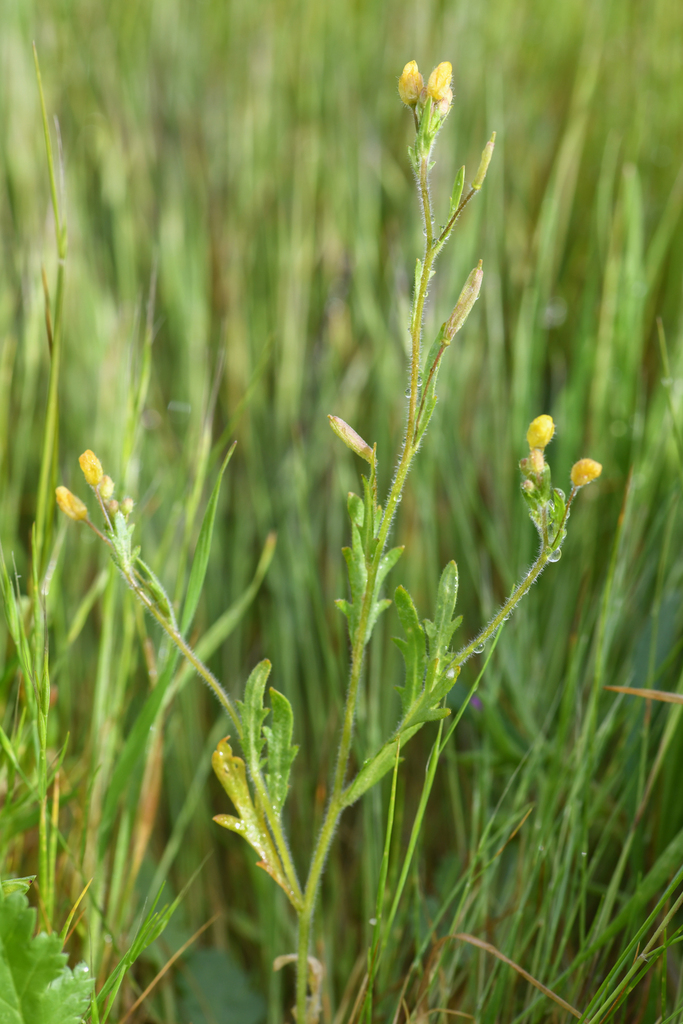
(c) Trevor Van Loon, some rights reserved (CC BY) · licence
Family: Brassicaceae · Type: Herb · Native
Conservation status: CNPS 1B.1
Tropidocarpum capparideum (Caper-fruited tropidocarpum) is a native California herb in the Brassicaceae family, recognized by intermediate silique size and shape.
Caper-fruited tropidocarpum is a rare (CNPS 1B.1) California native annual found in the northwestern San Joaquin Valley and southern Coastal Ranges on alkaline soils and low hills at elevations below 400 meters. Flowering from March to April, this plant produces yellow flowers, occasionally tinged with purple, that are 3 to 5 millimeters long and spoon-shaped. Growing 15 to 70 centimeters tall with ascending stems, it develops distinctive branching with proximal leaves having 3 to 6 lateral leaf lobes. Its leaves are 1.2 to 7 centimeters long, with entire lateral lobes arranged in distinctive pairs along the stem. The fruit develops as an oblong silique 9 to 20 millimeters long, containing 25 to 40 small oblong seeds.
Identification and appearance
Key characters: 1 sympatric species; distinguished by intermediate silique size and shape
Habitat and range
Habitat: Alkaline soils, low hills, valleys
Elevation: < 400 m
California counties: Contra Costa, Fresno, Monterey, Alameda, San Luis Obispo, San Joaquin
Bloom period
Tropidocarpum capparideum blooms Mar-Apr.
Conservation status
CNPS 1B.1
How to tell it apart
vs Camissoniopsis: Tropidocarpum has 4 petals in cross shape; Camissoniopsis has 4 petals but in evening primrose family with inferior ovary.; vs Sisymbrium: Tropidocarpum has leafy bracts throughout flower cluster; Sisymbrium has naked flower clusters without bracts.; vs Dithyrea: Tropidocarpum has leafy bracts throughout inflorescence; Dithyrea has naked flower clusters and spectacle-shaped fruits.; vs Hornungia: Tropidocarpum has leafy bracts throughout flower cluster; Hornungia has completely naked flower clusters.; vs Physaria: Tropidocarpum has leafy bracts throughout inflorescence; Physaria has naked flower clusters and distinctive silvery woolly appearance.
Frequently asked questions
Is Tropidocarpum capparideum native to California?
Yes. Tropidocarpum capparideum is native to California (recorded as native).
When does Tropidocarpum capparideum bloom?
Tropidocarpum capparideum blooms Mar-Apr.
Where in California does Tropidocarpum capparideum grow?
Tropidocarpum capparideum occurs in Contra Costa, Fresno, Monterey, Alameda, San Luis Obispo, San Joaquin, at elevations of < 400 m.
What plant family does Tropidocarpum capparideum belong to?
Tropidocarpum capparideum is in the Brassicaceae family, genus Tropidocarpum.
Is Tropidocarpum capparideum rare or endangered?
Tropidocarpum capparideum carries California Rare Plant Rank 1B.1, state rank S1.
Related species
Other California species in the same genus, family, or bioregion.
Sources: Jepson eFlora · CNPS Rare Plant Inventory · Index of California Plant Names · CalPhotos · CDFW CNDDB
Last updated 2026-10-07
Data from The California Species Project — 14,000+ California species with verified data from CNPS, CDFW, USFWS, Cal-IPC, and more.