Tsuga mertensiana
Mountain hemlock, Mountain Hemlock
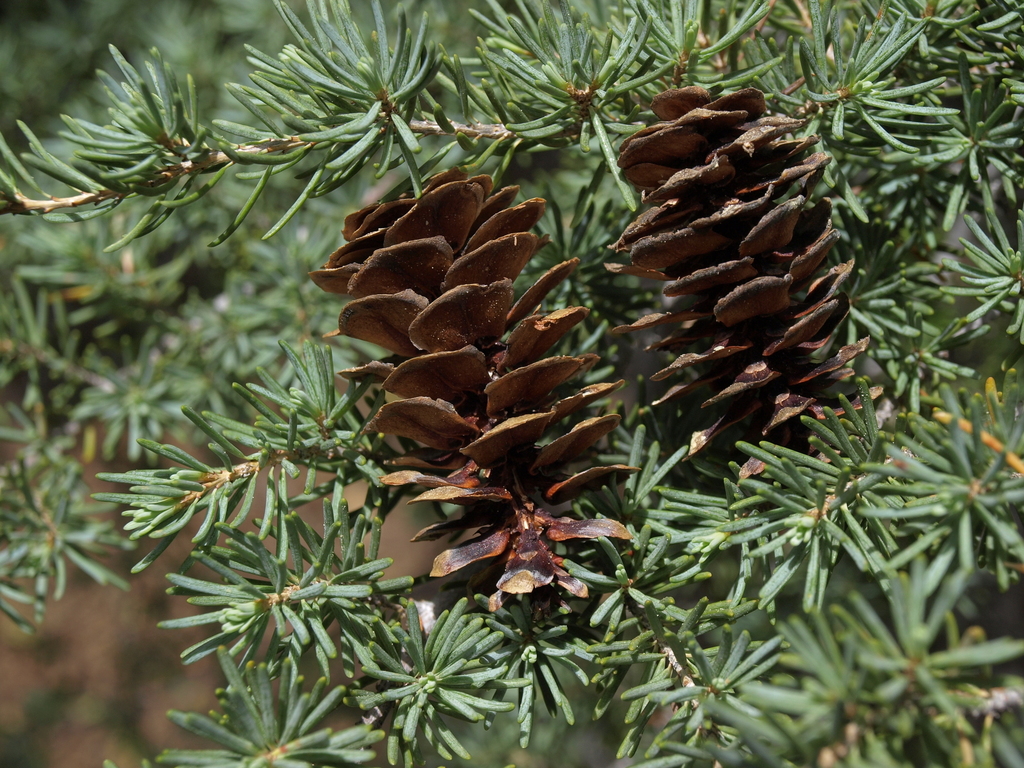
(c) Jim Morefield, some rights reserved (CC BY-SA) · licence
Family: Pinaceae · Type: Tree · Native
Tsuga mertensiana (Mountain hemlock) is a native California tree in the Pinaceae family, recognized by (T. heterophylla); differentiated primarily by elevation and growth form at timberline.
Mountain hemlock is a native shrub found in the Klamath Ranges, northern Coast Ranges, California Ranges, Sierra Nevada, North Coast Ranges, and northern Sierra Nevada eastern areas in subalpine and cold areas of red-fir and mixed-conifer forests at elevations of 1,200 to 3,500 meters. While no specific flowering time is noted, the plant is characterized by distinctive trunk characteristics, growing to less than 35 meters tall with trunks up to 2.2 meters wide that become prostrate at timberline. Its mature bark displays a rich red- or purple-brown coloration with narrow grooves between narrow ridges, creating a textured appearance. The tree produces short, persistent leaves 10 to 25 millimeters long with rounded tips that remain on branches for less than 7 years. At timberline, mountain hemlock often takes on a distinctive prostrate growth form, adapting to harsh alpine conditions with its uniquely shaped trunk and resilient foliage.
Identification and appearance
Key characters: 1 sympatric species (T. heterophylla); differentiated primarily by elevation and growth form at timberline
Habitat and range
Habitat: Subalpine, some scattered in cold areas of red-fir, mixed-conifer forest
Elevation: 1200-3500 m
California counties: El Dorado, Plumas, Mono, Fresno, Mariposa, Madera, Alpine, Nevada, Tuolumne, Amador, Placer, Trinity, Siskiyou, Shasta, Lassen, Tehama, Sierra, Humboldt, Modoc, Inyo, Tulare
Outside California: to Alaska, Montana
How to tell it apart
vs Abies: Hemlock cones hang down and are tiny (under 3 inches); fir cones stand upright like candles.; vs Conium: Hemlock is a tree with evergreen needles; poison-hemlock is an herbaceous plant with fernlike leaves and white flower umbels.; vs Pseudotsuga: Hemlock needles create feathery sprays with wedge-shaped scars; Douglas-fir has smoother twigs and larger cones with pitchfork bracts.; vs Sequoia: Hemlock has delicate needle sprays with tiny hanging cones; redwood has flat sprays of scale-like leaves.; vs Pinus: Hemlock needles attach individually; pine needles come bundled in groups of 2-5 with papery sheaths.
Frequently asked questions
Is Tsuga mertensiana native to California?
Yes. Tsuga mertensiana is native to California (recorded as native).
Where in California does Tsuga mertensiana grow?
Tsuga mertensiana occurs in El Dorado, Plumas, Mono, Fresno, Mariposa, Madera, Alpine, Nevada and other counties, at elevations of 1200-3500 m.
What plant family does Tsuga mertensiana belong to?
Tsuga mertensiana is in the Pinaceae family, genus Tsuga.
What habitat does Tsuga mertensiana grow in?
Tsuga mertensiana grows in Subalpine, some scattered in cold areas of red-fir, mixed-conifer forest.
Related species
Other California species in the same genus, family, or bioregion.
Sources: Jepson eFlora · Index of California Plant Names · CalPhotos
Last updated 2026-10-07
Data from The California Species Project — 14,000+ California species with verified data from CNPS, CDFW, USFWS, Cal-IPC, and more.