Turritis glabra
Tower rockcress
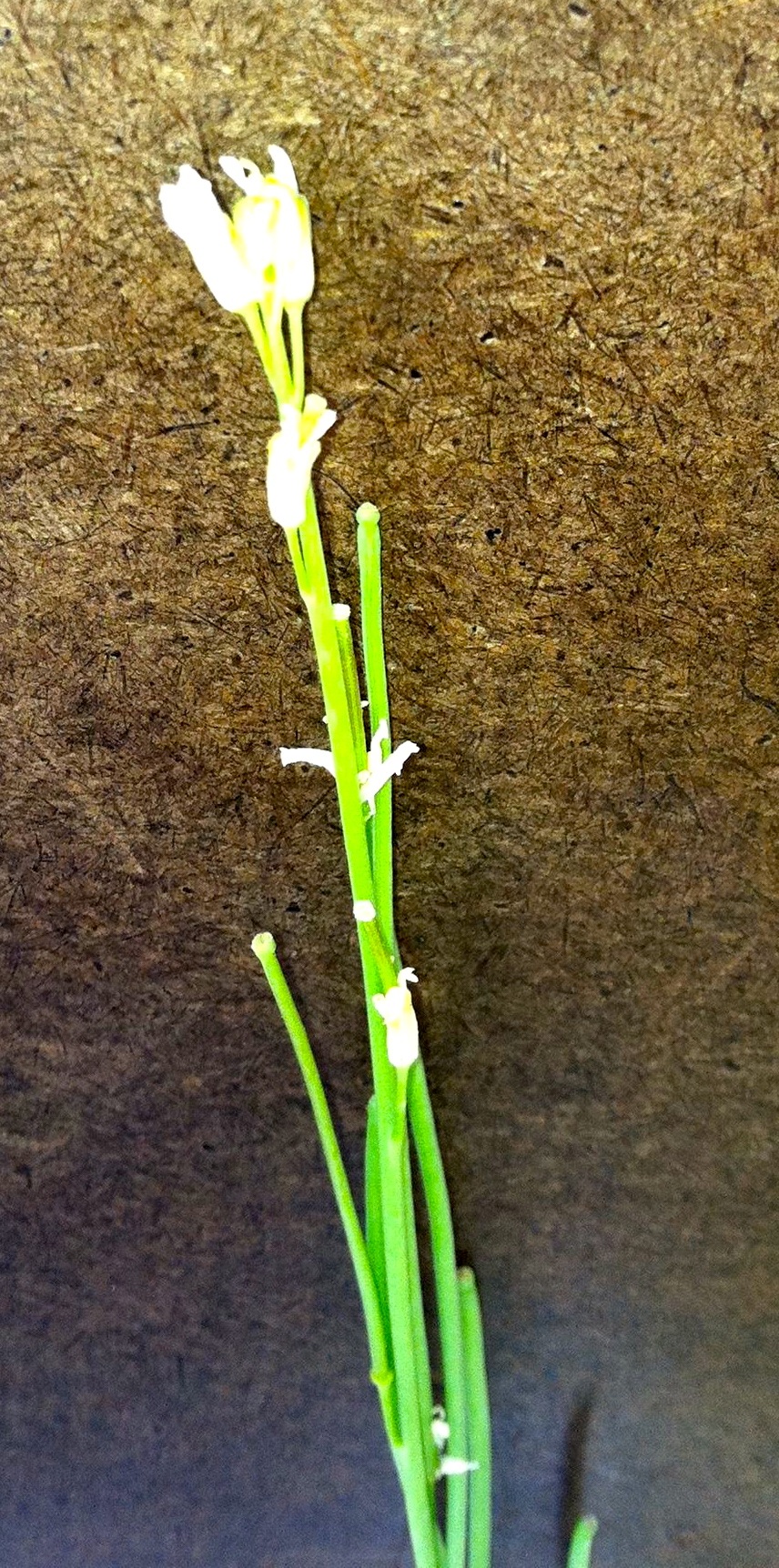
Photo by Chez Brungraber
Family: Brassicaceae · Type: Herb · Native
Turritis glabra (Tower rockcress) is a native California herb in the Brassicaceae family, recognized by Monotypic genus with circumpolar distribution; distinctive tall, narrow growth habit.
Tower rockcress is a California native perennial found in the Central Western and North Coast Ranges in open fields, meadows, and slopes at elevations up to 2,800 meters. Flowering from April to July, this plant produces cream, and occasionally lilac or purple flowers, 5 to 8.5 millimeters long with narrow, spoon-shaped petals. Growing with slender stems 3 to 4.5 meters tall, occasionally branching near the top, it develops a distinctive upright form. Its basal leaves are 4 to 12 centimeters long, oblanceolate to spoon-shaped, while cauline leaves are smaller and lanceolate to elliptic. The plant produces long, narrow fruits 4 to 10 centimeters in length, standing erect and tightly appressed to the stem.
Identification and appearance
Key characters: Monotypic genus with circumpolar distribution; distinctive tall, narrow growth habit
Habitat and range
Habitat: Open fields, meadows, slopes
Elevation: < 2800 m
California counties: Humboldt, Los Angeles, San Bernardino, San Diego, Orange, Tulare, Butte, Kern, Nevada, Santa Barbara, San Luis Obispo, Santa Cruz, San Francisco, Siskiyou, Monterey, Sonoma, Plumas, Marin, Fresno, Ventura, Mendocino, Riverside, San Mateo, Trinity, San Benito, Mariposa, Del Norte, Calaveras, Modoc, Amador, Shasta, Contra Costa, Lake, Santa Clara, Glenn, Tuolumne, Sierra, Alpine, El Dorado, Lassen, Placer, Alameda, Tehama, Napa
Outside California: temperate North America, Eurasia, northern Africa
Bloom period
Turritis glabra blooms Apr-Jul.
How to tell it apart
vs Caulanthus: Turritis has waxy blue-gray upper parts and two seed rows; Caulanthus lacks wax and has one seed row.; vs Phoenicaulis: Turritis has waxy coating and pods pressed to stem; Phoenicaulis lacks wax and has flattened spreading pods.; vs Arabis: Turritis has waxy upper parts and appressed pods; Arabis lacks wax and has slightly spreading pods.; vs Boechera: Turritis has four-angled pods pressed flat to stem; Boechera has rounder pods spreading at angles.; vs Transberingia: Turritis has pods pressed flat against stem; Transberingia has pods sticking out at angles.
Frequently asked questions
Is Turritis glabra native to California?
Yes. Turritis glabra is native to California (recorded as native).
When does Turritis glabra bloom?
Turritis glabra blooms Apr-Jul.
Where in California does Turritis glabra grow?
Turritis glabra occurs in Humboldt, Los Angeles, San Bernardino, San Diego, Orange, Tulare, Butte, Kern and other counties, at elevations of < 2800 m.
What plant family does Turritis glabra belong to?
Turritis glabra is in the Brassicaceae family, genus Turritis.
What habitat does Turritis glabra grow in?
Turritis glabra grows in Open fields, meadows, slopes.
Related species
Other California species in the same genus, family, or bioregion.
Sources: Jepson eFlora · Index of California Plant Names · CalPhotos
Last updated 2026-10-07
Data from The California Species Project — 14,000+ California species with verified data from CNPS, CDFW, USFWS, Cal-IPC, and more.