Typha domingensis
Southern cattail, Southern Cattail
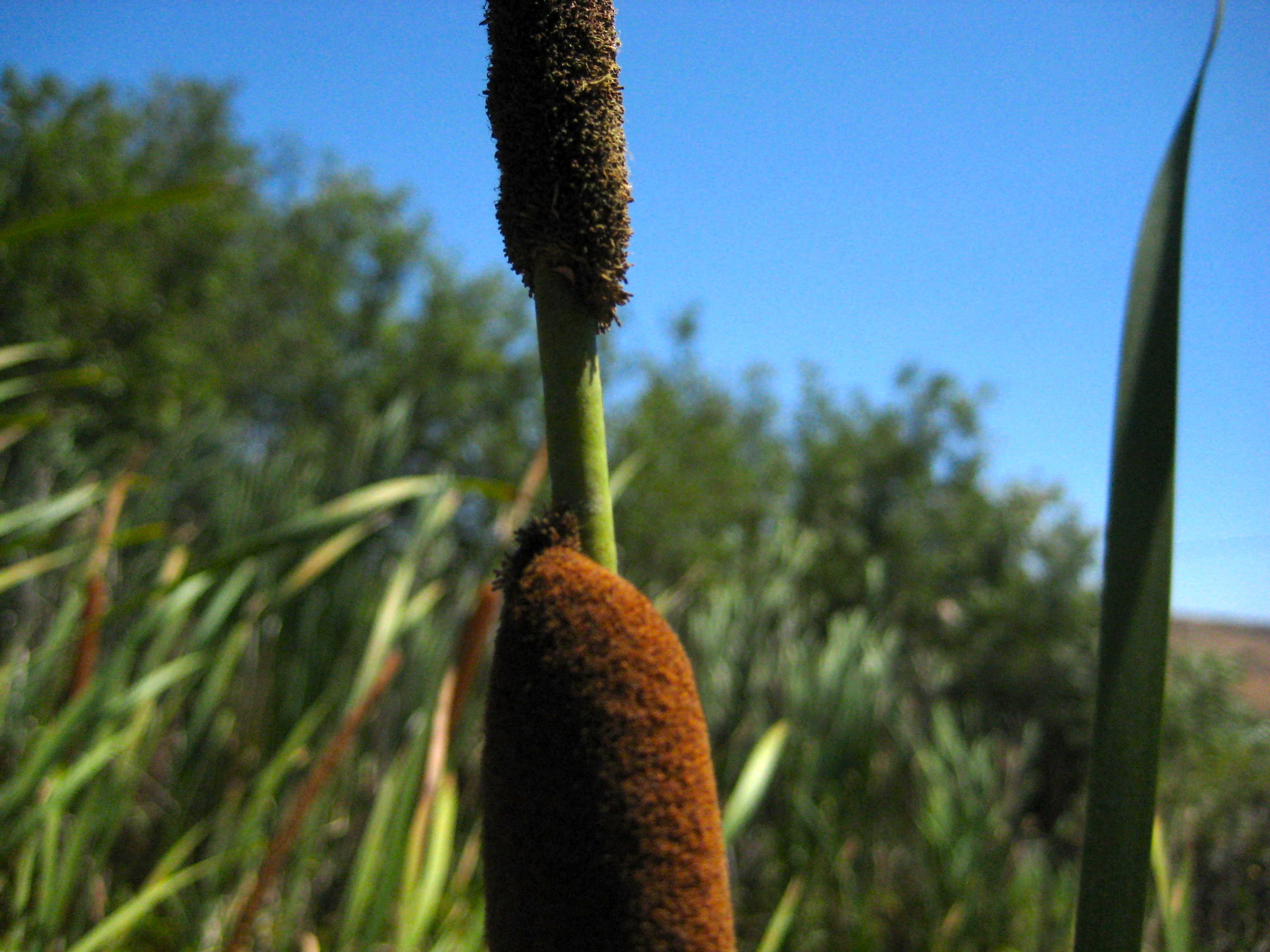
Photo by Chez Brungraber
Family: Typhaceae · Type: Herb · Native
Typha domingensis (Southern cattail) is a native California herb in the Typhaceae family, recognized by . Key diagnostic feature: orange-brown gland dots on leaf surfaces.
Southern cattail is a native perennial found in northern California coastal, North Coast Ranges, Great Valley, Central Western, southwestern California, Great Basin, and desert bioregions in nutrient-rich freshwater to brackish marshes at elevations below 1,500 meters. Flowering from June to July, this plant produces distinctive cinnamon to medium brown flower spikes with linear stigmas that transition from white to yellow-brown. Growing 1.5 to 4 meters tall with stems approximately 3 to 4 millimeters wide near the flower clusters, it develops dense, upright stems in marshy environments. Its leaves are distinctive, with blades 6 to 18 millimeters wide when fresh, featuring orange-brown gland dots along the lower portions and membranous ear-like sheaths. The plant produces unique flower clusters with strap-like staminate scales in yellow-brown tones and pistillate bractlets that are straw-colored with swollen hair tips featuring large orange-brown spots.
Identification and appearance
Key characters: 2 sympatric species. Key diagnostic feature: orange-brown gland dots on leaf surfaces
Habitat and range
Habitat: Nutrient-rich freshwater to brackish marshes, wet disturbed places
Elevation: < 1500 m
California counties: San Bernardino, San Diego, Los Angeles, Fresno, Inyo, Kern, Monterey, Orange, Riverside, San Francisco, San Joaquin, Santa Barbara, Santa Cruz, Ventura, Contra Costa, Merced, Santa Clara, Sonoma, Imperial, Tulare, Yolo, Humboldt, Marin, Sacramento, Calaveras, San Luis Obispo, Butte, Tehama, Colusa, Glenn, Yuba, Stanislaus, Mono, Mendocino, Lassen, San Mateo, Del Norte, Sutter, Solano, Alameda, El Dorado, San Benito
Outside California: to Alaska, eastern North America, worldwide warm temperate, tropics
Bloom period
Typha domingensis blooms Jun-Jul.
How to tell it apart
vs Schoenoplectus: Typha has wide flat leaves and cylindrical brown spikes; Schoenoplectus has round leafless stems.; vs Iris: Typha has cylindrical brown spikes; Iris has large showy flowers with 3 petals.; vs Leymus: Typha has brown cylindrical spikes; Leymus has typical grass seed heads.; vs Juncus: Typha has wide flat leaves and brown cylindrical spikes; Juncus has round stems and small brown flowers.; vs Sporobolus: Typha has distinctive brown cylindrical spikes; Sporobolus has open, branching grass inflorescences.
Frequently asked questions
Is Typha domingensis native to California?
Yes. Typha domingensis is native to California (recorded as native).
When does Typha domingensis bloom?
Typha domingensis blooms Jun-Jul.
Where in California does Typha domingensis grow?
Typha domingensis occurs in San Bernardino, San Diego, Los Angeles, Fresno, Inyo, Kern, Monterey, Orange and other counties, at elevations of < 1500 m.
What plant family does Typha domingensis belong to?
Typha domingensis is in the Typhaceae family, genus Typha.
What habitat does Typha domingensis grow in?
Typha domingensis grows in Nutrient-rich freshwater to brackish marshes, wet disturbed places.
Related species
Other California species in the same genus, family, or bioregion.
Sources: Jepson eFlora · Index of California Plant Names · CalPhotos
Last updated 2026-10-07
Data from The California Species Project — 14,000+ California species with verified data from CNPS, CDFW, USFWS, Cal-IPC, and more.