Typha latifolia
Broad-leaved cattail
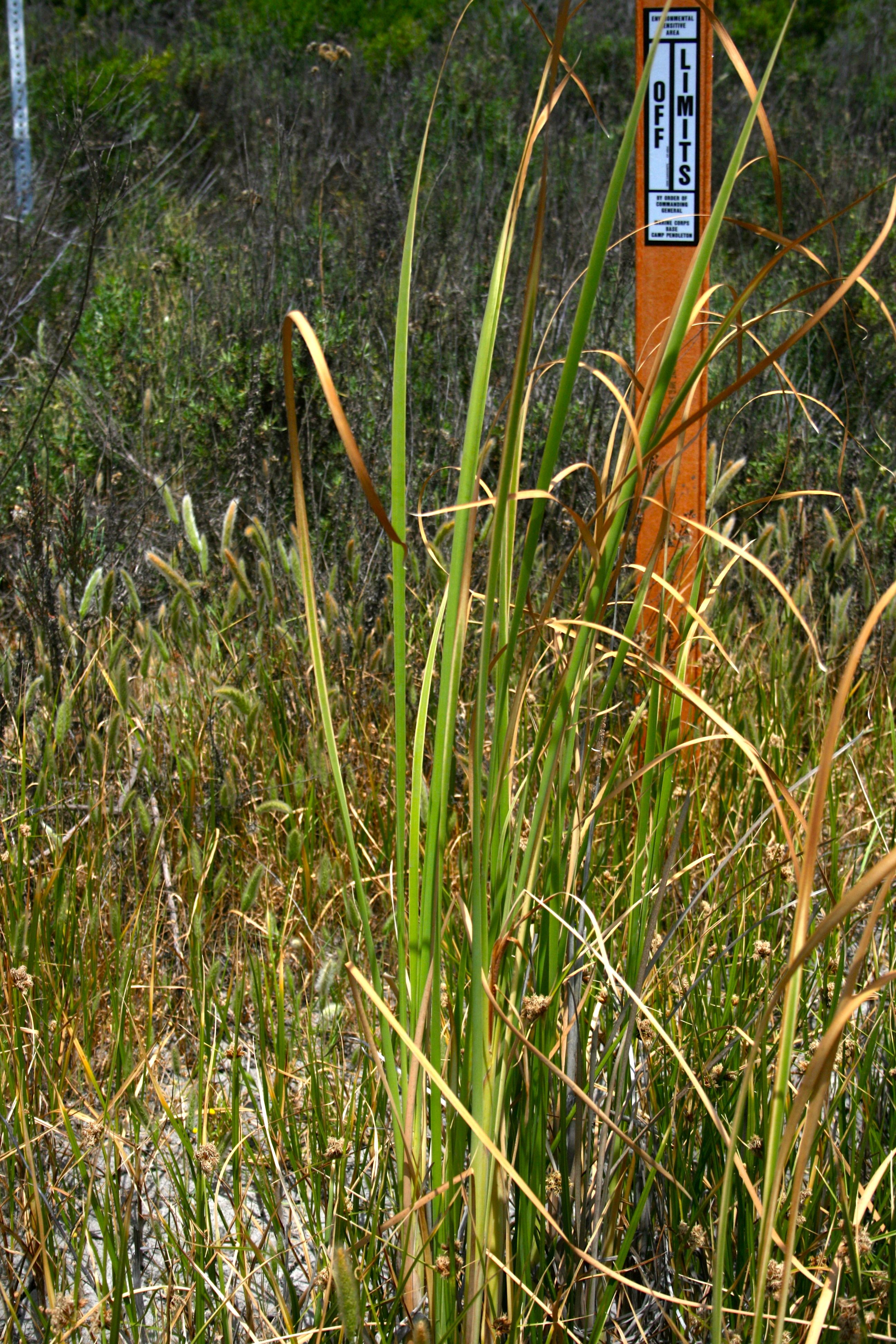
Photo by Chez Brungraber
Family: Typhaceae · Type: Herb · Native
Typha latifolia (Broad-leaved cattail) is a native California herb in the Typhaceae family, recognized by . Key features: broadest leaves, no gap between spikes, no glands.
Broad-leaved cattail is a California native perennial found in unpolluted to nutrient-rich freshwater marshes at elevations below 2,300 meters. Flowering from June to July, this plant produces dense cylindrical brown flower spikes with distinctive green stigmas that darken to reddish-brown as they mature. Growing with robust stems 1.5 to 3 meters tall and reaching up to 7 millimeters in diameter near the flower clusters, it forms dense stands in wetland environments. Its long, flat leaves are notably wide, measuring 10 to 29 millimeters across when fresh, with distinctive ear-like papery sheaths at the leaf base. The plant's unique flower spikes feature male and female sections with colorless scales and compact, mottled brown clusters that develop elongating bristle-like stems as the seeds mature.
Identification and appearance
Key characters: 2 sympatric species. Key features: broadest leaves, no gap between spikes, no glands
Habitat and range
Habitat: Unpolluted to nutrient-rich freshwater (brackish) marshes
Elevation: < 2300 m
California counties: Los Angeles, Inyo, San Diego, Riverside, Kern, Orange, San Bernardino, Santa Barbara, Plumas, San Francisco, San Luis Obispo, San Mateo, Ventura, Butte, El Dorado, Fresno, Lake, Santa Cruz, Sonoma, Tuolumne, Monterey, Sutter, Amador, Sacramento, Modoc, Marin, Tehama, Nevada, Lassen, San Joaquin, Contra Costa, Solano, Calaveras, Shasta, Humboldt, Mendocino, Del Norte, Mono, Santa Clara, Sierra, Merced, Siskiyou, Tulare, Trinity, Glenn, Yolo, Colusa, Stanislaus, San Benito, Mariposa
Outside California: boreal North America to northern South America, Eurasia, northern Africa, Tasmania (introduced)
Bloom period
Typha latifolia blooms Jun-Jul.
How to tell it apart
vs Schoenoplectus: Typha has wide flat leaves and cylindrical brown spikes; Schoenoplectus has round leafless stems.; vs Iris: Typha has cylindrical brown spikes; Iris has large showy flowers with 3 petals.; vs Leymus: Typha has brown cylindrical spikes; Leymus has typical grass seed heads.; vs Juncus: Typha has wide flat leaves and brown cylindrical spikes; Juncus has round stems and small brown flowers.; vs Sporobolus: Typha has distinctive brown cylindrical spikes; Sporobolus has open, branching grass inflorescences.
Frequently asked questions
Is Typha latifolia native to California?
Yes. Typha latifolia is native to California (recorded as native).
When does Typha latifolia bloom?
Typha latifolia blooms Jun-Jul.
Where in California does Typha latifolia grow?
Typha latifolia occurs in Los Angeles, Inyo, San Diego, Riverside, Kern, Orange, San Bernardino, Santa Barbara and other counties, at elevations of < 2300 m.
What plant family does Typha latifolia belong to?
Typha latifolia is in the Typhaceae family, genus Typha.
What habitat does Typha latifolia grow in?
Typha latifolia grows in Unpolluted to nutrient-rich freshwater (brackish) marshes.
Related species
Other California species in the same genus, family, or bioregion.
Sources: Jepson eFlora · Index of California Plant Names · CalPhotos
Last updated 2026-10-07
Data from The California Species Project — 14,000+ California species with verified data from CNPS, CDFW, USFWS, Cal-IPC, and more.